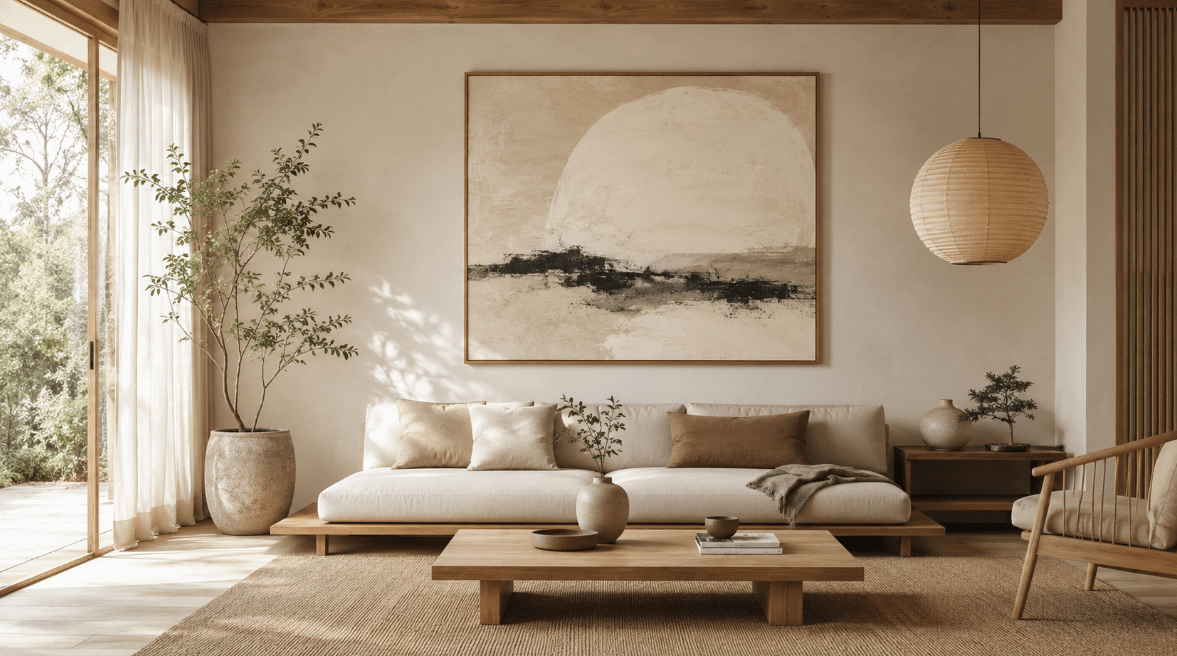
Japandi Wall Art: What the Style Really Means and How to Get It Right
Japandi is the most searched interior style of the last three years — a fusion of Japanese minimalism and Scandinavian hygge that has produced some of the most liveable, calming interiors of the decade. The wall art that works inside it is specific. Not just neutral. Not just minimal. Japandi wall art carries something quieter: a sense of craftsmanship, imperfection, and deliberate restraint.
If you have ever stood in front of a piece of art and felt the room settle around you — that is Japandi. This guide explains what to look for, what to avoid, and how to find wall art that genuinely belongs in a Japandi interior rather than simply being beige.
Quick Answer
Japandi wall art combines Japanese wabi-sabi philosophy with Scandinavian simplicity. Look for muted earthy tones — cream, warm grey, charcoal, soft brown — organic or hand-drawn forms, visible texture, and quiet compositions with intentional negative space. Avoid high contrast, digital precision, or busy pattern. Canvas prints hand-stretched on kiln-dried hardwood stretcher frames or original paintings with hand-applied texture are the best formats. Use Live Preview to see the piece in your space before buying.

What Is Japandi Wall Art?
Japandi is a portmanteau of Japanese and Scandinavian — two design traditions that share more than you might expect. Both prioritise function over decoration. Both find beauty in simplicity. Both resist excess. The wall art that belongs in a Japandi room reflects these shared values: it is purposeful, quiet, and made with care.
The Japanese influence brings wabi-sabi — the aesthetic of imperfection and transience. A canvas with visible brushwork, an irregular edge, or a composition that does not resolve neatly is more wabi-sabi than a perfectly symmetrical print. The Scandinavian influence brings hygge — warmth, cosiness, the sense of a room that feels lived-in rather than designed for a photoshoot. Together, they produce wall art that looks handmade, feels warm, and gives a room the quality designers call breathing space.
Chiara Rossetti’s wabi-sabi originals and neutral abstract canvases are among the most purchased pieces for Japandi rooms. All canvas prints are hand-stretched on hardwood stretcher frames and produced with HP latex inks designed to resist fading.

"Ground" — neutral abstract canvas print. Warm tones and organic form — one of the most popular choices for Japandi living rooms and bedrooms. View the piece →
The Key Visual Qualities to Look For
The most useful filter when choosing Japandi wall art is asking: does this piece feel handmade? Digital precision, perfect symmetry, and photo-sharp reproduction are not Japandi. What is Japandi is a composition where you can almost sense the artist’s presence — an irregular mark, a slightly uneven edge, a colour that shifts subtly across the canvas surface.
Look for visible texture. Original paintings with hand-applied layers, palette knife marks, and raw brush strokes carry this most directly. But canvas prints of original work can also convey texture — a photograph of a heavily textured painting, printed on canvas with HP latex inks, still reads as made-by-hand in a way that a graphic print cannot.
Negative space is equally important. A Japandi wall art piece should not fill every inch of the canvas with activity. Breathing room — empty space held with intention — is what separates a minimal piece from a sparse one. The composition should feel resolved, not unfinished.

"Still Strata" — original minimalist abstract painting. Layered horizontal form with warm neutral tones. View the piece →

Colours and Tones for Japandi Rooms
The Japandi palette is not monochrome. It is warm. Cream, warm white, sand, soft grey, charcoal, dusty rose, pale terracotta, moss green, and raw umber are all Japandi — what they have in common is that none of them is sharp or saturated. The palette is muted, organic, and grounded in natural pigments.
For wall art specifically, the best approach is to pick up one of the undertones already present in your room. If your walls are warm white and your furniture is oak, look for canvas art in cream, warm grey, or soft charcoal. If your palette already includes a soft sage green or dusty terracotta cushion, those tones can be reflected and expanded in the art.
High contrast is generally not Japandi. A single black mark on a white field can work if the execution is expressive and the composition has room to breathe — but black-and-white minimalism as a graphic design aesthetic is more Scandinavian than Japanese. For a room that leans Japanese in its sensibility, stay in the warm tonal range: the palette of rice paper, raw linen, aged bronze, and morning light.
FREE ART STYLE FINDER QUIZ
Not sure if your space calls for Japandi, wabi-sabi, minimalist or Scandinavian art? Take the free quiz and get a personalised style recommendation.
Download Free →Original Paintings vs Canvas Prints for Japandi Walls
Both work, but they serve the space differently. An original painting carries unique energy — no two pieces are identical, the texture is three-dimensional, and the work has a presence that is genuinely irreplaceable. For a dedicated feature wall in a Japandi home, an original wabi-sabi textured painting is the ultimate choice.
Canvas prints of original work offer the same visual qualities — the same hand-applied texture, the same palette, the same composition — at a more accessible price and in a wider range of sizes. For most Japandi rooms, a premium canvas print printed with HP latex inks on hand-stretched canvas is indistinguishable from the original at normal viewing distance. The hardwood floater frame option brings the presentation to gallery level.
What to avoid: glossy photographic prints on paper, high-contrast graphic art, pieces with visible digital construction, and anything that feels mass-produced rather than made.

Wabi-Sabi Textured Neutral — original painting by Chiara Rossetti. Hand-applied cream and warm grey texture. Gallery-quality, made to order. View the piece →

How to Style Japandi Wall Art in Your Home
Less is more — and this applies to both what you hang and how much of it. In a true Japandi room, one strong piece on a feature wall is more effective than a gallery arrangement of five. The single piece should be large enough to command attention — at least 24x36" for a living room wall, 20x28" for a bedroom — and hung at eye level with room to breathe on all sides.
The hardwood floater frame is the most appropriate finishing option. Its wood grain finish echoes the material warmth of oak dining tables, rattan chairs, and natural fibre rugs. It is the finishing option most often chosen for Japandi interiors.
Use the Live Preview tool on every Rossetti Art product page to see the piece in your exact room — at scale, on your actual wall — before buying. Not sure about size? Our Live Preview tool lets you visualise it in your space. Made to order, free shipping, multiple sizes available on every piece.
Frequently Asked Questions
What is japandi interior style?
Japandi blends Japanese minimalism (wabi-sabi, natural materials, purposeful simplicity) with Scandinavian hygge (warmth, functionality, cosiness). The result is a design style that is minimal without being cold — restrained, handmade-feeling, and deeply liveable.
What kind of art works in a japandi room?
Art with visible texture, organic forms, muted warm tones, and intentional negative space. Wabi-sabi originals, neutral abstract canvases, and hand-drawn botanical or geometric pieces in earthy palettes. Avoid high-contrast graphic prints and digital-looking art.
What colours are japandi?
Cream, warm white, warm grey, sand, soft charcoal, dusty terracotta, raw umber, moss green, pale sage, and natural wood tones. The palette is warm, muted, and drawn from natural materials — never sharp, saturated, or cool-toned.
Can canvas prints work in japandi interiors?
Yes. Canvas prints of original wabi-sabi paintings carry the same texture and warmth as the originals at normal viewing distance. Hand-stretched on kiln-dried hardwood stretcher frames, printed with HP latex inks, they read as handmade rather than mass-produced.
What is the difference between japandi and wabi sabi art?
Wabi-sabi is a Japanese philosophy of finding beauty in imperfection and transience. Japandi is a broader design style that incorporates wabi-sabi principles alongside Scandinavian functionality and warmth. Japandi wall art may include wabi-sabi pieces but also encompasses Scandinavian-inspired minimalism as long as it maintains the same quiet, handmade quality.
Keep Reading
About the Author — Chiara Rossetti is the founder of Rossetti Art, a canvas print and original art brand. She writes about interior design, wall art styling, and the art of making a home feel alive.

About the Author
Chiara Rossetti
Chiara Rossetti is the founder of Rossetti Art, a canvas print and original art brand. She writes about interior design, wall art styling, and the art of making a home feel alive.

Leave a comment
This site is protected by hCaptcha and the hCaptcha Privacy Policy and Terms of Service apply.