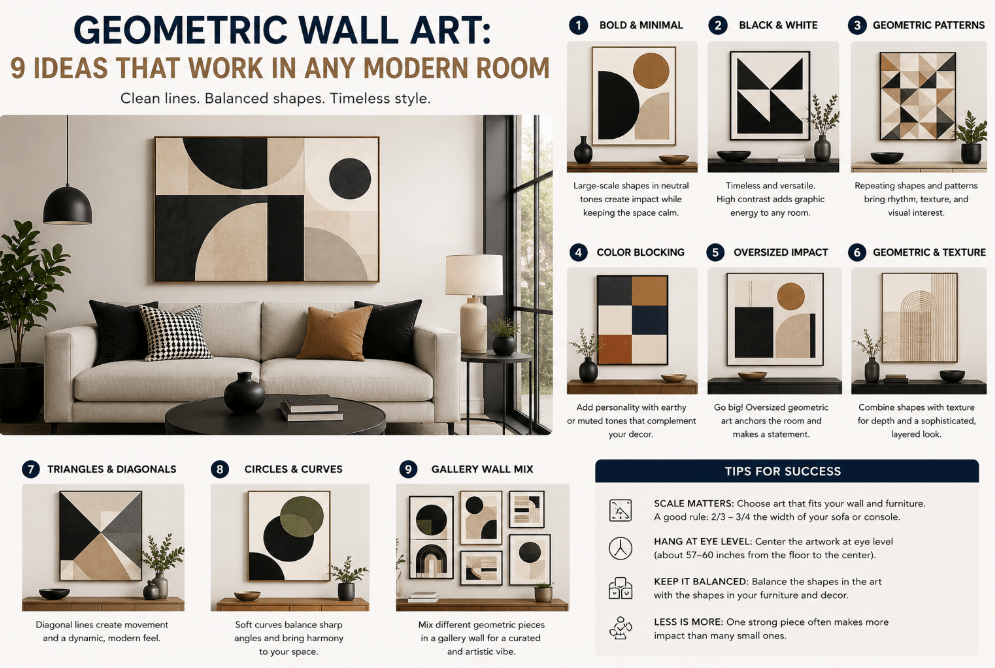
Geometric Wall Art: 9 Ideas That Work in Any Modern Room
Geometric wall art has become one of the most popular search terms in home decor — and for good reason. Shapes give a room structure. A well-chosen geometric piece anchors a wall without demanding constant attention, and it works across interior styles from Japandi to contemporary, minimalist to eclectic.
The challenge is knowing which type of geometry suits your space. A sharp-edged grid reads very differently from soft overlapping arcs. A high-contrast black and white pattern creates energy; a tonal study in warm grey creates calm. This guide covers the nine most effective approaches to geometric wall art, plus everything you need to choose the right scale, finish, and room placement.
Quick Answer
Geometric wall art uses shapes — triangles, grids, circles, arcs and abstract forms — to create visual structure on a wall. It works across modern, minimalist, Japandi and contemporary interiors. Canvas prints are hand-stretched over kiln-dried hardwood stretcher frames and printed with HP latex inks designed to resist fading. Use the Live Preview tool to see any piece in your room before buying.

What Makes Wall Art Geometric?
Geometric wall art is defined by its use of deliberate shape, pattern, or structural line. Abstract geometric art can feel soft, organic, and hand-made — arcs that suggest movement, overlapping planes that imply depth, grids broken by a single expressive mark. What matters is that the visual language is built on form rather than representation.
The category sits comfortably across several interior aesthetics. In a minimalist room, a clean circle or single arc reads as contemplative. In a Japandi interior, irregular hand-drawn geometry with earthy tones feels deeply at home. In a contemporary living room, a bold grid or high-contrast tessellation makes a clear design statement.
Chiara Rossetti at Rossetti Art uses geometric principles throughout her work. The prints are hand-stretched over kiln-dried hardwood frames and produced with UV- and fade-resistant HP latex inks that are UV-resistant and fade-resistant. Every geometric canvas arrives ready to hang.

"Labyrinth" — geometric abstract canvas print. Interlocking forms in a warm, tonal palette. View the piece →
9 Geometric Wall Art Ideas That Actually Work
1. Abstract Grid on a Neutral Wall — A high-contrast grid or linear pattern works best on a white or off-white wall with minimal furniture competition. It gives the wall structure without adding colour.
2. Circular Arcs for Softness — Overlapping or concentric circles add movement and rhythm while avoiding the hard-edge tension of angular geometry. Works well above a bed or console table.
3. Organic Geometric Abstraction — Irregular polygons, broken planes, and fragmenting shapes feel contemporary without being cold. These work in living rooms where you want energy but not aggression.
4. Tonal Geometry in Warm Earth Tones — Replace black-and-white geometry with ochre, warm grey, dusty rose, and raw umber. The shapes recede, but the texture stays. Ideal for Japandi and natural interiors.
5. Large-Scale Geometric as a Statement Piece — A single oversized geometric print — 30x40" or larger — says more than three smaller ones. Use our Live Preview to see exactly how it looks at scale before you buy.
6. Geometric Diptych or Triptych — Splitting a geometric composition across two or three panels adds interest and lets you scale up without overwhelming a wall.
7. Architectural Line Art — Fine-line geometric prints — minimal, precise, almost blueprint-like — are especially well-suited to home offices and studies.
8. Geometric Portrait (Figurative + Form) — A face or figure built from geometric shapes bridges representational and abstract art. Works in bedrooms and living rooms.
9. Nature-Inspired Geometry — Tree rings, growth patterns, fractals, and natural spirals are geometric in structure but feel organic in execution — useful when you want structure without stiffness.

"Dynamic Flow" — abstract geometric canvas. Bold movement and layered form in a contemporary palette. View the piece →

How to Choose the Right Scale
The most common mistake with geometric wall art is going too small. Geometric work relies on pattern and form to carry the eye — and that only works at a scale where the detail is readable from normal viewing distance. A 16x20" geometric print that would be striking at 30x40" ends up looking like a framed tile.
The general rule: the print should fill roughly two-thirds to three-quarters of the wall width it occupies. Above a sofa, that typically means 48–60" wide. Above a bed, 36–48" wide. In a hallway or above a console, portrait-format geometry reads well at 24x36".
Always consider the hardwood floater frame option for geometric canvas prints. The floating gap between canvas and frame gives geometric work a finished, gallery-quality look — the slight shadow around the edge adds depth and separates the art from the wall.
FREE ART STYLE FINDER QUIZ
Not sure which geometric style suits your interior? Take the free quiz and get a personalised recommendation in under 2 minutes.
Download Free →Best Rooms for Geometric Wall Art
Geometric wall art works in almost every room, but the type of geometry matters by context. Living rooms can handle the boldest pieces — high-contrast grids, large-scale abstraction, complex layered compositions. The sofa wall above the couch is the single best placement in the house.
Home offices benefit from architectural and linear geometric work. Clean lines suggest precision; minimal forms reduce visual noise and support focus. A black and white linear canvas at 24x36" or 20x30" works well at eye level on a side wall.
Bedrooms suit softer geometry — circular, tonal, organic. Earth tones, soft contrast, and gentle form are more restful than hard edges and maximum contrast.
Hallways and entryways are where portrait-format geometric prints excel. A tall, narrow geometric canvas at 20x28" or 24x36" transforms a corridor without taking floor space. Multiple sizes available on every geometric print at Rossetti Art — and free shipping on every order.

"Echoes of Growth" — geometric tree rings in contemporary blue and grey tones. View the piece →

Framing and Finishing Options
Geometric canvas prints at Rossetti Art arrive hand-stretched on kiln-dried hardwood frames in gallery-wrap style — the canvas wraps 1.25 inches around the sides, ready to hang. For a more elevated look, the hardwood floater frame adds a natural wood border with a visible gap around the canvas edge — the finishing option most interior designers choose for geometric work.
Canvas thickness is 1.5 inches. All pieces are made to order and ship in reinforced double-wall packaging with corner protectors. UV- and fade-resistant HP latex inks, UL GREENGUARD Gold certified for low chemical emissions, suit any room, including children's bedrooms.
Frequently Asked Questions
What is geometric wall art?
Geometric wall art uses shapes — triangles, circles, grids, arcs and abstract polygons — as the primary visual language. It can be precise and architectural or loose and organic. The defining quality is that structure and form carry the composition rather than representation or narrative.
What room suits geometric wall art best?
Geometric wall art is most at home in living rooms, home offices, and hallways. Bold high-contrast prints suit living rooms and statement walls. Softer, linear work suits offices. Organic geometric forms work well in bedrooms.
Should geometric wall art be framed?
Canvas geometric prints arrive gallery-wrapped and ready to hang without additional framing. A hardwood floater frame adds a finished, elevated look — particularly effective for geometric work where the shadow gap emphasises the structural nature of the piece.
How big should geometric wall art be for a living room?
For a standard living room sofa wall, aim for a piece at least 36–48 inches wide. Oversized geometric canvas prints — 30x40" and above — make the most impact. Use the Live Preview tool on every Rossetti Art product page to see the exact size in your room before ordering.
Can geometric wall art work in a Japandi interior?
Yes — it is one of the best style matches. Choose organic geometric forms in warm earth tones rather than hard-edged grids. Tonal compositions with off-white, warm grey, ochre and raw umber feel deeply at home in Japandi spaces.
Keep Reading
About the Author — Chiara Rossetti is the founder of Rossetti Art, a canvas print and original art brand. She writes about interior design, wall art styling, and the art of making a home feel alive.

About the Author
Chiara Rossetti
Chiara Rossetti is the founder of Rossetti Art, a canvas print and original art brand. She writes about interior design, wall art styling, and the art of making a home feel alive.

Leave a comment
This site is protected by hCaptcha and the hCaptcha Privacy Policy and Terms of Service apply.