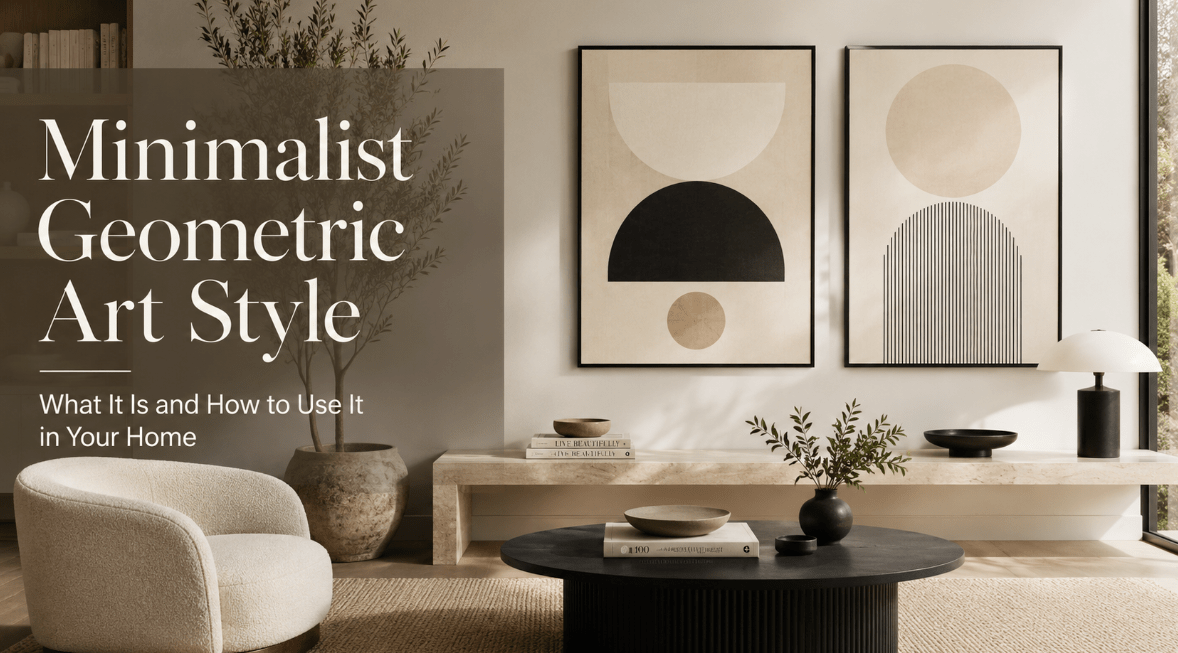
Minimalist Geometric Art Style: What It Is and How to Use It in Your Home
Minimalist geometric art has moved from the gallery to the living room — and stayed there. Walk through any considered interior in 2026 and you'll find it: a canvas of clean circles in muted grey above a linen sofa, a triptych of intersecting lines on a white bedroom wall, a large-format black and white composition anchoring an open-plan dining space. The style has become the defining aesthetic choice for interiors that prize order, calm, and visual intelligence over decoration.
This guide explains what minimalist geometric art style actually is — its origins, its defining characteristics, and how to use it well in every room of your home. Whether you're buying your first geometric canvas or refining a considered collection, the principles here apply.
Quick Answer
Minimalist geometric art style uses clean mathematical shapes — circles, squares, triangles, grids, lines — in structured compositions with intentional restraint. Colour palettes are limited, negative space is active, and every element earns its place. The style emerged from Constructivism, De Stijl, and Bauhaus in the early 20th century and has become the dominant language of contemporary interior design.

What Is Minimalist Geometric Art Style?
At its core, minimalist geometric art style is defined by two intersecting principles: the use of geometric form as the primary visual language, and the practice of restraint — removing everything that isn't structurally essential to the composition.
Geometric form means the composition is built from defined mathematical shapes: circles, semicircles, squares, rectangles, triangles, straight lines, and their intersections. These shapes may be hard-edged and precise or slightly softened — the distinction between geometric and organic abstraction — but they maintain a structural quality that separates geometric work from gestural or expressive abstraction.
Minimalism means the composition contains only what it needs. No decorative surplus. Limited palette — often two to four tones, sometimes a single tone with value variations. Generous negative space. A sense that each element's position and scale was considered rather than accumulated. The result is work that asks for sustained attention and rewards it: what initially reads as simple reveals itself, on longer looking, as precisely calibrated.
This combination — geometric structure + minimalist restraint — produces art that is simultaneously visually calm and intellectually engaging. It doesn't tell a story or evoke a landscape; it offers a composition. This makes it unusually versatile in interior contexts: it enhances a space without competing with it.
Where the Style Comes From
Minimalist geometric art doesn't have a single origin — it developed through several converging movements across the early and mid 20th century.
Constructivism (Russia, 1910s–20s) was the first major movement to place geometric abstraction at the centre of a visual language. Artists like Kazimir Malevich and El Lissitzky believed that pure geometric form — stripped of narrative, symbolism, or representation — was the most honest visual expression possible. Malevich's Black Square (1915) remains the most radical assertion of this principle.
De Stijl (Netherlands, 1917) refined geometric abstraction into a systematic visual language: primary colours, horizontal and vertical lines only, black and white. Mondrian's grid paintings are its most famous expression. The movement explicitly connected visual order to social and spiritual harmony — the grid as an idealist proposition about how the world could be organised.
Bauhaus (Germany, 1919–1933) merged geometric abstraction with design practice, insisting that art and craft serve functional purposes. Its influence on contemporary minimalist geometric art is pervasive — the Bauhaus aesthetic of useful beauty, of form following function, underlies most contemporary geometric work. According to the history of geometric abstraction, these movements collectively established the vocabulary that contemporary designers still draw on.
Minimalism (USA, 1960s) took geometric art in a different direction — away from the painting and toward three-dimensional objects, industrial materials, and the relationship between the work and the viewer's space. But its influence on contemporary geometric painting and canvas art is clear: the insistence on essentiality, on the primacy of the object itself rather than what it represents.

"Labyrinth" — Geometric Abstract Wall Art Canvas Print by Chiara Rossetti. Hand-stretched on kiln-dried hardwood, HP latex inks, ready to hang. View the piece →
Key Characteristics: What Makes It Geometric and Minimalist
When evaluating a piece for its geometric-minimalist credentials, these are the characteristics that define the style:
Defined mathematical forms: The composition is built from shapes that have clean edges and clear geometric identity. Circles are circles, not blobs. Lines are straight or precisely curved, not gestural. Even when a piece has an expressive quality, the underlying structure is always geometric. For a deeper look at how these shapes function as a design language on their own, see our guide to geometric abstract art.
Limited palette: Minimalist geometric art rarely uses more than three or four tones. The most coherent pieces use colour strategically — one warm tone, one cool, one neutral — rather than expressively. Black and white geometric work is a sub-category unto itself: the most graphic, the most immediately impactful, and the most versatile in interior contexts.
Active negative space: The areas of the canvas that contain no shape are not empty — they're compositional elements as deliberate as the shapes themselves. A circle placed off-centre in a large field of warm grey reads very differently from a centred circle in a smaller space. Minimalist geometric artists treat the void as carefully as the mark.
Structural tension: The most effective minimalist geometric compositions carry a sense of tension — shapes that nearly touch but don't, proportions slightly off-symmetric, a diagonal line that subtly destabilises an otherwise static composition. This is what makes geometric abstraction visually engaging rather than merely decorative.
For more on how geometric and minimalist principles relate to other abstract styles, see our guide to wabi-sabi wall art — the Japanese aesthetic that shares minimalism's commitment to essentiality through a very different visual language.

🎨 FREE ART STYLE FINDER QUIZ
Not sure which art style suits your home?
Download our free Art Style Finder Quiz — answer 10 questions and discover your ideal aesthetic.
Download Free →Room by Room: How to Use Minimalist Geometric Art
Minimalist geometric art is unusually versatile across interior contexts — but each room has specific conditions that shape which pieces work best.
Living room: The dominant wall (usually behind the sofa) is the primary opportunity. Large-format geometric canvases — 30×40 inches and above — create visual anchors without competing with other furnishings. Neutral-palette geometric work functions well in most living room colour schemes. High-contrast black and white pieces suit rooms with already-high visual contrast; muted tone-on-tone compositions work better in warmer, softer interiors. See our guide on canvas wall art for living rooms for sizing and placement rules.
Bedroom: Geometric art works exceptionally well above the bed, where its structural quality creates a calm, grounding focal point. Avoid high-contrast pieces (strong black and white, saturated colours) which can feel too stimulating in a sleep environment. Prefer warm neutrals, dusty blues, soft greys. A triptych format — three panels across the wall — is a classic choice for the space above a king bed. See our triptych wall art guide for layout options.
Home office: Geometric art supports focused mental states. The clarity of geometric form — its absence of narrative complexity — keeps the visual environment ordered without sterility. High-contrast pieces work here better than in bedrooms; the visual energy supports concentration. Small-to-medium format works (16×20 to 24×30) are appropriate for the limited wall space of most home offices.
Hallway and entry: Geometric canvases make strong hallway pieces because they read quickly and confidently as you pass. A vertical format (portrait orientation) suits most hallways. A single striking geometric work — high contrast, precisely placed — creates the kind of first impression that sets the tone for the whole home.

"Still Strata" — Minimalist Abstract Painting Original (Set of 3) by Chiara Rossetti. A hand-painted minimalist original — the ultimate expression of the geometric-minimalist aesthetic. View the piece →
How to Choose the Right Geometric Piece for Your Space
Geometric minimalist art is unforgiving of poor sizing decisions — more so than gestural or expressive work. The precision of the style means that a canvas that's slightly too small, or slightly off-centre, is more noticeable than with looser art forms.
Scale before style: Identify the correct size before you start looking at compositions. The canvas should span 60–70% of the wall width it will occupy (or 60–70% of the sofa width for the sofa wall). Then choose within that size range. Rossetti Art's Live Preview tool lets you visualise any geometric canvas at exact scale in your actual room — we recommend using it before every canvas purchase.
Palette coherence: Geometric art announces its palette clearly and unambiguously. If your room has warm tones (wood, cream, warm white), choose geometric work in warm neutrals, ochres, or dusty warm greys. If your room is cool (grey walls, stainless steel, cool white), lean toward cool blues, graphite, and true black and white. The style's precision means palette clashes are more visible than with expressive work.
Frame choice: The hardwood floater frame — our most popular frame option — works particularly well with geometric abstract art. The natural wood grain of the solid oak frame provides warmth that counterbalances the coolness of geometric precision. The floating mount (canvas appears to hover inside the frame with a shadow gap) adds depth that suits the style's three-dimensional quality.
For a structured approach to finding your ideal style, download our free Art Style Finder Quiz below — it maps your interior aesthetic and design preferences to the most compatible art categories.
What Gallery-Quality Geometric Art Looks Like
Minimalist geometric art exposes the quality of printing and stretching more ruthlessly than almost any other style. A slightly uneven stretch distorts the geometric composition. Inferior inks produce colour banding in the flat tonal areas that define so much geometric work. Warping introduces line distortion that the eye immediately catches in an otherwise precise composition.
At Rossetti Art, every geometric canvas print is hand-stretched over a kiln-dried hardwood frame — standard 1.5-inch depth, hand-tensioned and stapled to the back, not the sides. Printing uses UV- and fade-resistant HP latex inks designed to resist fading, with a satin-matte, low-glare finish that protects flat tonal areas from the colour drift that cheaper inks suffer under light exposure. Every canvas is made to order — not a pre-produced stock item — and ships in reinforced double-wall packaging with corner protectors.
These are not marketing terms. They are the specific technical standards that determine whether a geometric canvas still looks precise and calibrated in ten years, or whether it has faded, warped, or produced the banding artefacts that reveal its commercial-grade origins. For the style that punishes imprecision, material quality is not optional.

"Frequency" — Black and White Abstract Wall Art Canvas Print by Chiara Rossetti. Graphic, precise, enduringly versatile — the most deployable geometric format. View the piece →

Frequently Asked Questions
What is minimalist geometric art style?
Minimalist geometric art style combines mathematical precision with intentional restraint. It uses clean shapes — circles, squares, triangles, lines — in structured compositions with a limited palette. The style prioritises form, proportion, and negative space over complexity or narrative, creating work that is visually calm but compositionally rich.
What's the difference between minimalist geometric art and abstract art?
All minimalist geometric art is abstract, but not all abstract art is geometric. Geometric abstraction uses defined shapes and mathematical structure; expressive abstraction uses gestural marks and organic forms. Minimalist geometric work is the most ordered end of the abstract spectrum — it removes everything that isn't structurally essential.
What interior styles suit minimalist geometric art best?
Minimalist geometric art works best in Scandinavian, Japanese, and contemporary minimalist interiors — spaces that share the style's commitment to essentiality. It also works well in industrial and Bauhaus-influenced interiors. It tends to clash with maximalist, romantic, or traditional styles unless used as a deliberate counterpoint.
What size geometric canvas works best in a living room?
For most living rooms, a geometric canvas between 24×30 and 36×48 inches works well on the sofa wall. The key principle: geometric art relies on visible precision, so it needs to be large enough for the composition to read clearly from a seated position. A piece that's too small loses its structure in the room. Use our Live Preview tool to test exact sizes in your space.
Does geometric abstract art work in a bedroom?
Yes — minimalist geometric art is one of the best choices for bedrooms because its ordered, restrained quality supports the calm that bedrooms need. Choose pieces in muted palettes (warm neutrals, dusty blues, charcoal) rather than high-contrast black and white, which can feel too energising for sleep environments. Smaller formats (16×20 to 20×30) work well above bedside tables; larger pieces (24×36 and up) work above the headboard.
Ready to find your piece? Explore our abstract and geometric canvas prints — every canvas hand-stretched on kiln-dried hardwood, HP latex inks, hardwood floater frame available. Free shipping on every order.
Keep Reading
About the Author — Chiara Rossetti is the founder of Rossetti Art, a canvas print and original art brand. She writes about interior design, wall art styling, and the art of making a home feel alive.

About the Author
Chiara Rossetti
Chiara Rossetti is the founder of Rossetti Art, a canvas print and original art brand. She writes about interior design, wall art styling, and the art of making a home feel alive.


Leave a comment
This site is protected by hCaptcha and the hCaptcha Privacy Policy and Terms of Service apply.