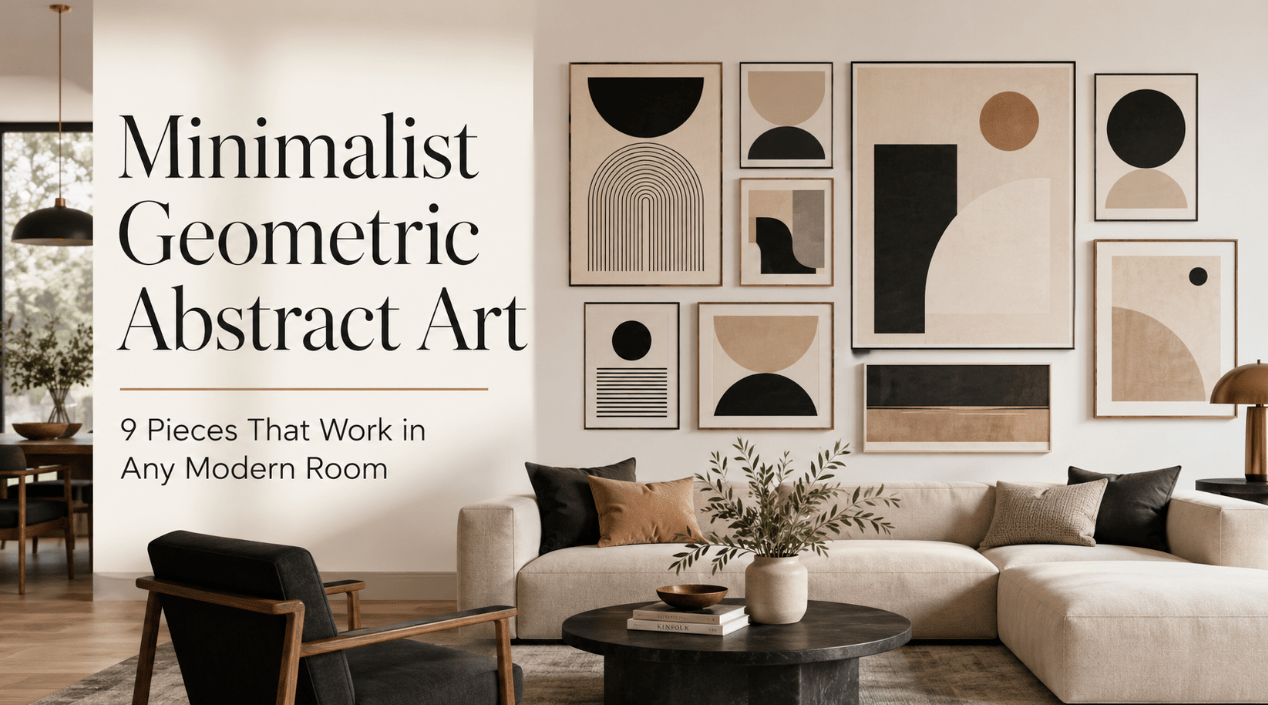
Minimalist Geometric Abstract Art: 9 Pieces That Work in Any Modern Room
Minimalist geometric abstract art has become the defining visual language of contemporary interior design. Its clean shapes, structured compositions, and restrained palettes work with almost any architectural context — from open-plan new builds to Victorian terraces, from Scandinavian minimalism to warm Mediterranean interiors. The question isn't whether geometric minimalism works in your home. It's which piece to choose.
This guide presents nine types of minimalist geometric abstract art — organised by palette and approach — and explains what each one suits, where it works best, and what to look for when buying. Every piece referenced is available at Rossetti Art, hand-stretched on kiln-dried hardwood, HP latex inks, shipped free.
Quick Answer
Minimalist geometric abstract art uses clean mathematical shapes in restrained compositions with limited palettes — the intersection of geometric abstraction and minimalism. Nine types work across every interior context: neutral-palette geometric canvases are the most versatile; black and white geometric pieces are the most graphic; tonal colour pieces create confident focal points; triptych formats suit wide walls and above-bed placement.

Why Geometric Minimalism Works in Every Room
Geometric minimalist art has one quality that makes it more interior-friendly than almost any other art style: it enhances a space without competing with it. Its ordered, precise character doesn't fight for visual dominance the way expressive or narrative art might — instead, it adds structure to the room's visual field, creating a focal point that is confident but not aggressive.
This is particularly valuable in contemporary homes with neutral palettes and clean architectural lines. The room provides the context; the geometric canvas provides the punctuation. Together, they produce interiors that read as considered and alive rather than empty or over-furnished.
For a deeper understanding of the style's origins and aesthetic principles, see our complete guide to minimalist geometric art style. Here, we focus on the practical question: which pieces, and how to choose between them.
The Neutral Palette Pieces: Warmth Through Restraint
Neutral geometric canvases — warm greys, creams, taupes, dusty whites — are the most versatile category. They work in virtually any interior because their warmth complements most colour schemes without ever competing with them. Three types worth knowing:
#1 — The Tonal Square: A canvas built around a single geometric form (a square, circle, or rectangle) in a tone very close to the background, with the distinction coming from subtle value difference or slight texture variation. Quiet, meditative, works best in bedrooms and reading spaces where calm is the priority.
#2 — The Geometric Field: A canvas in which geometric marks — fine lines, precise grids, sparse dots — are distributed across a warm neutral ground with generous negative space. The composition is all about proportion and placement. At 30×40 inches and above, these pieces have genuine presence without visual weight. See Ground in our collection: a neutral abstract that balances geometry and warmth for maximum interior versatility.
#3 — The Minimalist Original: For buyers who want the material presence of paint on canvas — visible texture, the evidence of a hand — a neutral minimalist original painting delivers what no print can: physical depth. Still Strata, a three-panel original by Chiara Rossetti, is the ultimate expression of this approach: three canvases, each a minimal horizontal composition in warm tone, creating a sequence that can stretch across an entire bed wall or sofa wall.

"Ground" — Neutral Abstract Wall Art Canvas Print by Chiara Rossetti. The most versatile neutral geometric canvas in the collection. View the piece →
The Monochrome Pieces: Black, White, and Maximum Clarity
Black and white geometric abstract art is its own sub-category — the most graphic, the most immediately impactful, and in many ways the most demanding. Get it right and it anchors a room with effortless authority. Three types in this category:
#4 — The High-Contrast Geometric: A canvas with strong, clear shapes in true black against white (or white against dark grey). The composition is precise and reads from across the room. These pieces suit modern minimalist interiors with high contrast in their existing palette — white walls, dark furniture, chrome or matte-black fixtures. They're not backgrounds; they're statements. Frequency — a black and white abstract canvas in our collection — exemplifies this type.
#5 — The Graphic Line Composition: Fine, precise lines on a white or near-white ground. The composition is dense but the tone is light — it's geometric complexity with minimal visual weight. Works well in smaller spaces (hallways, home offices, bedrooms) where a high-contrast piece would be overwhelming. The lines create movement and structure without heaviness.
#6 — The Black Ground Geometric: White or near-white geometric forms on a dark ground. Reversed from the classic format, this approach creates dramatic depth. Suited to rooms with confident dark elements — charcoal sofas, navy walls, walnut furniture. It's the most statement-making of the monochrome types, and typically works best in living rooms and home offices rather than bedrooms, where the drama can feel too strong.
For more on working with high-contrast dark art, see our guide on dark wall art for living rooms.

🎨 FREE ART STYLE FINDER QUIZ
Not sure which art style suits your home?
Download our free Art Style Finder Quiz — answer 10 questions and discover your ideal aesthetic.
Download Free →The Tonal Colour Pieces: Single Hue, Maximum Impact
The third major category is minimalist geometric art built around a single dominant colour — but used with restraint, structural precision, and careful relationship to the neutral ground. Not maximalist colour use, but colour as a structural choice.
#7 — The Deep Blue Geometric: Deep indigo or navy geometric compositions are the most popular coloured geometric choice in contemporary interiors. The depth of the blue provides colour saturation without visual noise. Against warm white or cream walls, deep blue geometric canvases create focal points with genuine presence. Indigo Drift — a deep blue abstract canvas print — demonstrates how colour and geometric structure interact at their most effective.
#8 — The Warm Earth Geometric: Rust, terracotta, ochre, or warm brown used as the dominant tone in a minimalist geometric composition. These pieces bridge the gap between warm, natural interiors and the precision of geometric form. They work exceptionally well alongside natural wood furniture, linen upholstery, and the warm-toned palettes that dominate contemporary British, Scandinavian, and Australian interior design. The warm minimalism trend identified by Architectural Digest has made this type increasingly popular.
#9 — The Cool Neutral Coloured Field: Sage green, dusty rose, or pale slate used as a tonal geometric ground — colour that reads almost as neutral from a distance but reveals its hue up close. These are the most subtle of the coloured geometric types, and the most widely deployable: they work in rooms where stronger colour would be too dominant but where a pure neutral lacks interest. For rooms with sage green or dusty rose accents, these pieces create coherent visual links without repetition.

"Indigo Drift" — Dark Blue Abstract Wall Art Canvas Print by Chiara Rossetti. Deep blue geometric abstraction — the most popular coloured geometric format. View the piece →
The Triptych Option: Three-Panel Geometry
The triptych format deserves its own category in any geometric art guide. Three matching panels across a wall create a panoramic geometric composition that changes the scale equation entirely — you're no longer placing a canvas on a wall, you're articulating the wall's full width with geometric structure.
Triptychs work best above long horizontal surfaces: the bed wall (the three panels spanning the full width above a king or queen headboard), the sofa wall in an open-plan living room, or the full length of a hallway wall. The key technical requirement: equal spacing between panels, precisely measured. Geometric art in triptych format punishes uneven spacing more severely than any other format.
Our Orbit triptych canvas — three circular geometric canvases in a warm neutral palette — demonstrates how the format can work as a single unified composition rather than three separate pieces. For a complete guide to triptych formats, sizing, and placement, see our triptych wall art guide.

"Orbit" — Triptych Canvas Print by Chiara Rossetti. Three-panel geometric composition — the most impactful format for wide walls. View the piece →
How to Choose Your Geometric Canvas
With nine types in play, the choice narrows quickly when you apply three filters:
Palette first: What tones are dominant in your room? If warm (wood, cream, terracotta), choose neutral or warm earth geometric. If cool (grey walls, stainless, white), choose monochrome or cool-toned. If you want colour contrast, choose deep blue or a tonal colour piece that complements your existing accents.
Room function second: High-contrast black and white suits home offices and living rooms; quiet neutrals suit bedrooms; triptychs suit wide walls above beds and sofas. Match the visual energy of the piece to the function of the room.
Scale last: Once you know type and tone, identify the correct size. The standard rule: canvas should span 60–70% of the wall width it occupies (or sofa width). Use Rossetti Art's Live Preview tool to test exact dimensions in your space before purchasing.
Every canvas in our abstract and geometric collection is hand-stretched over a kiln-dried hardwood stretcher frame, printed with HP latex inks designed to resist fading, and protected with a UV-resistant coating. Made to order, shipped free, ready to hang.

Frequently Asked Questions
What is minimalist geometric abstract art?
Minimalist geometric abstract art uses clean mathematical shapes — circles, lines, grids, squares — in restrained compositions with limited colour palettes. It's the intersection of two artistic traditions: geometric abstraction (which uses mathematical form as its visual language) and minimalism (which removes everything inessential). The result is art that is visually calm, structurally precise, and unusually versatile in interior contexts.
What colours work best in minimalist geometric art?
The most versatile geometric canvases use warm neutrals (cream, taupe, warm grey, dusty white) or muted tones (charcoal, dusty blue, sage, ochre) against a neutral ground. Black and white geometric art is the most graphic option — strongest contrast, clearest impact, works in almost any room. Bold single-colour geometric pieces (a terracotta circle on warm white, a deep blue grid on cream) suit rooms with confident design intention.
How do I hang minimalist geometric art?
Centre the canvas on the wall at eye level — the centre of the canvas should sit approximately 57–60 inches (145–152cm) from the floor. For geometric art specifically, precise positioning matters more than with loose gestural work. Use a level. If hanging a triptych, ensure equal spacing between panels (typically 2–4 inches). Use our Live Preview tool to test placement before making holes in the wall.
What frame suits geometric abstract art?
The hardwood floater frame is the most popular choice for geometric abstract art — the natural wood grain provides warmth that balances the precision of geometric form. A clean black or white float frame suits high-contrast black and white geometric pieces. Avoid ornate or decorative frames, which compete with the composition's geometric clarity.
Can geometric art work alongside other art styles?
Yes — minimalist geometric art pairs well with botanical prints (the precision of geometry against the organic quality of plant forms), with figurative line art, and with photography. It is harder to mix with very expressive or gestural work (where the tonal contrast is strong) or with period/decorative pieces. The key is keeping the palette coherent: let colour be the unifying principle when mixing styles.
Find your piece in our geometric canvas collection or explore original geometric paintings — hand-stretched on kiln-dried hardwood, HP latex inks, free shipping on every order.
Keep Reading
About the Author — Chiara Rossetti is the founder of Rossetti Art, a canvas print and original art brand. She writes about interior design, wall art styling, and the art of making a home feel alive.

About the Author
Chiara Rossetti
Chiara Rossetti is the founder of Rossetti Art, a canvas print and original art brand. She writes about interior design, wall art styling, and the art of making a home feel alive.

Leave a comment
This site is protected by hCaptcha and the hCaptcha Privacy Policy and Terms of Service apply.