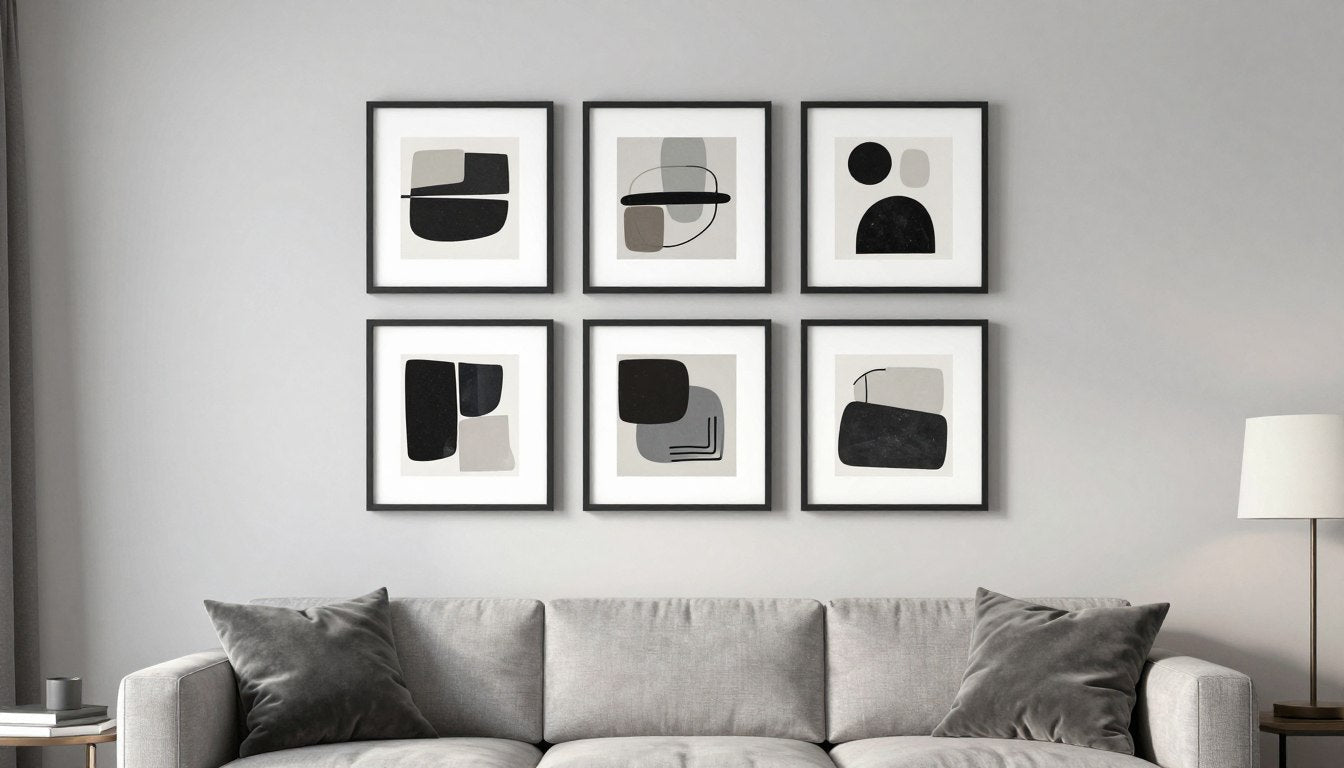
A bare wall feels like an unfinished sentence. Your living room deserves better than emptiness, and gallery wall ideas for living room spaces offer the perfect solution to transform that blank canvas into a statement of personal style.
Whether you're working with a sprawling space above your sofa or a compact wall near your entryway, the right arrangement of art can completely reshape how your room feels.
Choosing the Right Layout for Your Living Room Gallery Wall
The most successful gallery walls follow intentional layouts that complement your living room's architecture. Grid arrangements work beautifully in modern spaces with clean lines, while salon-style walls suit traditional or eclectic decor.
Start by measuring your wall space. A good rule is to keep your gallery wall about two-thirds the width of your furniture piece below it.

Symmetrical Grid Gallery Wall
Grid layouts bring order and sophistication to any living room. This approach works especially well with modern wall art pieces that share similar dimensions.
Choose artwork with consistent frame sizes. This creates visual harmony that designers love.

Space pieces 2-3 inches apart. Consistent spacing between frames makes your gallery wall look intentional rather than random.
Asymmetrical Salon-Style Gallery Wall
Salon walls embrace beautiful chaos. Mix different frame sizes, art styles, and even orientations for a collected-over-time aesthetic.

Start with your largest piece as an anchor. Place it slightly off-center, then build around it with smaller pieces.
This organic approach feels more personal. It allows you to showcase pieces you love without strict rules.

Linear Horizontal Gallery Wall
Horizontal arrangements stretch across your wall space. They work perfectly above long sofas or in narrow hallways connecting to your living area.

Keep all pieces at the same height. Align them by their centers or bottoms for a clean look.
This layout creates a sense of movement. Your eye naturally travels along the wall, making your room feel wider.

Mixing Art Styles and Sizes for Visual Impact
The magic happens when different pieces work together. Mixing art styles and sizes creates depth that single-size arrangements simply cannot achieve.

Combining Abstract and Figurative Art
Pair abstract canvas prints with figurative pieces. This contrast keeps your gallery wall interesting without overwhelming the space.
Use color as your common thread. Even different styles feel cohesive when they share a color palette.

Scale Variation Strategy
Mix large statement pieces with smaller supporting artwork. This creates visual hierarchy that guides the eye naturally.
Your largest piece should be 1.5 to 2 times bigger than your smallest. This ratio feels balanced without being too uniform.

Place your biggest art at eye level. Smaller pieces can float around it, creating constellation-like patterns.

Texture and Medium Diversity
Don't limit yourself to prints alone. Gallery-quality canvas prints with hand-stretched canvas add dimensional interest that flat prints cannot match.

UV-resistant and HP latex inks protect your investment. Quality materials ensure your gallery wall looks fresh for years.
Mix framed and unframed pieces. Canvas wraps on stretcher bars create depth between traditional frames.

Color Coordination Strategies for Gallery Walls
Color makes or breaks a gallery wall. Strategic color choices tie diverse pieces together into one cohesive statement.

Monochromatic Color Schemes
Black and white gallery walls never go out of style. This classic approach works in any room designed with any decor style from vintage to ultra-modern.
Vary the tones within your chosen color. Different shades add depth while maintaining harmony.

Monochromatic doesn't mean boring. Play with pattern, subject matter, and frame styles to keep things dynamic.
Complementary Color Pops
Choose a dominant neutral and add accent colors strategically. This approach lets you incorporate colorful canvas prints without overwhelming your space.

Limit yourself to three main colors. More than that and your wall starts competing with your furniture and decor.
Distribute color evenly across your gallery wall. Avoid clustering all colorful pieces in one spot.

Neutral Foundations
Start with neutral pieces that anchor your gallery. Beige, gray, and cream artwork provides flexibility as your style evolves.

Neutrals let your room decor shine. They won't compete with your furniture or seasonal decorations.
You can always add pops of color later. A neutral base gives you room to experiment without starting over.

Frame Selection and Spacing Techniques
Frames serve as the jewelry for your art. The right frame selection elevates good artwork into a stunning gallery wall.

Matching vs. Mixed Frame Styles
Matching frames create unity. Black frames work universally, while hardwood floater frames add warmth to modern spaces.
Hardwood stretcher frames offer versatility. Their natural finish complements both traditional and contemporary art styles.

Mixed frames tell a story. Combine vintage and modern frames when you want a collected-over-time aesthetic.

Spacing and Alignment Rules
Proper spacing makes the difference between professional and amateur. Aim for 2-3 inches between frames as your standard.
Tighter spacing creates intimacy. Pieces feel like they belong together when separated by just 1-2 inches.

Use templates before you hammer. Trace your frames on kraft paper and tape them to the wall first.
This saves walls and sanity. You can adjust placement without creating extra holes.

The 57-Inch Rule
Gallery professionals hang art with centers at 57 inches from the floor. This eye-level placement works for most adults.

For gallery walls, apply this rule to your central or largest piece. Other pieces can float around this anchor point.
Adjust for furniture. If your sofa back sits at 36 inches, start your gallery wall 6-8 inches above it instead.

📐 Not sure what size to choose? Use our free Wall Art Size Calculator to find the perfect dimensions for your space.
Gallery Wall Placement and Room Flow
Where you place your gallery wall affects how people experience your entire living space. Strategic placement guides movement and creates focal points.

Above the Sofa Placement
The space above your sofa is prime gallery wall real estate. This location naturally draws the eye when people enter your room.
Keep your gallery wall width proportional. It should span about two-thirds to three-quarters of your sofa's width.

Leave 6-12 inches between your sofa and the bottom of your lowest frame. This creates breathing room without floating the art too high.
Stairway and Hallway Gallery Walls
Stairways offer unique opportunities. Follow the stair angle with your arrangement for dynamic visual flow.

Hallways benefit from linear arrangements. Create a horizontal flow that leads people through your space.
Maintain consistent spacing from the floor. Align bottoms or centers to create rhythm as people walk past.

Alternative Wall Locations
Don't overlook side walls in your living room. These spaces work beautifully for vertical gallery arrangements.

Consider the area above your console table or sideboard. This zone creates a secondary focal point in larger rooms.
Dining room connections matter too. If your living and dining room flow together, coordinate your gallery walls for visual continuity.

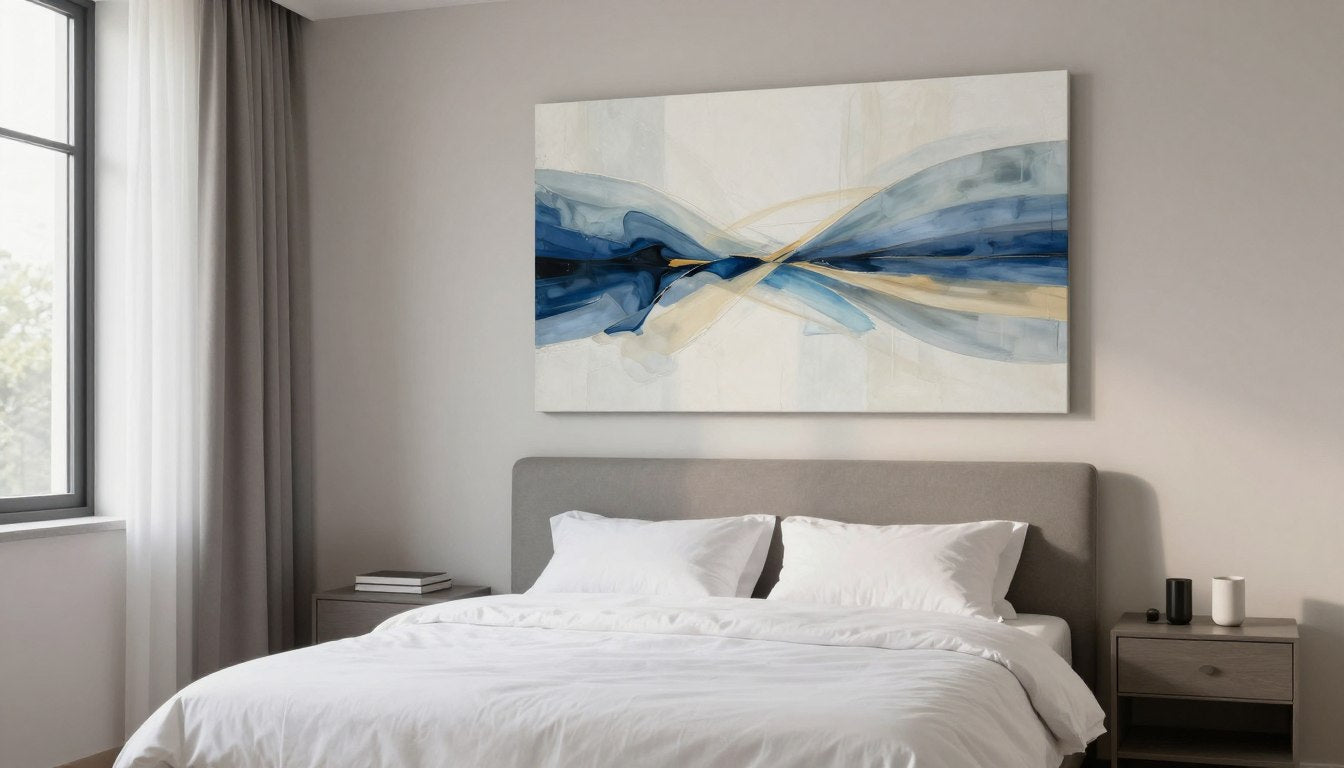
Bedroom gallery walls follow similar principles. The wall opposite your bed or above your headboard makes the strongest statement.

Working with Architectural Features
Windows don't have to stop your gallery wall. Frame around them, incorporating the window into your overall design.

Fireplaces create natural focal points. Place smaller gallery walls on the wall beside the fireplace rather than competing with it.
Built-in shelving offers gallery opportunities too. Mix framed art with decorative objects on shelves for dimensional interest.

High ceilings invite vertical thinking. Extend your gallery wall upward, but keep the bottom edge at proper eye level.

Frequently Asked Questions
How do I start a gallery wall in my living room?
Start by selecting your largest piece as an anchor. Measure your wall space and create paper templates of your frames.
Arrange templates on the wall using painter's tape until you find a layout you love. This method lets you experiment without making holes.
Choose pieces that share at least one common element, whether that's color, style, or frame finish. This creates cohesion even in eclectic arrangements.
What is the rule for gallery walls?
The most important rule is the 57-inch principle. Hang your art with centers at eye level, approximately 57 inches from the floor.
Space frames 2-3 inches apart for standard arrangements. Your gallery wall should span two-thirds to three-quarters of your furniture width when hung above pieces like sofas.
Beyond these guidelines, there are no strict rules. Personal style and room proportions should guide your final decisions.
How many pictures should be in a gallery wall?
Most successful gallery walls include 5-9 pieces, though this varies by wall size and artwork dimensions. Odd numbers tend to create more visually interesting arrangements.
Small walls work well with 3-5 pieces. Larger spaces above sofas or in entryways can accommodate 7-12 pieces comfortably.
Focus on balance rather than counting pieces. A few large statement pieces can have more impact than many small ones.
Should gallery wall frames be the same size?
Matching frame sizes create clean, modern grid layouts that feel organized and intentional. This approach works beautifully in contemporary spaces.
Mixed sizes offer more flexibility and visual interest. Combine large focal pieces with smaller supporting artwork for dynamic arrangements.
Either approach works. Choose based on your personal style and the look you want to achieve in your living room.
What is the best way to arrange a gallery wall?
The best arrangement depends on your space and style. Grid layouts suit modern homes, while salon-style arrangements work for eclectic or traditional spaces.
Lay everything on the floor first. Experiment with different configurations before committing to your wall.
Take photos of arrangements you like. This helps you remember your favorite layout when you start hanging pieces.
Creating Your Perfect Living Room Gallery Wall
Your living room gallery wall tells your story. Whether you choose structured grids or organic salon arrangements, the key is creating something that feels authentically yours.
Quality matters as much as composition. When you invest in gallery-quality pieces made to order with archival inks and UV-resistant materials, your gallery wall maintains its beauty for years.
Ready to start your gallery wall? Explore our Living Room Canvas Prints collection for pieces designed to anchor stunning arrangements in your home.

About the Author
Chiara Rossetti
Chiara Rossetti is the founder of Rossetti Art, a canvas print and original art brand. She writes about interior design, wall art styling, and the art of making a home feel alive.


Leave a comment
This site is protected by hCaptcha and the hCaptcha Privacy Policy and Terms of Service apply.