Sculpture Home Decor: How to Choose, Place, and Style a Statement Sculpture
Sculpture home decor works differently than a canvas print or a painting. It has weight, it casts a shadow, and it reads differently depending on where you're standing and what time of day it is. A single well-placed piece can change how a room feels more than an entire wall of art — but only if the scale, material, and position are right for the space it's going into.
This guide covers the decisions that actually matter when you're bringing a sculpture into your home: where it belongs, what size to buy, which material suits your interior, and how to style it once it's there. For inspiration on scale and material, see how famous sculptures that defined art history command attention in a room.
Quick Answer
Sculpture home decor works best as a single, uncluttered focal point — an entryway console, a living room side table, or a low plinth — rather than grouped with other objects. Choose a scale that fits the surface (20–50 cm for tabletop pieces, 50 cm and up for floor pieces) and a material that matches the room's mood: steel or bronze for weight, resin or ceramic for something lighter.

Where to Place a Sculpture in Your Home

Entryways are the strongest placement for a statement sculpture. It's the first thing a guest encounters, and a three-dimensional piece sets a tone that a flat print simply can't. A console table, a plinth, or low shelving near the door all work — just keep the scale in proportion to the space. A sculpture that's too large in a narrow hallway creates visual stress instead of impact.
In the living room, sculpture works on coffee tables, side consoles, and floating shelves. The key is giving it room to breathe — a piece surrounded by too many other objects loses its power. One considered sculpture on a clear surface does more for a room than a shelf crowded with decorative objects.
Dining tables and kitchen islands can take smaller sculptural centerpieces. Here, material matters more than subject: something in bronze, stone-effect resin, or matte ceramic suits these surfaces better than a highly polished piece competing with glassware and place settings.

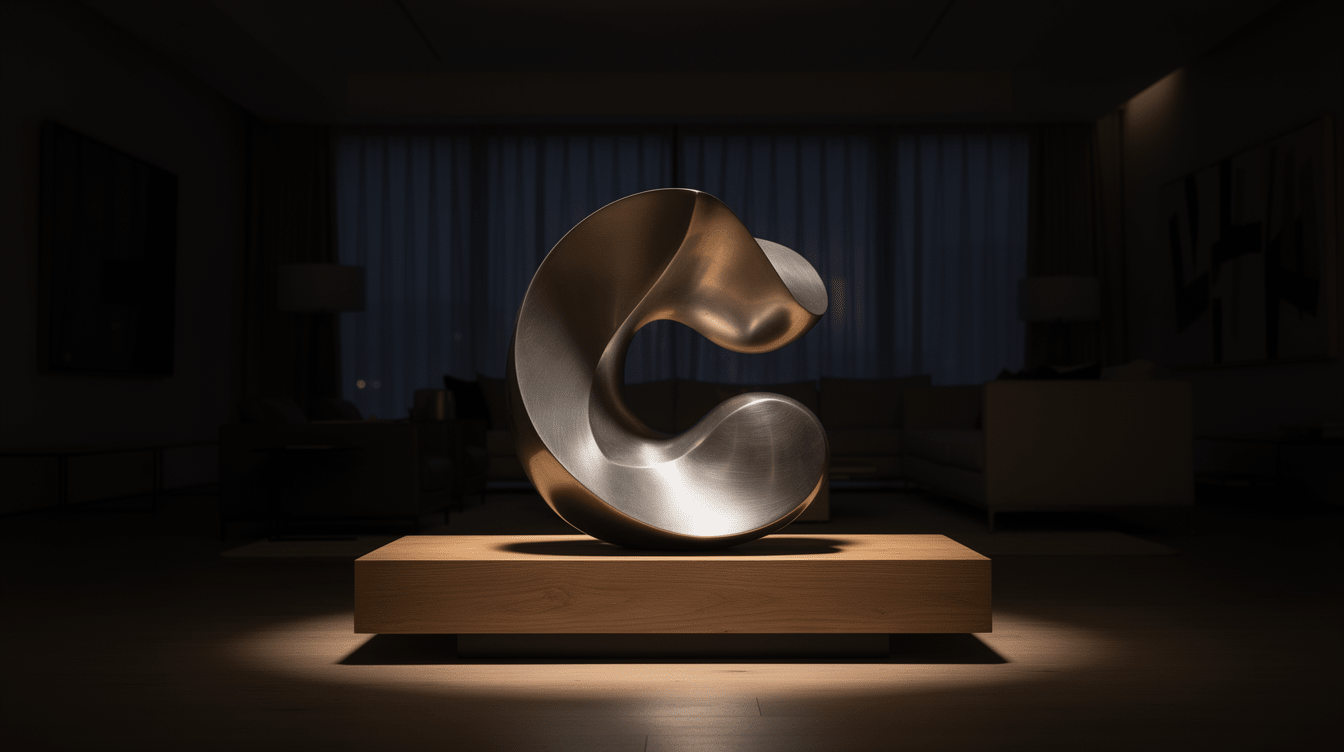
"Silver Flux" — a hand-formed stainless steel sculpture, one of Rossetti Art's best sellers. View the piece →
Choosing the Right Style and Material
Abstract sculpture suits modern, minimalist, and contemporary interiors best. Figurative pieces — human forms, faces, animal subjects — work across a wider range of styles, but need to be chosen carefully in a contemporary space, where an overly literal subject can feel decorative rather than artistic.
Material changes the entire atmosphere of a piece. Rossetti Art sculptures are hand-formed in stainless steel, cast resin, or fiberglass, and each piece is produced as a limited or one-of-a-kind edition rather than a mass-produced casting. Bronze and dark steel add weight and permanence to a room. Lighter resin and ceramic pieces feel more casual and approachable. Mixed-media sculptures — combining materials and finishes — tend to be the most versatile, because the contrast between materials creates interest on its own.
If your interior already leans neutral and textured — think beige, taupe, warm sand — a polished stainless steel piece adds contrast without adding colour, which is often exactly what a calm room needs.
What Size Sculpture Do You Need?
For a shelf or console table, sculptures between 20 and 50 cm (about 8–20 inches) in height work best in most rooms. For floor placement or a dedicated plinth, pieces starting around 50 cm create the presence needed to read as art rather than a decorative object. Measure your surface first, and leave at least 15–20 cm of clear space around the piece on each side — a sculpture with no breathing room reads as clutter, no matter how good the piece itself is.
As a quick reference: entryway consoles usually suit a compact 20–40 cm piece; living room coffee tables and side consoles can go from 30 cm up to a 50 cm-plus floor sculpture if you have the space; dining tables and islands work best with something in the 15–25 cm range so it doesn't interfere with place settings.

"Eternal Loop in Metal" — a 65 cm polished stainless steel piece, sized for a console or side table. View the piece →

🏠 FREE ROOM-BY-ROOM WALL ART GUIDE
Pairing your sculpture with wall art? Get the exact sizes, styles, and placement rules for every room in your home.
Download Free →Styling a Sculpture With Other Decor
The simplest rule: give the sculpture the best position in the room and let everything else support it. One sculpture on a clear surface has more impact than three sculptures competing with vases, books, and plants for attention. If you do want to group objects, use the rule of odd numbers — three items at different heights read as intentional, while two or four tend to look accidental.
Not every sculpture needs to be a $4,000 statement piece to earn its place. Several of Rossetti Art's most popular sculptures sit in the $1,500–$4,800 range, which lands between mass-market decorative figurines and gallery-level pricing — a smaller, lighter piece like a resin sculpture is a reasonable way to bring a first sculpture into a room before committing to a large-scale statement piece.

"Fluid Grace" — a 30 cm cast resin sculpture, an accessible entry point into sculptural decor. View the piece →
Do You Need a Sculpture, Wall Art, or Both?
Sculpture and wall art solve different problems, which is why the strongest rooms usually have both. A sculpture gives a room a physical focal point — something with shadow and dimension that changes as you move around it. Wall art gives a room colour, pattern, and scale on a flat surface. Neither replaces the other; they work in layers.
If you're adding a canvas print alongside a new sculpture, look for one finished with a handcrafted poplar hardwood floater frame — it gives the print the same physical presence as the sculpture beside it, instead of looking flat by comparison. And if you're not sure how much wall art the room needs once the sculpture is in place, Rossetti Art's Live Preview tool on any canvas print or original painting page lets you see the piece at scale in your own room before you order — useful for judging how much (or how little) wall art to add around a new sculpture.

Frequently Asked Questions
What size sculpture works best for a living room?
For a shelf or console table, 20–50 cm (8–20 inches) tall works in most living rooms. For a floor sculpture or dedicated plinth, go from around 50 cm upward so the piece reads as art rather than a small object lost in the room. Leave 15–20 cm of clear space around it.
How do I style a sculpture with other decor?
Give it the best position and let everything else support it — one sculpture on a clear surface has more presence than several competing pieces. If you want to group objects, use the rule of odd numbers: three items at different heights, not two or four.
What materials are Rossetti Art sculptures made from?
Rossetti Art sculptures are hand-formed in stainless steel, cast resin, or fiberglass, produced as limited or one-of-a-kind editions. Steel and bronze-toned pieces feel weighty and permanent; resin and lighter finishes feel more casual and contemporary.
Do I need a sculpture and wall art, or just one?
They solve different problems, so most rooms benefit from both — a sculpture adds physical dimension and shadow, wall art adds colour and pattern on the wall behind or beside it. Start with one statement sculpture, then add a canvas print or original painting once you can see how much wall space is actually left to fill.
How much does a statement sculpture cost?
Several of Rossetti Art's most popular sculptures run from about $1,500 for a smaller cast resin piece to $4,800 for a large hand-formed steel statement piece — positioned between mass-market decorative figurines and gallery-level sculpture pricing. Larger or more elaborate pieces in the full collection can run higher.
Ready to bring some dimension into a room? Explore the full Modern Sculptures collection, or pair a piece with something from our Abstract Canvas Prints for a layered, gallery-style room.
Keep Reading
About the Author — Chiara Rossetti is the founder of Rossetti Art, a canvas print and original art brand. She writes about interior design, wall art styling, and the art of making a home feel alive.


Leave a comment
This site is protected by hCaptcha and the hCaptcha Privacy Policy and Terms of Service apply.