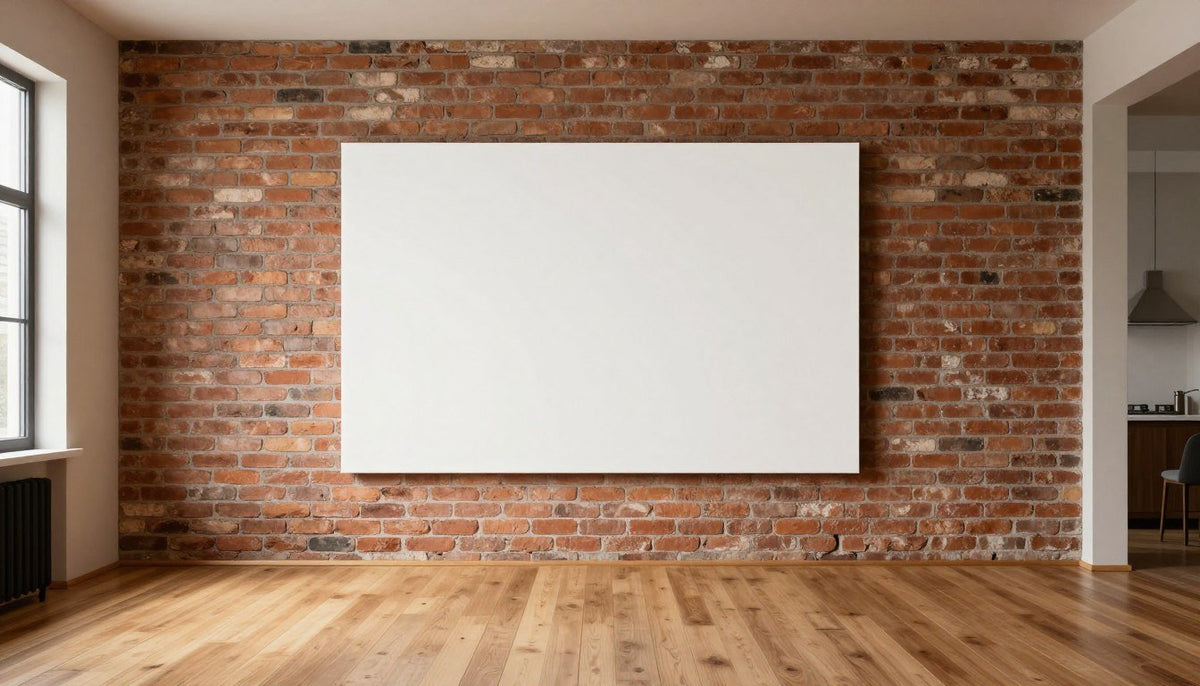
Mounting framed artwork on masonry requires matching the hardware to the surface condition instead of forcing standard drywall nails into solid stone. Brick clips grip proud edges without power tools, while masonry anchors drilled into the mortar line support heavier decorative pieces. Selecting the right method protects both the masonry structure and the frame from unexpected falls.
Wall texture, mortar joint depth, brick age, and frame weight determine whether mechanical clamps or drilled anchors provide the cleanest installation. Assessing these structural details beforehand keeps hanging hardware stable and prevents unnecessary damage to heritage surfaces.
Discover Wall Art for Masonry Spaces
Explore handmade artwork suited for exposed brick and concrete walls with free worldwide shipping.

Matching mounting hardware to the brick surface helps keep wall art level and secure.
Quick Answer: Choosing the Right Hanging Method
The fastest path to hanging art on masonry depends entirely on whether the mortar joints sit recessed behind the brick face. When mortar recedes cleanly, spring-steel brick clips snap directly over the brick edges without drilling any holes. If the wall is flush, painted, or supporting substantial weight, drilling a pilot hole into the mortar bed to seat a masonry anchor is the most reliable approach.
Adhesive strips work only on smooth, fully cured painted brick and should remain limited to very light items. The following overview outlines which hardware fits specific masonry conditions.
| Method | Best for | Needs drilling | Good to know |
|---|---|---|---|
| Brick clips | Recessed mortar | No | Clamps onto the brick edge without creating dust or holes. |
| Mortar anchors | Heavy artwork | Yes | Drilling mortar is softer than brick and leaves repairable holes. |
| Hardwall hooks | Medium frames | No | Small steel pins tap into dense mortar joints with a hammer. |
| Adhesive strips | Light posters | No | Requires smooth painted masonry and clean contact to bond. |
Know Your Brick First
Before selecting hardware, inspect the physical characteristics of the masonry and the surrounding joint structure. Natural fired brick possesses a hard exterior crust with a softer interior, while vintage brickwork can crumble under aggressive impact. Understanding whether the surface is raw, sealed, or heavily painted dictates which fasteners hold tight.
Mortar composition also varies dramatically between older architecture and modern construction. Historic structures rely on lime mortar, which is soft and easily damaged by high-impact hammer drills, whereas modern walls utilize durable Portland cement mixtures. Checking the stability of both the masonry unit and the joint line keeps the frame firmly anchored over time.
Always inspect the mortar joint by scraping a small inconspicuous spot with a flathead screwdriver. If the joint sheds powdery sand easily, avoid hammering hardwall pins and switch to low-speed drilling with sleeve anchors.
Artwork selection also impacts installation requirements. Neutral prints with generous negative space, like Open Plains by Chiara Rossetti, pair naturally with rich masonry textures. Each piece is hand-stretched over a 1.25-inch hardwood stretcher frame, arrives ready to hang, and features a satin-matte, low-glare finish with UL GREENGUARD Gold certified, UV- and fade-resistant HP latex inks. Using the Live Preview button on the product page allows homeowners to view the piece directly on their brick wall prior to purchase.

Inspecting the depth of the mortar joint reveals whether drill-free clips can grip the brick.
Method 1: Drilling into Mortar with Anchors
Drilling into the mortar joint provides an exceptionally firm foundation for heavy frames without cracking the fired clay face of the brick. Mortar is softer than the surrounding stone, making pilot holes easier to bore and significantly simpler to patch with matching mortar compound in the future. For additional guidance on dense masonry surfaces, consult techniques for how to hang pictures on concrete walls.
A rotary drill fitted with a dedicated masonry bit produces clean holes without unnecessary vibration. Setting the drill to standard rotary mode first prevents aggressive chipping along fragile joints, engaging the hammer function only if dense concrete mortar resists progress.
- Mark the desired mounting position along a horizontal or vertical mortar line using a pencil and level.
- Fit a masonry drill bit into the chuck and place a piece of painter's tape on the bit to indicate the anchor depth.
- Drill steadily into the mortar joint at medium speed, keeping the tool perpendicular to the wall face.
- Clear all loose masonry dust from the hole using a hand blower or bulb syringe.
- Insert a plastic wall anchor flush into the joint and drive a masonry screw directly into the anchor sleeve.

Boring directly into mortar preserves the brick face and allows straightforward hole repair.
Method 2: Brick Clips with No Holes
Brick clips, also called brick clamps, offer a completely non-destructive mounting solution that requires no power tools or anchors. These spring-tempered metal brackets hook under the bottom lip of a brick and snap securely over the top edge, using mechanical tension to grip the clay. Because the clips do not penetrate the wall, they leave historic masonry intact.
For clips to function properly, the individual bricks must project outward slightly from the mortar bed. The mortar joint needs an indentation deep enough for the clip teeth to latch over the top and bottom edges securely. For multi-panel arrangements on clean brick spans, balanced pieces like Ochre Divide by Chiara Rossetti bring structured rhythm to wide rooms. The triptych is hand-stretched over a 1.25-inch hardwood stretcher frame, arrives ready to hang, and uses UL GREENGUARD Gold certified, UV- and fade-resistant HP latex inks with a satin-matte, low-glare finish, with a Live Preview button available on the product page.
Advantages
- Installs in seconds without rotary tools, drill bits, or masonry dust.
- Leaves zero holes, cracks, or adhesive residue on historic brickwork.
- Allows effortless repositioning when rearranging framed displays.
Limitations
- Requires mortar joints recessed backward from the brick face.
- Incompatible with completely flush mortar or mortar that slopes forward.
- Restricted to standard modular brick heights that match clip sizing.
Method 3: Renter-Friendly Options
Renters seeking to hang wall art without making permanent structural alterations must work around lease restrictions on masonry drilling. While modern adhesive strips offer strong grip on sheetrock, raw masonry presents porous, dusty, and irregular surfaces that prevent standard adhesive pads from forming a secure chemical bond. Readers exploring non-invasive hanging methods can review alternatives in how to hang wall art without nails.
Smooth, factory-finished or fully painted brick provides better adhesion than rough antique brick because the paint seals the underlying pores. For raw brick, specialized hardwall picture hangers featuring ultra-thin tempered steel pins tap directly into dense mortar seams, leaving pinprick holes that brush clean with minimal effort. Further structural suggestions appear in practical overviews like how to hang artwork on a brick wall from home decor editors.
Never rely on standard adhesive foam tape on unfinished brick surfaces. Natural masonry chalking and airborne humidity weaken the bond, leading to dropped artwork and cracked frames.
How to Level and Space Art on Uneven Brick
Brick walls are rarely plumb, and handmade or vintage courses often feature undulating surfaces and wavy mortar joints. Relying solely on the horizontal mortar line to position frames can produce noticeably crooked artwork. Measuring upward from a stable floor line or employing a self-leveling cross-line laser establishes a true horizontal guide across textured masonry.
Uneven brick faces can also cause frames to tilt forward or rest awkwardly against protruding edges. Applying clear silicone or rubber bumper pads to the bottom rear corners of each frame cushions the frame against coarse clay and brings the picture parallel to the wall plane. When coordinating multi-piece gallery arrangements, refer to practical framing advice in how to hang canvas paintings.
- Project a horizontal laser reference line across the wall rather than following crooked mortar channels.
- Affix soft rubber bumpers to the frame corners to prevent scratching and balance out uneven brick relief.
- Maintain consistent spacing between adjacent frames by measuring from outer frame edge to outer frame edge.
- Keep the visual midpoint of single statement pieces near eye level relative to standing viewing heights.

Using an independent spirit level keeps artwork straight regardless of wavy mortar joints.
Which Art Works Best on Brick
Exposed masonry provides substantial visual texture, warmth, and architectural character, meaning the artwork placed upon it must hold its own visually. Thin wire frames or highly intricate miniature prints can disappear against the bold geometry of brick coursing. Choosing substantial canvas pieces, wide matting, or deep shadow boxes establishes clear separation between the wall surface and the art.
Color choice also plays a decisive role in balancing the natural warmth of terra-cotta clay. High-contrast monochromatic compositions create striking modern tension, while muted earth tones harmonize with rustic mortar lines. A minimalist statement such as Monochrome Reverie by Chiara Rossetti cuts through rustic brick textures with bold graphic balance. Hand-stretched over a 1.25-inch hardwood stretcher frame, the canvas arrives ready to hang, finished with a satin-matte, low-glare surface printed with UL GREENGUARD Gold certified, UV- and fade-resistant HP latex inks. The Live Preview feature on the product page allows collectors to test the piece against their specific brick color before ordering.

Large Scale Statements
Oversized canvases provide unbroken focal points that prevent busy brick patterns from overwhelming the room.

High-Contrast Palettes
Crisp black, white, and neutral artwork creates sharp architectural contrast against warm, earthy clay brick.
See It on Your Wall Before You Buy
Use the Live Preview tool to project any canvas print directly onto your brick wall using your smartphone camera.
Frequently Asked Questions
How to hang art on a brick wall without drilling?
Spring-steel brick clips snap directly over the top and bottom edges of individual bricks when the mortar joint is recessed. Hardwall plastic hangers with small steel pins can also be tapped into firm mortar seams without power tools. For very light frames on smooth painted brick, specialty heavy-duty mounting tape provides an adhesive option.
Will Command strips stick to brick?
Standard Command strips do not reliably bond to rough, unfinished brick because porous masonry sheds microscopic dust and prevents even adhesive contact. They adhere significantly better to clean, smooth painted brick surfaces free of grease and loose chalk. For unpainted or uneven brick, mechanical brick clips or anchors provide far greater stability.
What will stick to brick to hang things?
Outdoor-rated double-sided foam mounting tape and heavy-duty mounting adhesives designed for masonry stick best to clean brick surfaces. However, adhesive solutions can peel away paint or leave stubborn residue when removed from porous clay. Mechanical friction clips or mortar anchors avoid these surface adhesion failures entirely.
How do I hang pictures on a brick wall?
Select your mounting method based on whether your mortar joints sit recessed behind the brick face or remain completely flush. For recessed joints, snap non-damaging brick clips into place, while flush joints benefit from drilling pilot holes into the mortar to seat masonry anchors. Attach picture wire or sawtooth hangers securely to the mounted hardware and verify alignment with a level.
Should I drill into the brick or the mortar?
Drilling into the mortar joint is preferred because mortar is softer, easier to penetrate, and simple to patch with fresh compound if the artwork moves. Drilling into the brick face can crack brittle antique bricks and leaves permanent holes that are difficult to conceal. Reserve brick face drilling only for exceptionally heavy installations where mortar alone cannot support the load.
Creating a Lasting Wall Display
Selecting the correct mounting hardware preserves the architectural beauty of brick walls while keeping cherished artwork firmly anchored. Taking time to inspect mortar depth, level frames independently, and cushion rear edges supports a secure, polished presentation in any living space.
About the Author: Chiara Rossetti is the founder of Rossetti Art, a canvas print and original art brand. She writes about interior design, wall art styling, and making a home feel alive.

About the Author
Chiara Rossetti
Chiara Rossetti is the founder of Rossetti Art, a canvas print and original art brand. She writes about interior design, wall art styling, and the art of making a home feel alive.


Leave a comment
This site is protected by hCaptcha and the hCaptcha Privacy Policy and Terms of Service apply.