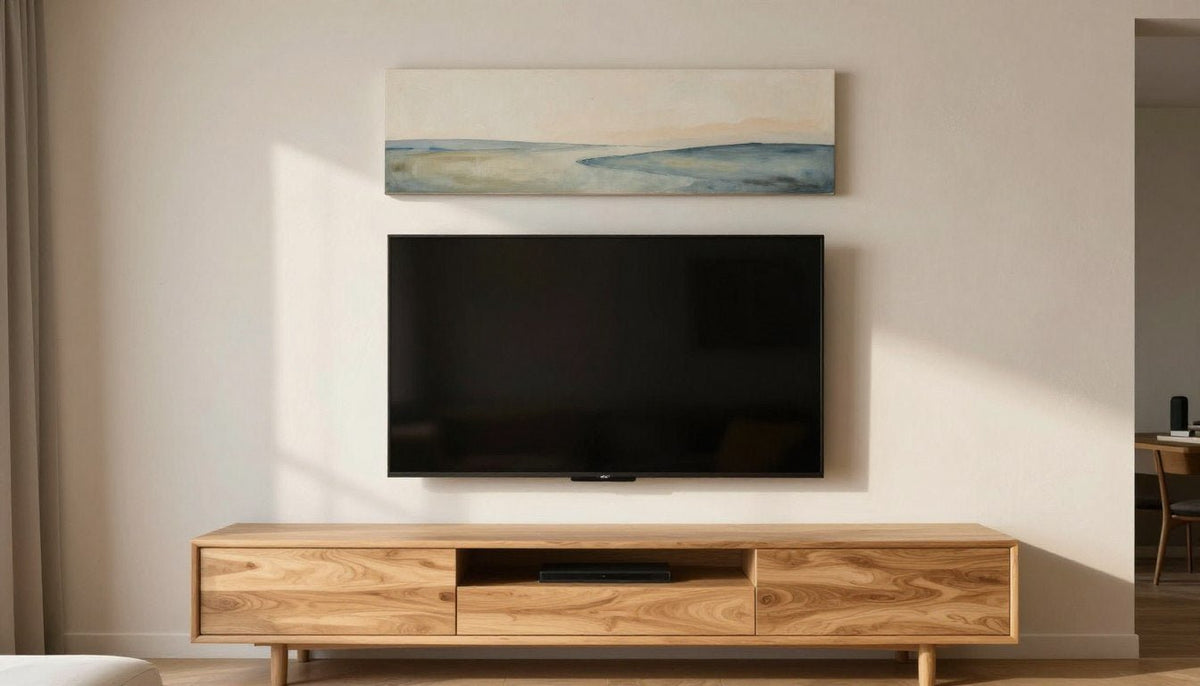
Hanging art above tv displays works well when the artwork balances the screen without overwhelming the wall. A wide horizontal format with subtle tones softens the heavy black rectangle beneath it while keeping viewing comfortable. Placement depends on treating both items as a unified vertical composition rather than isolated decorative objects.
Room proportions, ceiling height, and whether the screen sits on a media console or rests flat against the wall determine the right solution. Focusing on low-reflection materials and balanced dimensions keeps the living area peaceful both when the screen is active and when it remains powered off.

Should you put art above a TV?
Yes, you can put art above a TV if your wall has sufficient vertical space and the screen sits low enough for natural viewing. Adding artwork draws the eye upward, breaking up the stark dark surface of an idle screen, provided the piece uses calm imagery that avoids visual competition during television viewing.
Many living rooms feature an expansive blank wall behind a media setup. Leaving that surface bare can make the black screen look stranded or overly dominant. Introducing art transforms the entertainment zone into an intentional interior design feature, anchoring the entire seating layout.
Problems arise primarily when a screen is already mounted too high, such as over a tall mantel. In that arrangement, adding framed art above forces viewers to crane their necks and creates an uncomfortably crowded upper wall. When a screen sits on a low media console at comfortable eye level, hanging an understated piece above restores proportion.
To keep the focal point cohesive, choose pieces that complement nearby furnishings without shouting for attention. The horizontal composition of Whispering Horizon offers a calm, balanced presence above wide consoles. It is hand-stretched over a 1.25-inch hardwood stretcher frame, comes ready to hang, and features a satin-matte, low-glare finish printed with UV- and fade-resistant HP latex inks that carry UL GREENGUARD Gold certification, with a floater frame option available.
Upgrade Your Living Room Wall Decor
Browse balanced, horizontal canvas prints created specifically to bring harmony and warmth over media consoles with free worldwide shipping.
How high should art hang above a TV?
Art should hang close enough to the TV to form a connected visual unit, leaving a moderate gap that prevents collision while avoiding disconnected floating. Leaving a tight clearance keeps the arrangement grounded, whereas placing the artwork too close to the ceiling makes the room feel top-heavy and disjointed.
A standard mistake is treating artwork above a screen as an isolated accent hung at standard standing eye level. When art sits far above the television, the eye constantly jumps across an awkward stripe of empty drywall, breaking visual flow. Treating the screen and the canvas as one combined gallery group creates immediate harmony.
Take into account whether your display tilts forward on an adjustable bracket or remains flat against the studs. A tilted monitor projects outward into the room, meaning a tiny spacing margin may cause the top edge of the casing to overlap the lower edge of the frame visually from seated angles. Allowing a modest, deliberate breathing gap prevents any feeling of physical crowding.
Check the seated perspective from your primary sofa before driving nails into the wall. Standing sightlines often lead people to mount artwork higher than what looks restful when seated.
Consulting practical layout tools such as a wall art size calculator helps determine proper vertical margins relative to ceiling height. Keeping the upper frame border well below the ceiling line preserves open space and keeps the room feeling airy.

What size art goes above a TV?
The best art size above a TV spans slightly narrower than the screen itself, maintaining proportional balance without looking top-heavy. Choosing a canvas that extends roughly two-thirds to three-quarters of the display width anchors the electronics cleanly, while oversized frames create an unstable inverted pyramid effect on the wall.
Scale dictates whether a display feels intentional or clumsy. If the chosen piece is narrower than half the screen width, it appears tiny, like an accidental afterthought floating over machinery. Conversely, hanging a piece that overhangs the television edges makes the display look inadequate and visually unsupported.
Orientation matters just as much as dimensions. Wide horizontal panoramas mirror the landscape aspect ratio of modern televisions, echoing their geometry. Vertical portraits rarely work directly above displays because their height collides with ceiling moldings and exaggerates vertical lines in an awkward manner.
| TV size | Art width | Gap above the TV | Best orientation |
|---|---|---|---|
| 43-inch TV (about 37 in wide) | 25-28 in | about 4-8 in | Horizontal |
| 55-inch TV (about 48 in wide) | 32-36 in | about 4-8 in | Horizontal |
| 65-inch TV (about 57 in wide) | 38-43 in | about 4-8 in | Horizontal or slim panoramic |
| 75-inch TV (about 65 in wide) | 44-49 in | about 4-8 in | Slim panoramic |
For broad living room setups, selecting a Long Horizontal Canvas Print provides an elongated profile that bridges wide television credenzas. Each piece features UV- and fade-resistant HP latex inks certified UL GREENGUARD Gold, mounted across a 1.25-inch hardwood stretcher frame, finished in satin-matte to limit reflections, ready to hang, with an optional floater frame.

What kind of art looks good above a TV?
The art that looks best above a TV features muted palettes, gentle textures, and uncluttered compositions such as minimalist abstracts, peaceful landscapes, or organic line studies. These softer subjects avoid competing with colorful, moving video content, creating an inviting, tranquil backdrop that complements everyday home life.
Visual competition is the primary concern when placing artwork directly adjacent to a digital display. Vibrant primary colors, intense portraits with prominent faces, or high-contrast graphics fight for attention in your peripheral vision while watching movies. According to design perspectives outlined by Homes & Gardens, softening technology with subdued natural imagery helps media walls blend seamlessly into home interiors.
Subject matter should feel grounding and serene. Flowing watercolor washes, atmospheric horizon scenes, and textural neutral patterns soften hard edges and angular metal bezels. When the screen is dark, the artwork becomes an artistic centerpiece; when the screen is active, the artwork recedes quietly into the background.
Recommended Art Styles
- Muted landscape panoramas that evoke calm horizons
- Minimalist textured abstracts with earthy undertones
- Tonal geometric designs featuring soft color transitions
Styles to Avoid
- High-contrast typography and bold graphic lettering
- Busy, hyper-detailed patterns that fatigue the eyes
- Direct portraiture that pulls focus from movie scenes
A prime example of soft visual balance is Coastal Silence Horizon. Built ready to hang on a 1.25-inch hardwood stretcher frame, its satin-matte texture prevents sharp glare, utilizing UL GREENGUARD Gold certified HP latex inks that resist fading, with a floater frame option available for elevated presentation.

Does art above a TV cause glare?
Art above a TV causes glare primarily when framed behind standard reflective glass that catches ceiling fixtures, windows, or screen backlight. Switching to stretched canvas or matte finishes prevents unwanted specular highlights, preserving screen visibility while keeping the wall visually quiet during day and night viewing.
Standard glass picture frames act like dark mirrors in a brightly lit room. When positioned above an active screen, reflections bounce between the glass surface, recessed ceiling downlights, and the television panel itself. This visual noise creates distraction, forcing eyes to constantly readjust focus between moving video and flashing frame reflections.
Stretched canvas offers an ideal solution for media walls. The finely woven fabric absorbs and diffuses ambient room lighting rather than bouncing sharp beams back into viewer seating. Satin-matte print surfaces deliver deep pigment saturation and detail without producing the blinding hotspots typical of glossy resin coatings or budget glass frames.
Lighting layout also plays a decisive role. Directional ceiling spotlights aimed directly downward across the face of framed artwork can wash out both the print and the top edge of your monitor. Angling accent lighting toward adjacent accent walls or using dimmable ambient sconces keeps illumination gentle across the entire entertainment station.
See It on Your Wall Before You Buy
Test art dimensions and color palettes in your exact room setting using the Live Preview button found on every piece in our collection.
Is a gallery wall around a TV better?
A gallery wall around a TV is better if you want to camouflage the screen entirely within an eclectic collection of frames. However, for minimalist or modern spaces, a single large horizontal canvas above the screen offers a cleaner, less cluttered aesthetic that requires far less installation effort.
Gallery groupings work by disguising the monitor as just another dark rectangle among various framed items. Surrounding the display with varied frame profiles, small prints, and botanical sketches helps electronics merge into a curated feature wall. Those interested in detailed multi-frame layouts can explore practical strategies for a gallery wall around TV configurations.
Despite its camouflage benefits, a multi-frame display requires careful measuring and can feel visually chaotic in modest rooms. Multiple frames introduce dozens of competing lines, shadows, and reflective glass panes that distract the viewer during family movie nights. Deciding between options often comes down to personal taste, as detailed in our guide on one large canvas vs gallery wall arrangements.
- Choose a single horizontal piece for clean architectural serenity and rapid hanging
- Choose a gallery cluster to disguise an awkward off-center monitor placement
- Select unified canvas finishes over mixed shiny frames to reduce ambient light bounce
Frequently Asked Questions
Can I hang framed art above a TV if my ceiling is low?
Yes, but you should select a slim panoramic canvas rather than a tall print. Keeping vertical frame dimensions compact leaves generous breathing space beneath low ceiling lines.
What is the best frame style to use above an entertainment screen?
Unframed gallery-wrapped canvas or slender floater frames work best because they eliminate heavy borders. They prevent bulky silhouettes from crowding the clean edges of modern displays.
How do I test how artwork will look above my TV before ordering?
Use the Live Preview tool available on every product page to view the artwork directly on your own wall through your camera. Taping butcher paper templates to the wall also tests physical proportions.
Should artwork above a TV be wider than the console table?
No, wall decor should remain narrower than both the underlying console table and the television. Keeping upper pieces within the footprint of lower furniture creates a stable visual foundation.
Achieving a Balanced Media Wall
Decorating above an entertainment setup succeeds when you treat the display and the artwork as parts of a single, coordinated composition. Choosing a horizontal satin-matte canvas with understated tones prevents glare while softening dark screens. Measure your wall proportions carefully to maintain comfortable clearance and turn your entertainment wall into a tranquil focal point.
About the Author: Chiara Rossetti is the founder of Rossetti Art, a canvas print and original art brand. She writes about interior design, wall art styling, and making a home feel alive.

About the Author
Chiara Rossetti
Chiara Rossetti is the founder of Rossetti Art, a canvas print and original art brand. She writes about interior design, wall art styling, and the art of making a home feel alive.

Leave a comment
This site is protected by hCaptcha and the hCaptcha Privacy Policy and Terms of Service apply.