
Transforming your space with canvas art is one of life's simple pleasures—until you're faced with the challenge of hanging it properly. Whether you've invested in a statement piece or a collection of smaller works, this guide will help you achieve gallery-worthy placement with the right hardware, ensuring your canvas paintings remain secure and perfectly level.
Quick Guide: How to Hang Canvas Paintings
- Follow the centerline rule: hang artwork with its center at 57–60 inches (145–152 cm) from the floor for gallery-standard eye level
- Use a single hook for canvases under 18" × 24", two hooks for medium to large pieces, and French cleats for oversized art
- Measure the "hanger drop" (distance from top of canvas to where wire/hardware sits) before marking your wall
- Install wall anchors for drywall or locate studs for heavier pieces to prevent damage
- Leave 6-12 inches of space above furniture when hanging canvas art
- For triptychs or sets, maintain 2-3 inches of spacing between each canvas
- Renters: explore hang canvas without nails (renter tips) for damage-free options
Before You Hang: Identify Your Canvas Type
Different canvas types require specific hanging approaches. Identifying what you're working with is the first step toward a successful installation.

Different canvas types require specific hanging hardware and techniques
Wrapped/Stretched Canvas
The most common type, with canvas stretched over wooden stretcher bars. These are lightweight and typically come with pre-installed hanging hardware on the back frame. Best hung with sawtooth hangers, D-rings, or wire depending on size.
Large/Oversized Canvas
Canvases larger than 24" × 36" require more substantial support. These heavier pieces need wall anchors or stud mounting, and often benefit from two-point hanging systems or French cleats to distribute weight evenly.
Framed/Floater Framed Canvas
Canvas paintings with decorative frames or floater frames (where the canvas appears to float within the frame). These add weight and may require stronger hanging hardware, but often come with professional-grade wire or D-rings already installed.
Rolled/Unstretched Canvas
These require stretching or framing before hanging. If you have a rolled canvas, consider professional stretching services before proceeding with installation.
For a deeper understanding of these differences, explore our guide on rolled vs stretched vs floater framed canvas.
The Gallery Height Rule (So It Never Looks "Off")

Professional galleries follow a simple yet effective rule that you can apply in your home: the centerline principle. This ensures your canvas paintings are displayed at the optimal viewing height.
Eye-Level Centerline
Hang your canvas so its center point is 57–60 inches (145–152 cm) from the floor. This height corresponds to the average eye level, creating a comfortable viewing experience. This single rule will immediately elevate your home's aesthetic to gallery standards. For the same principle applied across every kind of framed piece, not just canvas, see our complete guide to hanging pictures at the right height.
Above Furniture Placement
When hanging canvas paintings above sofas, beds, or consoles, maintain 6–12 inches of space between the top of the furniture and the bottom of the artwork. This creates visual breathing room while maintaining a cohesive relationship between the pieces.

Maintain 6-12 inches between furniture and artwork for proper visual balance
Fireplace Exception
When hanging above a fireplace, position the bottom of the canvas 4–6 inches above the mantel. This exception to the centerline rule accounts for the already elevated viewing position created by the fireplace structure.
Multiple Canvas Spacing
For pairs, triptychs, or gallery walls, treat the entire arrangement as a single unit when applying the centerline rule. The center of the complete arrangement should sit at 57–60 inches from the floor.
- Single pieces: Apply the centerline rule directly
- Pairs: Hang at the same height with 2–3 inches between them
- Triptychs: Maintain equal spacing of 2–3 inches between each panel
For more on proportional sizing, check out our guide on the 2/3 rule for wall art sizing.
Choose the Best Way to Hang Canvas Paintings (By Size + Weight)
| Canvas Size | Weight Range | Recommended Hardware | Wall Type Considerations | Common Mistake to Avoid |
| Small (up to 16"×20") | Light (1-3 lbs) | Sawtooth hanger, single hook | Standard nails for most walls | Using oversized hardware |
| Medium (16"×20" to 24"×36") | Medium (3-8 lbs) | D-rings with wire, 1-2 hooks | Wall anchors for drywall | Skipping the level check |
| Large (24"×36" to 36"×48") | Heavy (8-15 lbs) | Heavy-duty wire, two hooks | Wall anchors or stud mounting | Using only one hook |
| Oversized (larger than 36"×48") | Very Heavy (15+ lbs) | French cleat, security hardware | Stud mounting essential | Solo installation attempt |
Small (Lightweight) Canvas Paintings

For canvases up to 16" × 20", simplicity is key:
- Sawtooth hangers work perfectly for most small canvases
- A single picture hook or nail is typically sufficient
- For rental spaces, consider adhesive strips rated for the weight of your canvas
- Small canvases can also be displayed on easels or leaned on shelves for a casual look
Medium Canvas Paintings
Canvases between 16" × 20" and 24" × 36" benefit from more robust hanging systems:

- D-rings provide more stability than sawtooth hangers
- Wire hanging allows for easier leveling adjustments
- Use a level both when installing hardware and when hanging the canvas
- Consider using two hooks for added stability, especially for wider pieces
Pro Tip: When installing wire, position it at the upper third of the canvas and ensure it has enough tension that when pulled up, it doesn't reach the top of the frame.
Large Canvas Paintings

Canvases between 24" × 36" and 36" × 48" require more substantial support:
- Always use two hooks spaced appropriately for the width of the canvas
- Install wall anchors rated for the weight of your canvas when hanging on drywall
- Consider finding wall studs for the most secure mounting
- Add rubber bumpers or felt pads to the bottom corners to prevent wall damage and keep the canvas level
- Large canvases benefit from anti-tilt hardware to prevent shifting over time
Oversized / Statement Pieces
For canvases larger than 36" × 48", take extra precautions:

- French cleats provide the most secure support for very large canvases
- Always enlist a helper for two-person installation
- Mount directly into wall studs whenever possible
- Consider professional installation for extremely valuable or heavy pieces
- Use a laser level for precise alignment across wide spans
For more specific guidance on handling larger pieces, see our article on giant canvas prints hanging tips.
Measure Like a Pro (3-Minute Checklist)

Pre-Hanging Measurement Checklist
- Determine your canvas center point (measure height and width, divide by 2)
- Mark your desired wall center at 57-60 inches from the floor
- Measure the "hanger drop" (distance from top of canvas to where wire/hardware sits when taut)
- Subtract the hanger drop from half the canvas height
- Mark your hook point(s) this distance above your center mark
- For two hooks, measure equal distances left and right from center
- Use a level to ensure your marks are perfectly horizontal
- Install anchors or locate studs before placing hooks
- Double-check all measurements before making holes
Step-by-Step: How to Hang a Canvas Painting (Numbered)
Tools You'll Need
- Measuring tape
- Pencil (for marking)
- Level
- Hammer
- Appropriate hooks or hardware
- Wall anchors (for drywall)
- Screwdriver
- Stud finder (optional)
- Painter's tape (optional)
- Rubber bumpers or felt pads

1. Choose Position
Decide where you want to hang your canvas. For a quick preview, cut paper to the size of your canvas and use painter's tape to position it on the wall. This allows you to visualize the placement before making any holes.
2. Measure and Mark Centerline
Mark the wall at 57-60 inches from the floor for your centerline. If hanging above furniture, ensure there will be 6-12 inches of space between the furniture and the bottom of your canvas.

3. Calculate Hanger Drop
Hold your canvas with the hanging wire or hardware pulled taut (as it would be when hanging). Measure from the top of the canvas to the point where the wire or hardware reaches its highest point. This is your "hanger drop."
4. Mark Hook Points
For a single hook: Measure up from your centerline mark by half the height of your canvas, then subtract the hanger drop. This is where your hook should go.
For two hooks: Mark two points at the same height, spaced appropriately for your canvas width (typically 1/3 in from each side).

5. Install Anchors / Find Studs
For drywall, install appropriate anchors at your marked points. For heavier canvases, use a stud finder to locate wall studs for more secure mounting. For brick or concrete walls, you'll need special masonry hardware.
6. Hang, Level, Adjust
Hang your canvas on the installed hook(s). Use a level on top of the frame to ensure it's perfectly straight. Make small adjustments as needed.

7. Stabilize with Bumpers (Optional)
Add small rubber bumpers or felt pads to the bottom corners of your canvas. These prevent wall marks, reduce shifting, and help maintain a level position over time.
Renter-Friendly: How to Hang Canvas Without Nails (Brief + Link Out)

Concerned about wall damage in your rental? There are several effective ways to display your canvas art without putting holes in the walls:
- Adhesive hanging strips designed specifically for canvas weights
- Removable hooks with damage-free adhesive backing
- Tension rods with canvas clips for gallery-style display
- Leaning larger canvases on mantels, shelves, or consoles
- Easels or display stands for smaller pieces
- Picture ledges that mount with minimal wall impact
For a complete guide to damage-free hanging methods, including product recommendations and step-by-step instructions, visit our detailed article:
Easy Tips for Hanging Canvas Without NailsCommon Mistakes (and Fast Fixes)

Hanging Too High
Mistake: Placing artwork far above eye level, creating an uncomfortable viewing angle.
Fix: Follow the 57-60 inch centerline rule, measuring from the floor to the center of the canvas.
Wrong Hardware for Weight
Mistake: Using lightweight hooks for heavy canvases, risking falls and damage.
Fix: Match hardware to your canvas weight—sawtooth for small pieces, D-rings and wire for medium, and French cleats for large works.
Skipping Anchors
Mistake: Hanging directly into drywall without proper support.
Fix: Use appropriate wall anchors rated for your canvas weight or locate wall studs.
Not Measuring Hanger Drop
Mistake: Failing to account for the distance between the top of the canvas and where the wire sits.
Fix: Always measure the hanger drop with wire pulled taut and factor it into your calculations.
Using One Hook for Large Pieces
Mistake: Relying on a single support point for wide or heavy canvases.
Fix: Use two hooks for anything wider than 24 inches to prevent tilting and ensure stability.
Crooked Alignment
Mistake: Eyeballing level instead of using proper tools.
Fix: Always use a level both when marking hook positions and after hanging.
Wrong Spacing Above Furniture
Mistake: Hanging too close to or too far above furniture, creating visual disconnect.
Fix: Maintain 6-12 inches between the top of furniture and the bottom of your canvas.
Ignoring Lighting Considerations
Mistake: Placing canvas where glare from windows or lights obscures the image.
Fix: Test different times of day before finalizing placement or add picture lights for controlled illumination.
Overcrowding a Wall
Mistake: Hanging too many pieces too close together, creating visual chaos.
Fix: Follow the 2/3 rule—artwork should occupy about 2/3 of the available wall space with adequate breathing room.
Ignoring Room Proportion
Mistake: Hanging small pieces on large walls or vice versa.
Fix: Scale your canvas to your wall size—larger walls need larger pieces or thoughtfully arranged groupings.
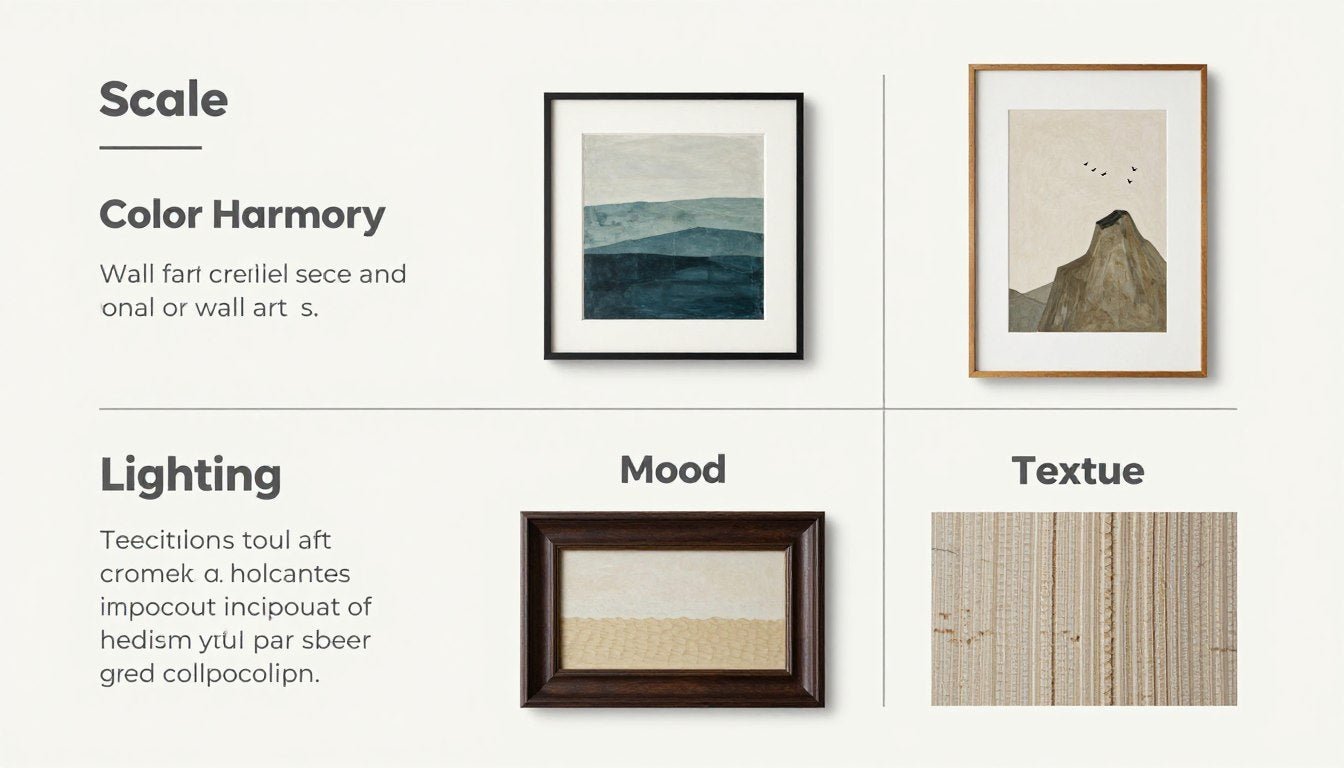
Style Notes: Make Canvas Art Look Intentional

The difference between a random canvas on a wall and a thoughtfully curated space often comes down to these subtle styling considerations:
Repeat a Color Cue
Select canvas art that picks up a color from your room's palette—perhaps from a throw pillow, rug, or accent piece. This creates a harmonious visual connection that makes the art feel purposefully chosen rather than randomly placed.
Balance Negative Space
Allow your canvas room to breathe. The empty wall space around your art is just as important as the art itself. For a balanced look, ensure your canvas occupies approximately 2/3 of the available wall space, leaving adequate margins.

Lighting Placement
Consider how natural and artificial light interact with your canvas. Thoughtful lighting can dramatically enhance the impact of your art. For important pieces, consider adding picture lights or adjustable track lighting to highlight the work.
Triptychs and Sets
Multi-panel canvas sets create a cohesive statement and work particularly well in larger spaces or above wide furniture pieces. When hanging sets, maintain consistent spacing (typically 2-3 inches) between each panel.
For stunning multi-panel options, explore our canvas print sets / triptych wall art collection.
Designer Tip: For a collected, gallery-like feel, learn how to mix and match art prints for a gallery wall that tells your unique story.
Recommended Picks (Canvas Art for Different Spaces)

Minimal / Calm Interiors
For spaces that embrace minimalism and tranquility, subtle pieces with refined lines create a sense of peace. The Whispered Profile canvas print offers elegant simplicity that enhances rather than overwhelms quiet spaces. For textural depth, the original painting Silent Geometry adds subtle dimension while maintaining a serene palette.

Color Statement Wall
When your space needs a vibrant focal point, the right canvas can transform an entire room. The Colorful Stroll canvas print introduces dynamic energy with its abstract urban scene. This piece works beautifully as a standalone statement or as the anchor in a gallery arrangement, adding depth and personality to neutral spaces.

Geometric / Modern Office
Structured environments like home offices benefit from art that balances creativity with order. The Whirling Patterns canvas brings geometric precision with artistic flair, creating visual interest without distraction. For larger office walls, the Modern Abstract Trio offers a bold, textured statement that enhances focus and inspiration.

Mid-Century Vibe
For spaces that embrace mid-century modern aesthetics, art that echoes the era's distinctive style creates cohesion. The Retro Flow canvas print captures the period's characteristic forms and color palette, complementing wooden furniture and brass accents. This piece hangs particularly well above credenzas or as part of a curated vignette with vintage objects.
Find Your Perfect Canvas
Discover artwork that transforms your space and reflects your unique style.
Frequently Asked Questions
What is the ideal height to hang canvas paintings?
The gallery standard is to hang canvas paintings so their center point is 57-60 inches (145-152 cm) from the floor, which corresponds to average eye level. This creates a comfortable viewing experience and professional appearance. When hanging above furniture, maintain 6-12 inches of space between the furniture and the bottom of the artwork.
How do you hang a large canvas painting securely?
Large canvas paintings (larger than 24" × 36") should be hung using two hooks or a French cleat system for proper weight distribution. Always use wall anchors rated for the weight of your canvas when hanging on drywall, or locate wall studs for the most secure mounting. For very large pieces, consider professional installation or enlist a helper for safe handling.
Do I need anchors for a canvas?
Wall anchors are recommended for any canvas hung on drywall that weighs more than 5 pounds or is larger than 16" × 20". Small, lightweight canvases can often be hung with a simple nail or picture hook, but medium to large pieces require proper anchoring to prevent wall damage and ensure long-term stability.
How do I keep a canvas from tilting?
To prevent tilting, use two hooks for wider canvases, ensure your hanging wire has proper tension, and add small rubber bumpers or felt pads to the bottom corners of the frame. These bumpers create friction against the wall and help maintain a level position. For valuable or heavy pieces, consider security hardware that locks the bottom of the frame to the wall.
How to hang canvas without nails (for renters)?
Renters can use adhesive hanging strips designed for the weight of their canvas, removable hooks with damage-free adhesive, tension rods with canvas clips, or display easels. For larger pieces, consider leaning the canvas on a mantel or console table, or install picture ledges that require minimal wall impact.
What's the best hardware for hanging canvas on brick or concrete walls?
For brick or concrete walls, use masonry anchors and screws designed specifically for these materials. You'll need a masonry drill bit and hammer drill to create pilot holes. Alternatively, adhesive hooks rated for your canvas weight can work on smooth concrete or painted brick surfaces. For valuable artwork on masonry walls, consider professional installation.
How much space should I leave between multiple canvas paintings?
For a cohesive, gallery-like appearance, leave 2-3 inches between canvases hung side by side. For more dramatic spacing, up to 4-6 inches can work in larger rooms. When creating a gallery wall with mixed pieces, maintain consistent spacing throughout the arrangement. Treat the entire grouping as a single unit when applying the centerline rule.
Creating Your Gallery-Worthy Display
Hanging canvas paintings is both an art and a science—balancing aesthetic principles with practical considerations. By following the gallery height rule, choosing appropriate hardware for your canvas type and size, and taking time to measure properly, you'll achieve professional results that showcase your art at its best.
Whether you're displaying a cherished original painting or a new canvas print, these techniques ensure your artwork remains secure, level, and perfectly positioned for maximum impact in your space.
Ready to refresh your walls with new canvas art? Rossetti Art offers a curated collection of canvas prints and original paintings designed to transform any room. From minimalist abstracts to vibrant statement pieces, find artwork that speaks to your unique style and hangs beautifully in your home.
Elevate Your Space with Rossetti Art
Discover canvas prints crafted with premium materials and ready to hang with ease.
Explore Rossetti Art Canvas Prints
About the Author
Chiara Rossetti
Chiara Rossetti is the founder of Rossetti Art, a canvas print and original art brand. She writes about interior design, wall art styling, and the art of making a home feel alive.

Leave a comment
This site is protected by hCaptcha and the hCaptcha Privacy Policy and Terms of Service apply.