To frame a canvas print correctly, place a stretched canvas into a floater frame or an open-back frame without glass, securing it from behind. If the canvas is rolled, stretch it over solid wooden stretcher bars before inserting it into any frame structure.
The right approach depends entirely on whether your artwork arrives as loose fabric or mounted over a wooden stretcher frame. Selecting the right frame depth and mounting hardware protects the fabric while creating a balanced visual presentation on the wall.

First Check: Is Your Canvas Rolled or Stretched?
Before purchasing framing materials, inspect the physical structure of your artwork. A canvas print arrives in one of two distinct forms: rolled as flat fabric inside a shipping tube or stretched over an internal wooden frame.
A rolled canvas consists solely of the printed textile with raw or mirrored margins along the outer perimeter. It cannot drop directly into a standard frame because the unmounted fabric will sag, curl, and warp without constant tension. Stretched canvas, conversely, is already pulled taut across sturdy wooden bars, giving it a rigid three-dimensional profile that holds its shape independently.
Understanding this distinction prevents costly framing errors and delays. For a deeper breakdown of physical formats, review Rolled vs Stretched vs Floater Framed Canvas before choosing your supplies.
Upgrade Your Walls with Pre-Mounted Artwork
Skip the hassle of stretching loose fabric and mount beautiful artwork directly out of the box.
Stretched canvas features rigid corner joints and folded fabric edges, while rolled canvas rolls smoothly into a compact cylinder for transport.
Every stretched canvas requires framing depth that matches or exceeds its wooden frame bars. Measuring this depth early keeps the artwork from extending awkwardly beyond the outer molding.
Framing a Stretched Canvas with a Floater Frame
Floater frames provide a clean, modern border that makes artwork appear suspended inside the molding. Unlike standard picture frames, floater moldings attach directly to the reverse side of the stretcher frame rather than clamping down over the front artwork margins.
To achieve this signature look, follow these essential steps during assembly:
- Measure the outer depth of your stretched canvas to choose a floater frame channel that matches or slightly exceeds the fabric thickness.
- Center the stretched canvas within the frame opening to maintain a uniform shadow gap around all four outer edges.
- Secure the wooden stretcher bars from the reverse side using countersunk wood screws driven through the pre-drilled holes in the frame base.
A classic floater frame leaves a deliberate shadow gap, typically around 5/16 in (8 mm), between the edge of the artwork and the inner wall of the frame. This visible gap highlights the outer sides of the canvas and lets the composition breathe. Historical and structural aspects of these surrounds are detailed on Picture frame.

A consistent shadow gap creates the illusion of floating artwork inside the outer wooden frame.
What buyers tell us: One customer recently rejected a frame sample because the finish looked too shiny and the corner joints did not look clean. Whoever supplies your frame, ask for a close-up photo of the finish and the mitre joints before you commit. In a June 2026 public Trustpilot review, another Rossetti Art customer described the canvas as having perfect tension and a very solid frame structure.
When selecting molding styles, read our guide on Floater Frame Canvas Print to choose the right depth for your space.
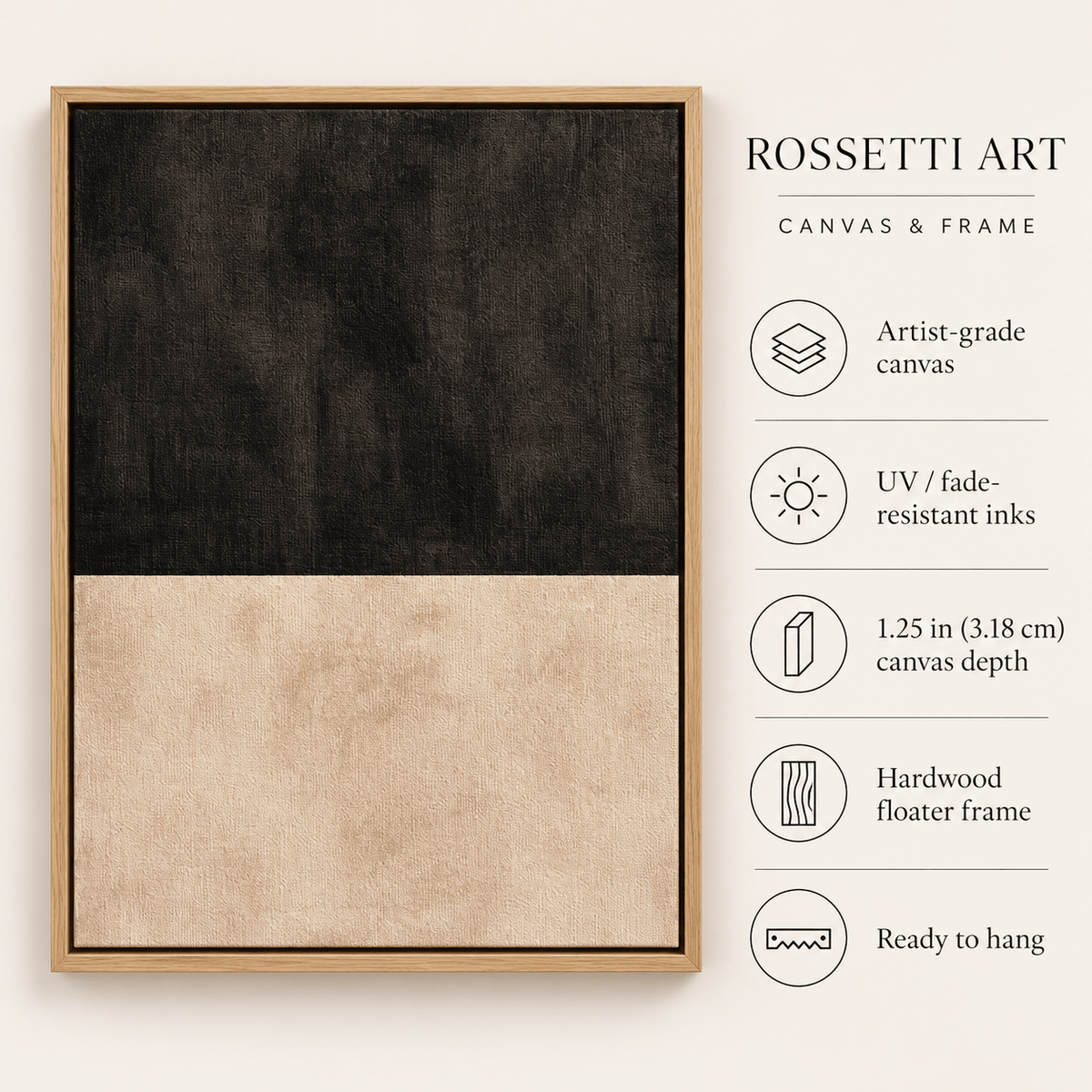
For an understated organic interior, consider Silent Structure. This artwork features ivory, warm beige, taupe, and soft brown tones, available in sizes from 16x24 to 53x75 in. Each piece is printed on artist-grade poly-cotton canvas with UV- and fade-resistant HP latex inks (UL GREENGUARD Gold certified) and hand-stretched over a 1.25-inch hardwood stretcher frame with a satin-matte, low-glare finish. It includes an optional floater frame handcrafted from poplar hardwood with a 5/16 in (8 mm) shadow gap in Black, Oak, Brown, or White, sized to fit the canvas so you do not order a separate frame in the same dimensions. It arrives ready to hang, made to order, with 30-day returns on standard sizes and free worldwide shipping, with US delivery in 5 to 7 business days with tracking.

Silent Structure — ivory, warm beige and taupe.
Framing a Stretched Canvas with an Open-Back Frame
An open-back frame uses traditional outer molding without glass, glazing, or a solid backing board. It allows the rich texture of the canvas weave to remain fully visible while providing a classic finished border.
Because traditional frames were originally designed for thin paper or board, a 1.25-inch deep canvas will often protrude past the rear lip of the frame. Instead of trying to force standard framing points into the wood, install metal offset clips along the back edge. These stepped metal brackets screw into the inner frame molding on one side and the wooden stretcher bars on the other, locking the canvas securely in place.
Never place glass directly over a canvas print, as trapped moisture and lack of airflow can damage the printed surface over time.

Offset clips bridge the height difference between deep wooden stretcher bars and standard frame moldings.
Ensure that the screws used with offset clips do not pierce through the front face of the stretcher bars. Using screws of the appropriate length keeps the front fabric smooth and completely flat.
Framing a Rolled Canvas
A rolled canvas cannot be inserted directly into a frame without first being stretched over a rigid wooden support. Attempting to press unmounted fabric behind glass causes severe rippling and ruins the clean lines of the artwork.
The stretching process requires four interlocking wooden stretcher bars assembled into a square or rectangular base frame. The canvas is laid face down, aligned squarely with the frame, and pulled tight with canvas pliers starting from the center of each side. Heavy-duty staples secure the textile to the reverse side of the bars, working outward toward neatly folded corners to create balanced tension across the entire surface.
Proper canvas tension should create a drum-like feel across the front face without warping the square corners of the stretcher bars.

Stretching provides the uniform tension required before placing fabric artwork into any display molding.
Once your canvas is properly stretched, it can easily slide into either a floater frame or an open-back decorative surround.
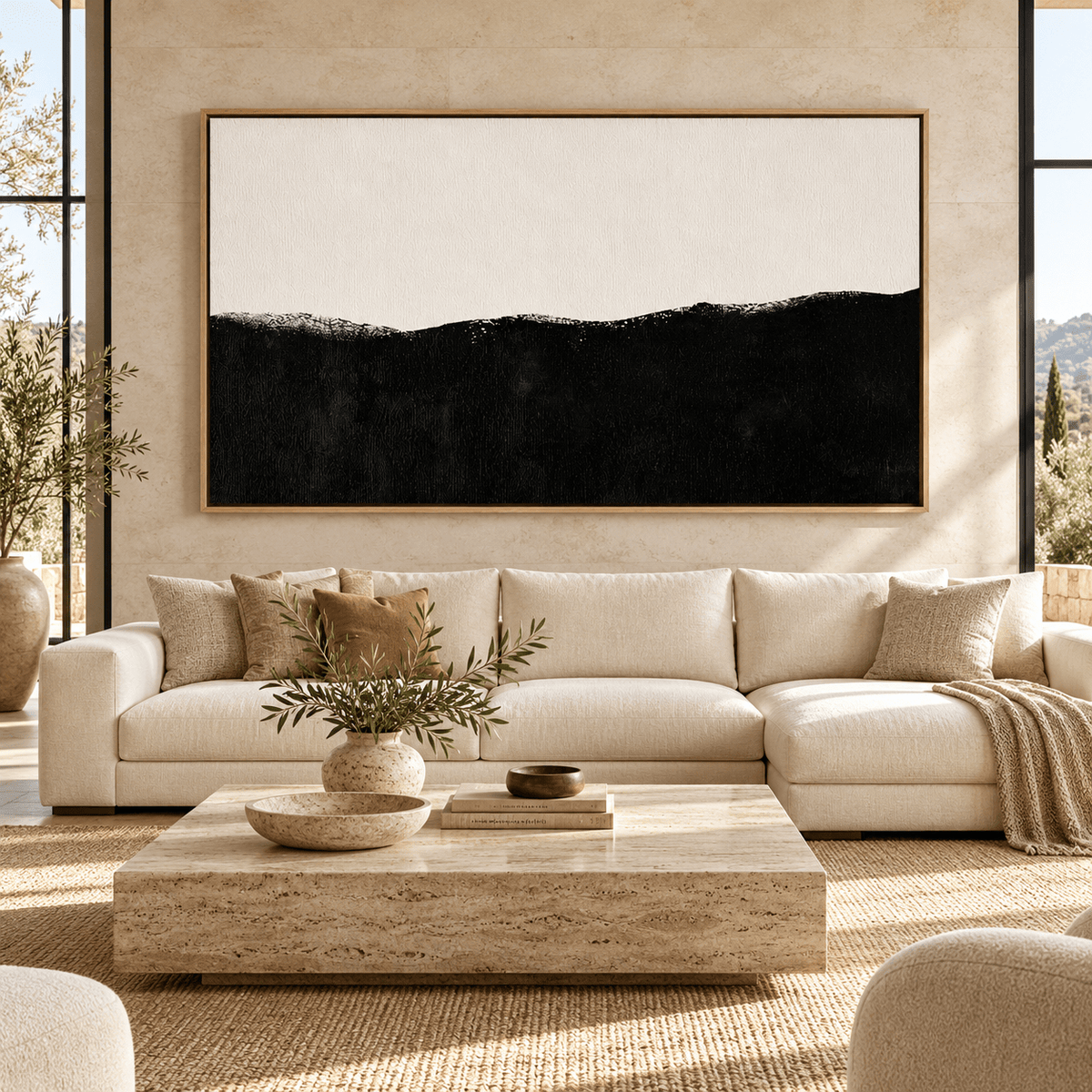
If you prefer dramatic natural scenery, explore Midnight Ridge. Available in sizes from 24x16 to 81x54 in, this design showcases crisp black and ivory contrasts. It is printed on artist-grade poly-cotton canvas using UV- and fade-resistant HP latex inks (UL GREENGUARD Gold certified) and hand-stretched over a 1.25-inch hardwood stretcher frame with a satin-matte, low-glare finish. An optional floater frame handcrafted from poplar hardwood with a 5/16 in (8 mm) shadow gap is available in Black, Oak, Brown, or White, precisely sized to fit the canvas so you do not order a separate frame in the same dimensions. This made-to-order piece arrives ready to hang, with 30-day returns on standard sizes and free worldwide shipping, with US delivery in 5 to 7 business days with tracking.

Midnight Ridge — pure black and ivory.
Which Frame Suits Which Room
Selecting the ideal frame style depends on your existing interior architecture, furniture finishes, and lighting conditions. Different frame formats create distinct moods across living rooms, dining spaces, and entryways.
Floater frames work exceptionally well in modern, minimalist, and Scandinavian-inspired rooms where clean lines take center stage. Open-back frames with wider profiles complement transitional, traditional, or eclectic settings that benefit from substantial ornamentation. To discover ideal finish pairings, review our guide on the Best Floater Frame Colors for Modern Canvas Art.
| Frame type | Works with | Look | Difficulty |
| Floater frame | Stretched canvas | Modern floating look | Straightforward back attachment with basic wood screws |
| Open-back frame | Stretched canvas | Traditional profile | Moderate effort requiring offset clips and depth alignment |
| Rolled canvas with stretching | Rolled canvas print | Custom clean mount | Advanced assembly needing stretching bars and hand tensioning |
| Ready-made framed canvas | Framed artwork order | Fully finished display | Minimal effort arriving pre-mounted and ready to hang |

Pairing frame molding colors with room furniture creates a unified and thoughtful interior aesthetic.
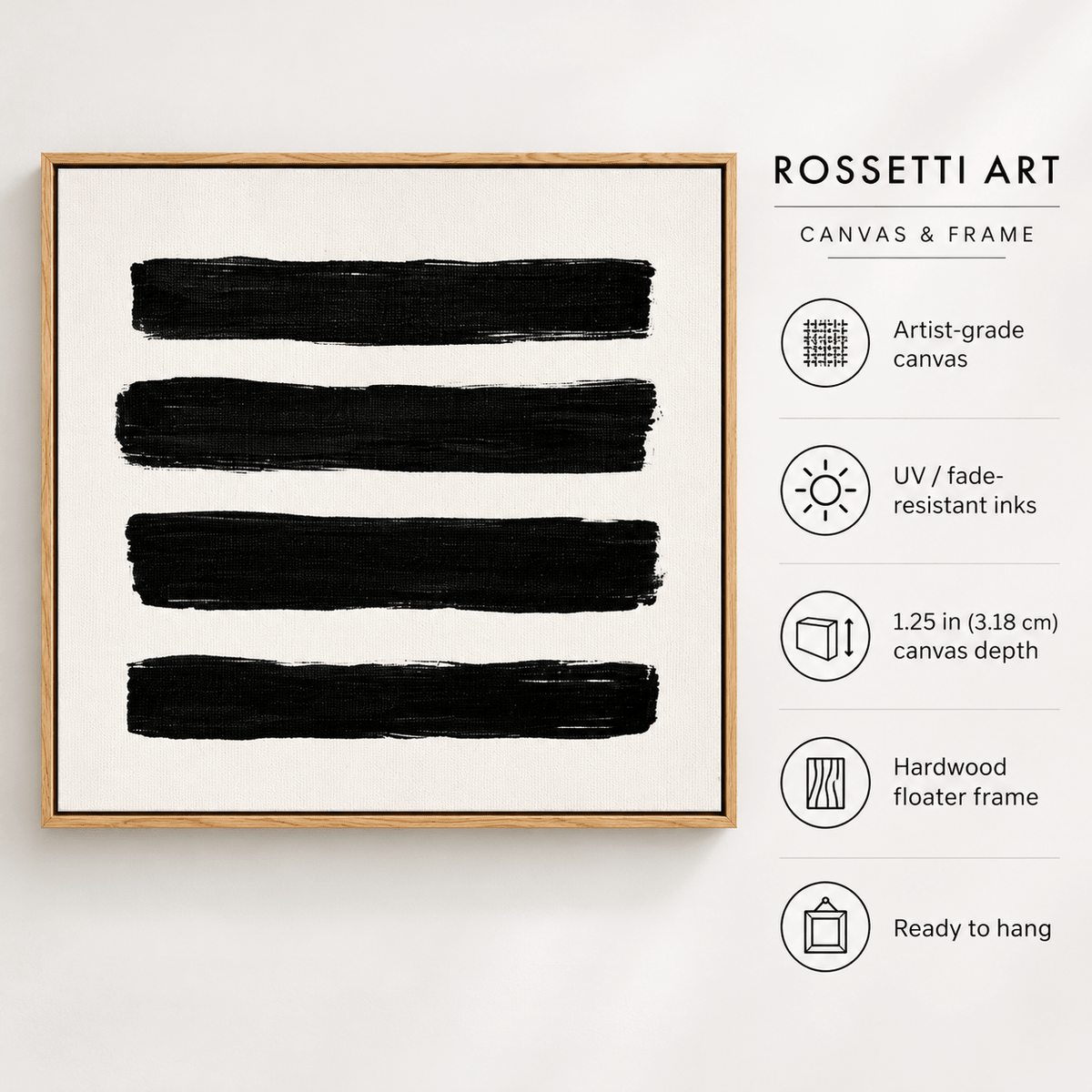
To bring balanced geometric structure to a dining room or living space, look to Crossed Beams. This piece displays bold black strokes on a warm beige ground across sizes from 16x24 to 53x75 in. Hand-stretched over a 1.25-inch hardwood stretcher frame with a satin-matte, low-glare finish, it is printed on artist-grade poly-cotton canvas using UV- and fade-resistant HP latex inks (UL GREENGUARD Gold certified). It features an optional floater frame handcrafted from poplar hardwood with a 5/16 in (8 mm) shadow gap in Black, Oak, Brown, or White, built to order and ready to hang with free worldwide shipping and 30-day returns on standard sizes.

Crossed Beams — bold black strokes on a warm beige ground.
Ready-Made Option: A Canvas That Already Comes with a Floater Frame
Ordering a canvas print that arrives already fitted with a floater frame eliminates the measuring, stretching, and mounting required for raw prints. This complete package delivers a professionally finished presentation straight out of the box.
When you select a pre-framed design, the outer wooden molding is manufactured to match the exact dimensions of the stretched canvas. There is no need to source external hardware, drill pilot holes, or calculate clearance allowances. Everything arrives aligned with balanced shadow margins, pre-installed hanging fixtures, and clean corners.
A striking example of this format is Evening Hourglass. Offering square proportions from 20x20 to 58x58 in, this black and ivory artwork is printed on artist-grade poly-cotton canvas with UV- and fade-resistant HP latex inks (UL GREENGUARD Gold certified). It is hand-stretched over a 1.25-inch hardwood stretcher frame with a satin-matte, low-glare finish. The optional floater frame is handcrafted from poplar hardwood with a 5/16 in (8 mm) shadow gap in Black, Oak, Brown, or White, sized to fit the canvas so you do not order a separate frame in the same dimensions. Every piece is made to order, arrives ready to hang, and includes 30-day returns on standard sizes with free worldwide shipping and US delivery in 5 to 7 business days with tracking.

Evening Hourglass — black and ivory square canvas.
See It on Your Wall Before You Buy
Use your camera to preview framed artwork in your actual living space before making a final selection.
Frequently Asked Questions
Can you frame a canvas print?
Yes, canvas prints can be framed easily using either floater frames or traditional open-back moldings. Stretched canvas mounts into the frame from the rear using screws or clips, while unmounted rolled canvas prints require stretching over internal wooden bars before they can fit into any frame.
What type of frame is best for a canvas painting?
A floater frame is widely considered the best choice for canvas artwork because it showcases the entire composition without covering the edges. It leaves a delicate shadow gap around the perimeter, creating a clean gallery feel that complements both modern and transitional interior styles seamlessly.
Do you need glass to frame a canvas?
No, canvas prints do not require glass and should generally be displayed without it. The textured surface is durable, and sealing canvas behind glass can trap residual moisture, cause reflections that obscure the print, and flatten the appealing texture of the fabric.
Can you frame a rolled canvas print?
A rolled canvas print can certainly be framed, but it must be stretched over wooden stretcher bars first. Mounting loose canvas directly into a frame without tensioning causes sagging, so proper hand-stretching over sturdy bars is an essential first step before final framing.
How do you attach a canvas to a frame?
To attach a stretched canvas into a floater frame, insert wood screws through pre-drilled holes in the back of the frame directly into the stretcher bars. For open-back frames, fasten stepped metal offset clips to secure the raised stretcher bars firmly against the frame molding.
Choosing the Best Framing Path for Canvas Art
Framing a canvas print enhances its visual impact while preserving the physical structure of the artwork. By identifying whether your canvas is stretched or rolled, you can select the right floater frame or open-back molding to complement your home decor.
Keep Reading
About the Author — Chiara Rossetti is the founder of Rossetti Art, a canvas print and original art brand. She writes about interior design, wall art styling, and the art of making a home feel alive.

About the Author
Chiara Rossetti
Chiara Rossetti is the founder of Rossetti Art, a canvas print and original art brand. She writes about interior design, wall art styling, and the art of making a home feel alive.

Leave a comment
This site is protected by hCaptcha and the hCaptcha Privacy Policy and Terms of Service apply.