
Abstract art breaks free from literal representation, using color, form, and texture to express emotions and ideas that transcend the physical world. Rather than depicting recognizable objects, abstract artists communicate through visual elements that evoke feelings and spark imagination, creating a unique dialogue between artwork and viewer.
TL;DR: Quick Answers
- What is abstract art? Art that uses visual elements (color, shape, texture) to express emotions and ideas rather than depicting recognizable objects.
- How to read it: Focus on composition, color relationships, texture, and how it makes you feel rather than trying to "figure it out."
- Best rooms: Living rooms (statement pieces), bedrooms (calming abstracts), offices (structured geometrics), and entryways (vertical pieces).
- How to choose: Select based on emotional response, color harmony with your space, and scale appropriate to your wall.
What Is Abstract Art?
A Clear Definition
Abstract art is a visual language that prioritizes elements like color, line, form, and texture over recognizable imagery. Rather than depicting the physical appearance of people, places, or objects, abstract artists express emotions, concepts, and experiences through non-representational means. This approach creates space for viewers to form their own interpretations based on personal experiences and emotional responses.

Abstract art uses visual elements to communicate directly with viewers' emotions
The power of abstraction lies in its ability to communicate directly with our emotions and subconscious. When Wassily Kandinsky, often credited as a pioneer of abstract art, first moved away from representation, he described it as expressing "inner necessity" – the spiritual and emotional impulses that transcend physical reality.
What Abstract Art Is Not
Despite its century-long history, abstract art still faces misconceptions. Understanding what abstract art is not helps clarify its true nature and value:
- Not random or meaningless – Abstract works involve deliberate choices about composition, color relationships, and visual balance.
- Not "something anyone could make" – Creating effective abstract art requires understanding of visual principles, technique, and artistic intent.
- Not a rejection of skill – Many abstract artists mastered traditional techniques before developing their abstract styles.
- Not meant to be "figured out" like a puzzle – The value lies in the emotional and aesthetic experience rather than identifying specific objects.
Abstract art invites us to experience rather than analyze, to feel rather than decipher. As you explore this art form, remember that your emotional response is a valid and important part of the experience. Learn more about the fundamentals in our article on Understanding Abstract Art: Definition, Characteristics, and Abstraction.
A Short Timeline of Abstract Art
| Period | Key Developments | Notable Artists |
| Early Experiments (1900-1910) | Cubism fragments reality; Fauvism explores expressive color; artists begin moving away from literal representation | Picasso, Braque, Matisse |
| Early Abstraction (1910-1925) | First fully abstract works appear; Kandinsky develops theory of color and emotion; geometric abstraction emerges | Kandinsky, Mondrian, Malevich, Hilma af Klint |
| Between Wars (1925-1945) | Surrealism influences abstraction; Bauhaus school promotes abstract design principles; abstract art spreads globally | Miró, Klee, Moholy-Nagy |
| Post-War Abstraction (1945-1965) | Abstract Expressionism emerges in America; Action painting and Color Field painting develop; abstraction becomes dominant | Pollock, Rothko, de Kooning, Frankenthaler |
| Minimalism & Beyond (1965-1980) | Minimalism reduces art to essential forms; Hard-edge painting emphasizes clean lines and flat color | Agnes Martin, Frank Stella, Ellsworth Kelly |
| Contemporary Abstraction (1980-Present) | Digital tools expand possibilities; abstract art incorporates diverse cultural influences; boundaries between abstraction and other styles blur | Gerhard Richter, Julie Mehretu, Cecily Brown |

The evolution of abstract art through major movements and periods
How to "Read" Abstract Art in 60 Seconds
Many viewers feel intimidated when facing abstract art, unsure of what they're "supposed" to see. This practical checklist helps you engage with abstract works confidently, focusing on the visual elements that create meaning and impact.
Abstract Art Reading Checklist
- Composition: Notice how elements are arranged. Is there balance or intentional imbalance? Tension or harmony? Symmetry or asymmetry? The arrangement creates the visual rhythm of the piece.
- Color Temperature & Contrast: Observe the color palette. Warm colors (reds, oranges, yellows) advance and energize, while cool colors (blues, greens, purples) recede and calm. High contrast creates drama; subtle transitions suggest serenity.
- Rhythm & Pattern: Look for repetition, grids, or patterns. These create visual movement and can suggest order, growth, or progression.
- Gesture & Mark-making: Notice the quality of lines and brushwork. Bold, energetic marks suggest movement and emotion; precise, controlled lines convey order and restraint.
- Negative Space: Pay attention to the empty areas. How do they interact with the painted elements? Negative space is an active component of composition.
- Scale Effect: Step back and observe how the piece changes from different distances. Some abstracts reveal different aspects up close versus from across the room.
After exploring the piece with this checklist, trust your intuitive response. Abstract art creates a direct conversation between artist and viewer through visual elements rather than narrative content. Your personal reaction is a valid part of the artwork's meaning.
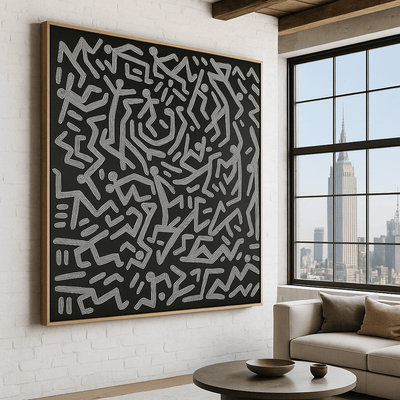
Modern Abstract Canvas Print for Living Room – Bold geometric forms create visual energy perfect for contemporary spaces

Abstract Minimalist Art Black and White: Eclipse Symmetry – Subtle balance and contrast create a sophisticated focal point
Types of Abstract Art (with a Style Matrix Table)
Abstract art encompasses diverse approaches, each with distinct visual characteristics and emotional impacts. Understanding these styles helps you identify what resonates with you and where it might work best in your space.
| Type | Visual Cues | Best Rooms | Best Palettes to Pair With | Mood | Recommended Pieces |
| Geometric Abstraction | Precise shapes, clean lines, mathematical order, grid-like structures | Living room, office, modern kitchen | Monochrome, primary colors, architectural neutrals | Architectural, structured, intellectual | Canvas Print: Celestial Mosaic |
| Minimalist Abstraction | Reduced elements, limited palette, essential forms, subtle variations | Bedroom, meditation space, minimalist living room | Tonal neutrals, warm minimalism, Japanese-inspired | Serene, contemplative, refined | Lunar Silence – Minimalist Abstract Painting |
| Abstract Expressionism | Gestural brushwork, emotional color, spontaneous marks, dynamic energy | Living room, creative studio, energetic spaces | Bold color, eclectic mix, dramatic contrasts | Energetic, emotional, expressive | Original Painting: Color Symphony |
| Biomorphic Abstraction | Organic shapes, nature-inspired forms, flowing lines, biological references | Dining room, sunroom, spaces connecting to nature | Earthy tones, botanical greens, natural materials | Organic, flowing, natural | Original Painting: Verdant Silence |
| Color Field-inspired | Large areas of solid color, atmospheric quality, subtle transitions | Bedroom, meditation space, reading nook | Monochromatic, tonal variations, subtle contrasts | Immersive, meditative, atmospheric | Canvas Print: Solar Flow |
| Textural Neutral | Tactile surfaces, material emphasis, subtle color variations, layered effects | Transitional spaces, sophisticated living rooms, luxury bedrooms | Warm neutrals, metallics, natural textures | Sophisticated, tactile, grounding | Original Painting: Desert Lines |
These categories often overlap, with many contemporary artists blending multiple approaches. Learn more about specific styles in our articles on Abstract Expressionism, Abstract Geometric Wall Art, and Minimalist Abstract Paintings.

Comparison of three major abstract styles: geometric precision, expressionist energy, and minimalist restraint
Abstract Art vs Modern vs Contemporary
The terms "abstract," "modern," and "contemporary" are often used interchangeably in art discussions, but they refer to distinct concepts. Understanding these differences helps you communicate more precisely about your preferences and make informed choices.
Abstract Art
Definition: Art that does not attempt to represent visual reality accurately but uses shapes, colors, forms, and gestural marks to achieve its effect.
Time Period: Emerged in early 20th century but continues today.
Key Point: Refers to a style approach rather than a time period.
Modern Art
Definition: Art created during the "Modern" period, roughly from the 1860s to the 1970s.
Time Period: A historical era that includes many movements (Impressionism, Cubism, Abstract Expressionism, etc.).
Key Point: Not all modern art is abstract, though abstraction was a significant development within modernism.
Contemporary Art
Definition: Art produced in our lifetime, generally from the late 20th century to the present.
Time Period: Constantly evolving; what's "contemporary" shifts with time.
Key Point: Includes both abstract and representational approaches; often blends multiple styles and media.
The confusion often arises because abstract art developed during the modern period and continues to evolve in contemporary practice. A piece can be both abstract and contemporary, or abstract and modern, depending on when it was created and its stylistic approach. For a deeper exploration of these distinctions, visit our article on Understanding the Difference Between Modern and Contemporary Art.
How to Decorate With Abstract Art (Room-by-Room)
Abstract art's versatility makes it suitable for virtually any space, but different rooms benefit from different approaches. Here's how to select and place abstract pieces throughout your home for maximum impact.
Living Room
As the heart of most homes, living rooms offer prime opportunities for statement abstract pieces that anchor your design scheme and spark conversation.
- Scale matters: Choose larger pieces (or groupings) that command attention without overwhelming the space.
- Focal point placement: Position above sofas, fireplaces, or central walls where the eye naturally lands.
- Color connection: Select art that pulls from and enhances your existing color palette.
Quick Styling Tip
For living rooms with neutral furniture, choose abstract art with bold color to create a dynamic focal point. The artwork becomes the room's personality center while the neutral furnishings provide balance.

Canvas Print: Solar Pulse creates a vibrant focal point in this contemporary living room
Bedroom
Bedrooms call for abstract art that supports rest and reflection, with compositions and colors that promote the desired mood.

Original Painting: Silent Geometry brings subtle texture and calm to this restful bedroom
- Consider the mood: For restful spaces, choose pieces with harmonious compositions and soothing color palettes.
- Size appropriately: Above beds, select art that's approximately 2/3 the width of the headboard for visual balance.
- Personal connection: Bedroom art should resonate with you emotionally, as it's the last thing you see before sleep and first upon waking.
Office
Work spaces benefit from abstract art that stimulates creativity while maintaining focus and clarity.
- Structure and clarity: Geometric abstractions with clear compositions can promote ordered thinking.
- Eye-level placement: Position art where you can easily glance up from your work for visual refreshment.
- Inspirational energy: Choose pieces that energize rather than distract.

Original Painting: Ethereal Motion adds sophisticated energy to this focused workspace
Hallway / Entry
Transitional spaces offer unique opportunities for abstract art that creates movement and first impressions.
- Vertical emphasis: Hallways often benefit from taller pieces that enhance ceiling height.
- Series potential: Long hallways provide perfect galleries for related abstract works that create rhythm.
- First impressions: Entryway art sets the tone for your entire home – choose pieces that reflect your overall aesthetic.
For more detailed guidance on integrating abstract art throughout your home, explore our articles on Decorate Your Home Ideas: Modern Abstract Wall Art Looks for Every Room and Home Decor Ideas with Modern Abstract Wall Art.
Frequently Asked Questions
What is abstract art in simple terms?
Abstract art is visual art that doesn't try to look exactly like things in the real world. Instead of painting recognizable objects, abstract artists use colors, shapes, lines, and textures to express feelings, ideas, or experiences. It's like visual poetry – communicating through form and color rather than through realistic images.
Why is abstract art valuable if it doesn't "look like anything"?
Abstract art's value lies in its ability to communicate directly with our emotions and subconscious. It can express complex feelings, concepts, and experiences that realistic imagery might not capture as effectively. Additionally, abstract art often showcases innovative approaches to composition, color relationships, and material techniques that advance artistic practice.
What are the main characteristics of abstract art?
Key characteristics include: non-representational imagery (not depicting recognizable objects), emphasis on visual elements like color, line, shape, and texture, focus on composition and visual relationships, expression of emotions or concepts rather than narrative content, and freedom from conventional perspective or proportions.
What's the difference between abstract art and abstract expressionism?
Abstract art is the broader category encompassing any non-representational artwork. Abstract expressionism is a specific movement within abstract art that emerged in America after World War II, characterized by spontaneous, emotional application of paint, gestural brushwork, and an emphasis on conveying the artist's psychological state. Abstract expressionism is a type of abstract art, but not all abstract art is expressionist.
How do I choose abstract art colors for my room?
Start by considering your existing color palette – you can either complement it with harmonious colors or create contrast with complementary hues. Consider the mood you want to create: cool blues and greens tend to be calming, while warm reds and oranges energize. For versatility, choose abstract pieces with multiple colors that include at least one shade present in your room's existing scheme.
What size abstract canvas should I pick for above a sofa/bed?
For above a sofa, choose a piece (or grouping) that's approximately 2/3 to 3/4 the width of the sofa, but never wider. The bottom edge should hang 8-10 inches above the sofa back. For beds, select art that's about 2/3 the width of the headboard, centered, with the bottom edge 8-12 inches above the headboard. When in doubt, larger pieces generally create more impact than smaller ones.
How do I style a gallery wall with abstract prints?
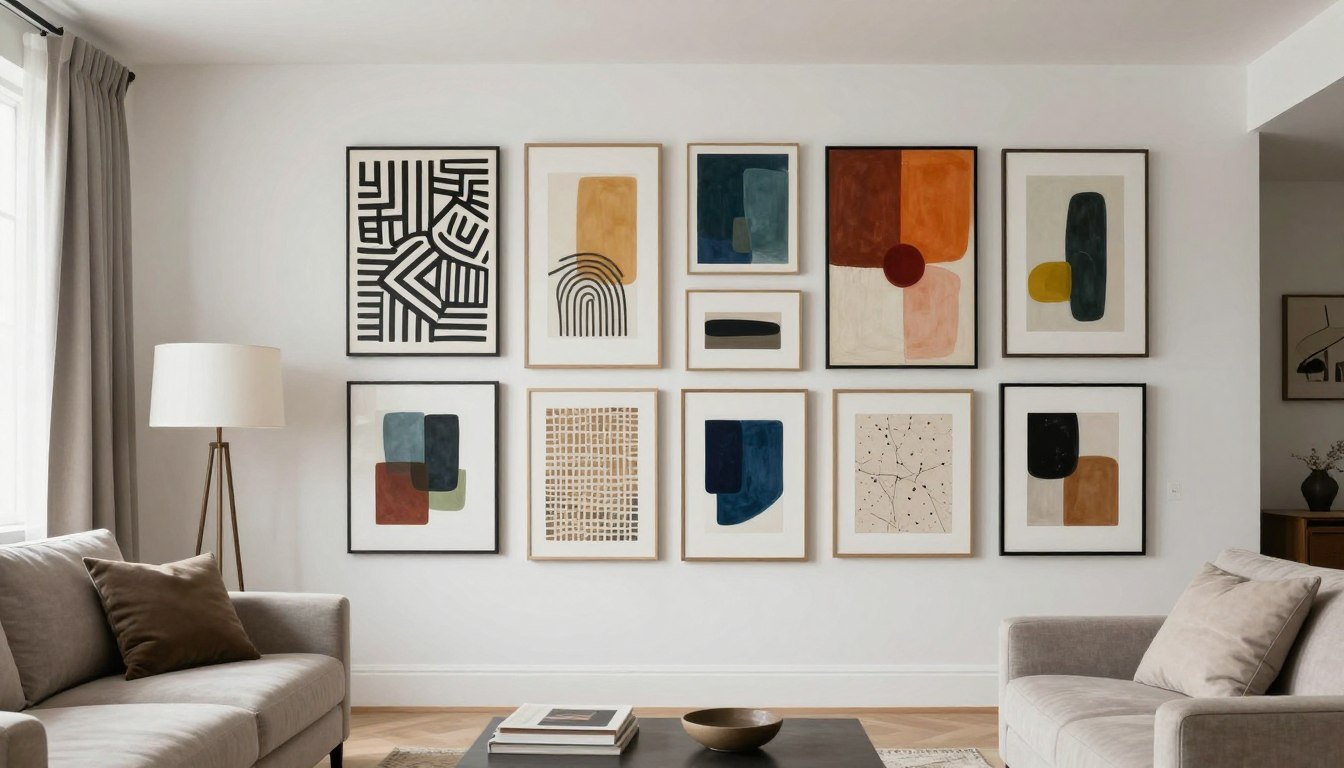
Create cohesion by choosing pieces with a connecting element – similar color palette, complementary styles, or unified framing. Arrange pieces on the floor first to experiment with layout. For visual balance, place larger or bolder pieces toward the center and smaller works around them. Maintain consistent spacing (2-3 inches) between frames, and consider using a template made from kraft paper to test the arrangement on your wall before hanging.
Is minimalist art a type of abstract art?
Yes, minimalist art is generally considered a subset of abstract art. Minimalism emerged in the 1960s, characterized by extreme simplification of form, use of basic geometric shapes, and elimination of expressive content. While not all minimalist art is abstract (some includes recognizable forms), the movement's emphasis on essential elements and rejection of representation aligns it closely with abstract principles.
Embracing the Abstract Journey
Abstract art offers a unique opportunity to connect with visual expression on an intuitive, emotional level. As you explore this rich artistic tradition, remember that there's no "correct" interpretation – your personal response to a piece is valid and valuable. Whether you're drawn to the structured clarity of geometric abstraction, the emotional intensity of expressionism, or the serene presence of minimalist works, abstract art can transform your space while engaging your imagination.
We invite you to explore our curated collection of abstract pieces, each selected to bring distinctive energy and visual interest to your home. From vibrant statement pieces that anchor living spaces to serene compositions that enhance private retreats, you'll find abstract works that resonate with your aesthetic vision and complement your interior design.
Find Your Perfect Abstract Piece
Discover canvas prints and original paintings that speak to your space and sensibility.
Browse Canvas Prints Explore Original Paintings
The right abstract piece becomes the soul of your space, creating visual interest and emotional resonance

About the Author
Chiara Rossetti
Chiara Rossetti is the founder of Rossetti Art, a canvas print and original art brand. She writes about interior design, wall art styling, and the art of making a home feel alive.


Leave a comment
This site is protected by hCaptcha and the hCaptcha Privacy Policy and Terms of Service apply.