Warm Minimalism Interior Design: The Complete Guide (With Wall Art Ideas)
Warm minimalism interior design has become the antidote to the stark, sterile version of minimalism that dominated the last decade. Instead of white walls and empty corners, warm minimalism keeps the same restraint and calm — fewer objects, more breathing room — but replaces the cold palette with sand, cream, walnut, and clay. It's minimalism you actually want to come home to.
If you've ever loved the idea of a simple, uncluttered room but felt like true minimalism looked more like a waiting room than a home, this is the style you've been reaching for. Below, we'll walk through exactly what warm minimalism is, where it came from, the materials and colors that define it, and — since a room this pared-back lives or dies by its one or two statement pieces — how to choose wall art that actually earns its place on a warm minimalist wall.
Original Minimalist Textured Paintings
Shop the Collection →What Is Warm Minimalism?
Traditional minimalism, as it was popularized in the 2010s, prized emptiness for its own sake: glossy white surfaces, sharp black accents, glass and steel. It photographed beautifully but rarely felt like somewhere you wanted to linger. Warm minimalism interior design keeps minimalism's core discipline — fewer, better things, generous negative space, no visual clutter — and swaps the materials for ones with actual warmth: raw wood, boucle and linen textiles, handmade ceramics, and a neutral palette built from sand, oat, clay, and soft charcoal rather than pure white and black.
The result reads less like a showroom and more like a considered, calm home. It's why warm minimalism has become one of the most searched interior design styles of 2026 — people want the simplicity without the sterility.
Where Warm Minimalism Came From
Warm minimalism didn't appear overnight. It's the natural convergence of a few design movements that were already circling the same idea. Scandinavian design contributed hygge — the idea that a simple room can still feel emotionally warm through texture and soft lighting. Japanese wabi-sabi contributed an appreciation for natural imperfection: a hand-thrown ceramic bowl, a hand-painted canvas with visible brushwork, a raw linen weave. And a broader cultural fatigue with the "Instagram minimalism" of all-white apartments pushed designers toward richer, earthier neutrals.
By 2024–2026, these threads had merged into a recognizable aesthetic with its own name. Design publications and interior stylists now treat warm minimalism as a distinct category — separate from both maximalism and the colder minimalism that preceded it — built around restraint plus warmth rather than restraint plus sterility.
The Core Elements of Warm Minimalism
The look rests on four pillars. Get these right and a room will read this way even with very few pieces in it.
1. A Warm Neutral Palette
Instead of true white and black, this palette works from a tighter, warmer range: cream, sand, oat, taupe, soft terracotta, walnut brown, and the occasional deep charcoal or forest green as a grounding accent. Every color in the room should sit comfortably next to raw wood — that's the quickest gut-check for whether a shade belongs.
2. Natural, Tactile Materials
Linen, boucle, raw or lightly oiled wood, travertine, rattan, and unglazed ceramic do the heavy lifting. These materials bring warmth and texture into a room without adding visual noise — a linen sofa reads as "simple" the same way a glossy leather one does, but it feels entirely different to live with.
3. Negative Space, Used Intentionally
Minimalism's core rule still applies: not every wall needs to be filled, not every shelf needs an object. But here, negative space is framed by warm materials rather than cold ones, so it feels restful instead of empty.
4. One or Two Statement Pieces, Never a Dozen Small Ones
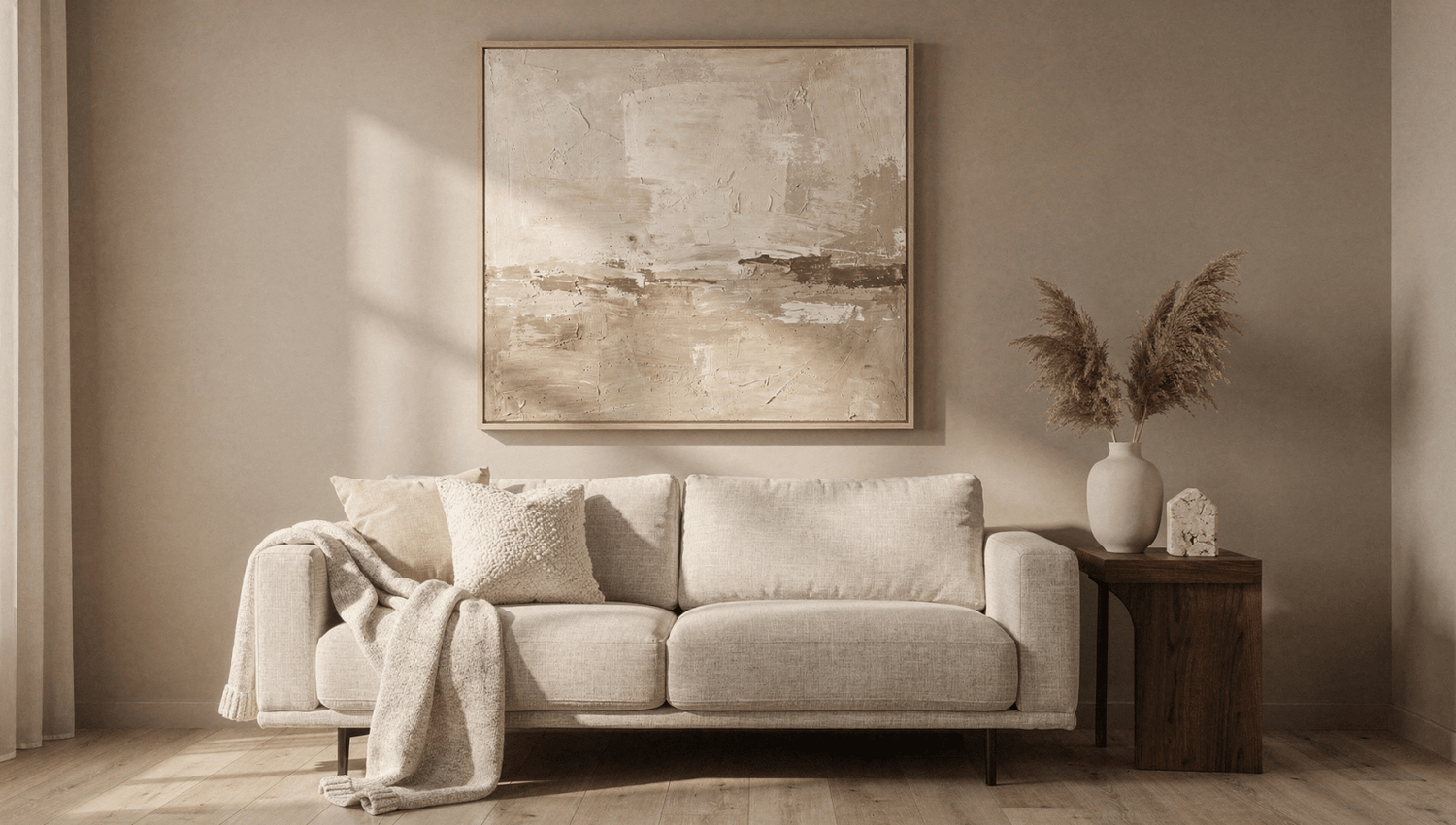
Because a room built this way has so little going on, whatever is in it carries real weight. This is exactly why wall art choice matters more here than in almost any other style — a single large, textured, neutral abstract canvas print does more for a living room built around this aesthetic than five small frames ever could.
How to Choose Wall Art for a Warm Minimalist Room
Because a room like this is edited down to so few elements, the wall art you choose is doing a disproportionate amount of the room's visual work. A few guidelines that consistently work:
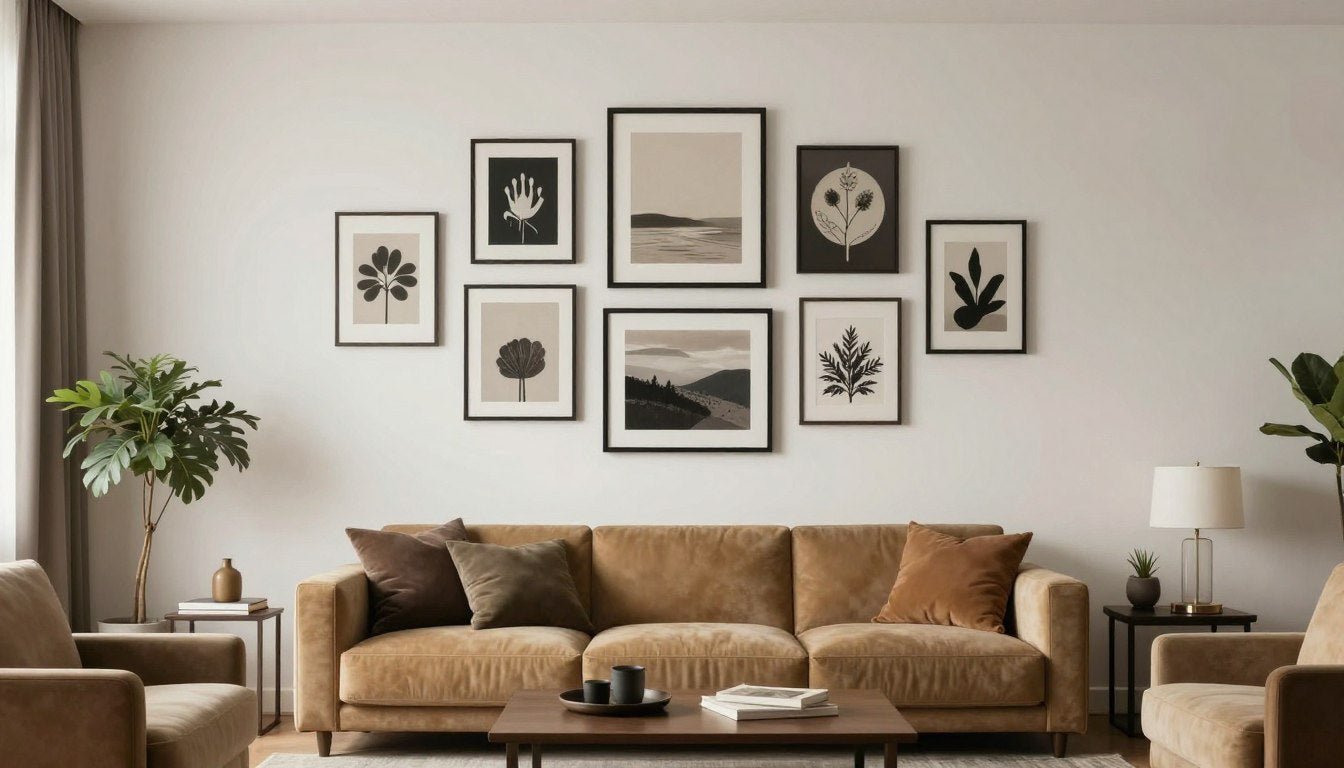
- Go bigger than feels comfortable. One generously sized piece reads as intentional; several small ones read as clutter, even in a warm palette.
- Stay inside the warm neutral family. Cream, sand, taupe, soft rust, and warm charcoal all work. Cool blues, bright whites, and neon accents break the mood immediately.
- Look for texture in the piece itself. A textured, tactile canvas — visible brushwork, raised plaster-like layers, an organic abstract form — does more for this look than a flat, glossy print, because it echoes the room's other materials.
- Let the frame matter. A hand-stretched canvas in a poplar hardwood floater frame keeps the piece feeling handmade and grounded rather than mass-produced — exactly the quality this whole aesthetic is built on.
Rossetti Art's Wabi Sabi Textured Painting — Quiet Ridges is a good example of the kind of piece this style calls for: a hand-painted, heavily textured cream and sand abstract that reads as calm from across the room and richly detailed up close. For a slightly more graphic option, the Neutral Abstract Painting — Threshold keeps the same warm palette with a bit more structure, which suits rooms with strong architectural lines.
If you're unsure how large to go, use our Wall Art Size Calculator guide — as a rule of thumb, a piece above a sofa should span roughly two-thirds to three-quarters of the furniture's width, and warm minimalist rooms tend to look better erring toward the larger end of that range.
Wabi-Sabi Wall Art Paintings
Shop the Collection →Warm Minimalism Room by Room
Living Room
This is where the style is easiest to apply and easiest to get wrong. A linen or boucle sofa in oat or cream, a walnut coffee table, one large textured neutral canvas above the sofa, and almost nothing else. The temptation is to add "just one more" accent piece — resist it. The Minimalist Wall Art Canvas Print — Teal Orbit works well here for a slightly more contemporary living room that still holds the warm-neutral rule.
Bedroom
Applied to a bedroom, this look leans even further into softness — unbleached linen bedding, a low upholstered frame, warm wood nightstands, and a single oversized piece above the headboard rather than a gallery wall. The Minimalist Abstract Landscape — Ember Fields, with its soft rust and sand tones, was practically designed for this exact placement.
Entryway
Entryways are small, high-traffic, and the first impression of the whole home — which makes them a natural fit for the "one strong piece, nothing else" philosophy at the heart of this style. A narrow console in raw oak, a single ceramic vessel, and one vertical textured canvas is enough.
Home Office
This approach works especially well in home offices because visual calm translates directly into mental calm. A single grounding piece behind the desk — something textured and quiet rather than busy or graphic — keeps video calls looking intentional without looking staged.
A closer look at how designers build a warm minimalist palette room by room.
Warm Minimalism vs. Japandi vs. "Cold" Minimalism
These three get confused constantly, so it's worth being precise. Cold, traditional minimalism is the white-walls-glass-and-chrome version — restraint with no warmth added back in. Warm minimalism is the broader corrective trend: the same restraint, but rebuilt with warm neutrals and natural materials, and it isn't tied to any single cultural aesthetic. Japandi is a specific style within that same warm-minimalist family — a deliberate fusion of Japanese wabi-sabi and Scandinavian hygge, with its own conventions around low furniture, natural wood tones, and asymmetry.
Put simply: every Japandi room is warm minimalist, but not every warm minimalist room is Japandi. If you want the specific Japanese-Scandinavian rules and pairings, our Japandi Wall Art guide goes deep on that narrower style. If you're after the broader warm-neutral, texture-forward look without the specific cultural framing, this guide — and pieces from our Original Abstract Paintings collection — is the better starting point. For living rooms specifically, our guide to choosing neutral wall art for a living room covers the sizing and undertone questions in more depth.
Caring for Your Warm Minimalist Pieces
Because rooms like this rely on so few statement pieces, protecting the investment matters. Every Rossetti Art canvas print is produced with UV- and fade-resistant HP latex inks designed to resist fading under normal indoor lighting, and hand-stretched over a kiln-dried hardwood frame so the canvas stays taut without warping. Original paintings ship ready to hang, ready to display immediately in the finished poplar hardwood floater frame we build for every piece. Keep any canvas or original painting out of direct sun exposure, dust gently with a dry microfiber cloth, and avoid hanging near a working fireplace or radiator, since sustained heat can dry out the canvas over time.
Common Mistakes When Trying This Look
Because so little is happening in a warm minimalist room, small missteps show up immediately. These are the four that come up most often:
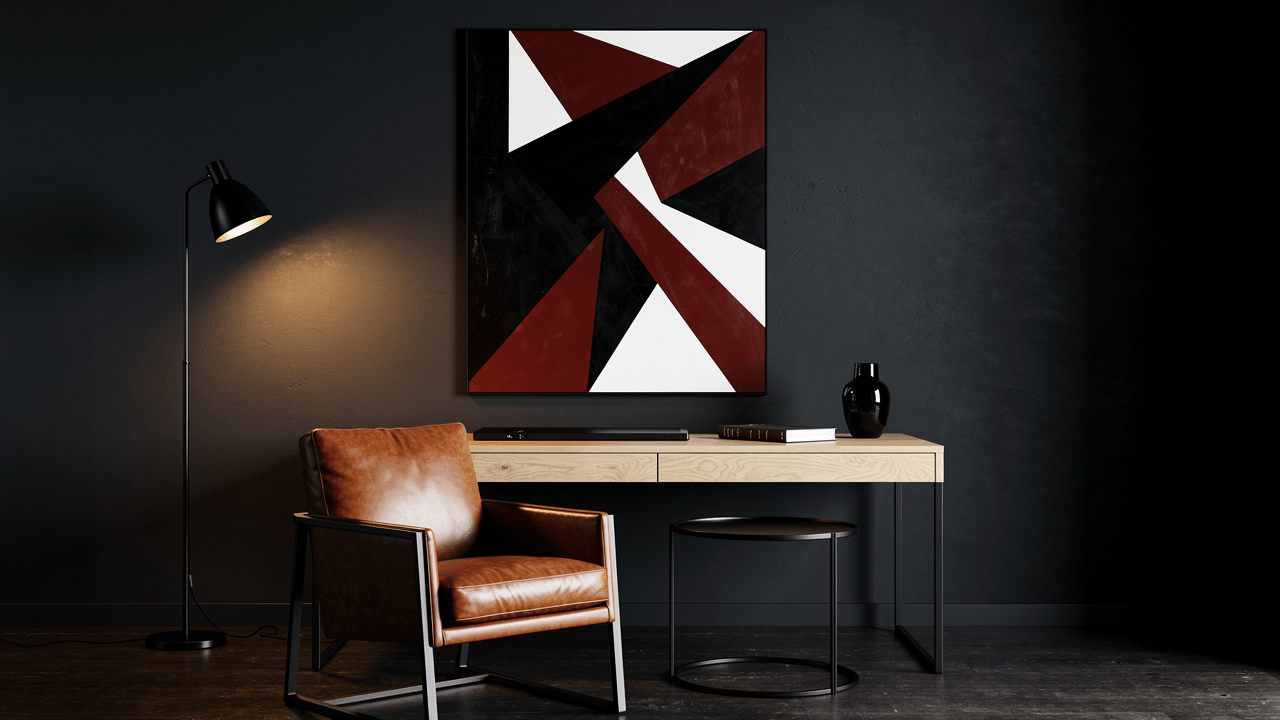
- Going too cool with the "minimalist" half. Grey concrete floors, black steel shelving, or icy white paint will fight the warm half of the equation every time. If a material or finish reads as industrial or clinical, it belongs in a different style.
- Choosing wall art that's too small. A small, delicate frame gets visually lost the moment a room is this pared-back. Undersized art is the single most common reason a warm minimalist room ends up looking unfinished rather than intentional.
- Confusing "minimal" with "empty." A room with nothing on the walls doesn't read as calm — it reads as unfinished. The negative space in this style is meant to frame a small number of considered pieces, not replace them entirely.
- Mixing in too many textures at once. Boucle, rattan, linen, and raw wood all work together, but stacking five different textures in one small room starts to look busy rather than curated. Pick two or three and repeat them.
Getting the wall art right is usually the fastest fix for all four. A single, appropriately sized, texture-rich piece in a warm neutral tone does the work of a dozen smaller decorating decisions — it sets the palette, adds the texture, and fills the negative space with something considered instead of leaving it blank.
Our Warm Minimalism Wall Art Picks


Every piece above is available as a gallery-quality, made to order canvas print or original painting — nothing sits in a warehouse waiting to be shipped, and every size is built specifically for your wall. If you want to see exactly how a piece will look at true scale before you order, use Live Preview on any product page to place the artwork directly on a photo of your own room.
Original Abstract Paintings
Shop the Collection →Frequently Asked Questions
What is warm minimalism?
Warm minimalism is an interior design style that pairs minimalism's restraint — few objects, generous negative space — with warm, natural materials and a sand-and-walnut color palette, instead of the stark white-and-chrome look of traditional minimalism.
How is warm minimalism different from regular minimalism?
Traditional minimalism is built on cool, often stark neutrals (pure white, black, glass, chrome). Warm minimalism keeps the same "less but better" philosophy but replaces those materials with linen, raw wood, travertine, and warm earth tones like cream, sand, and terracotta.
Is warm minimalism the same as Japandi?
Not quite. Japandi is a specific style within the broader warm minimalism trend — it fuses Japanese wabi-sabi with Scandinavian hygge and follows its own conventions. Warm minimalism is the wider umbrella; you can build a warm minimalist room without following Japandi's specific rules.
What colors define a warm minimalist palette?
Cream, sand, oat, taupe, soft terracotta, and walnut brown, usually grounded by one deeper accent like charcoal or forest green. The test is simple: if a color looks good next to raw or lightly oiled wood, it belongs.
What kind of wall art fits a warm minimalist room?
One large, textured, neutral-toned abstract piece — a hand-stretched canvas print or original painting in a poplar hardwood floater frame — does more for a warm minimalist room than several smaller pieces. Look for visible texture or brushwork so the piece echoes the room's other tactile materials.
Is warm minimalism still popular in 2026?
Yes — search interest in warm minimalism interior design has grown significantly through 2025 and into 2026, as more people move away from the starker, colder minimalism of the previous decade toward something that photographs simply but lives warmly.
Ready to bring warm minimalism home?
Shop Minimalist Textured Paintings →Warm minimalism works because it asks less of a room and more of the few things left in it. Start with a warm neutral palette, add natural texture through fabric and wood, and choose one wall art piece that can carry the whole room. Explore our Original Abstract Paintings and Wabi-Sabi Wall Art collections to find the piece that anchors yours.
Keep Reading
- Japandi Wall Art: Warm Minimalism for Modern Homes
- How to Choose Neutral Wall Art for a Living Room
- Wabi-Sabi Interior Design: Embrace the Beauty of Imperfection
- 10 Tips to Create a Minimalist Home
About the Author — Chiara Rossetti is the founder of Rossetti Art, a canvas print and original art brand. She writes about interior design, wall art styling, and the art of making a home feel alive.

Leave a comment
This site is protected by hCaptcha and the hCaptcha Privacy Policy and Terms of Service apply.