How to Choose the Right Size Art for Your Walls: A Room-by-Room Sizing Guide
Have you ever found a painting you love, then wondered whether it will look lost on your wall or overwhelm the room? The right scale can make the difference between a finished home and a space that still feels unfinished.
Quick Answer: How to Choose Art for Your Home
Measure the wall or furniture first, then choose art that fills about two-thirds of the available width above it. In most rooms, place the center of the art 57–60 inches from the floor and leave 5–8 inches between the art and nearby furniture. Choose a subject you genuinely love, and use scale to make it feel balanced.
In this article:
- The basic principles of art scale
- How to measure your wall before buying
- Living room art sizes
- Bedroom art sizes
- Dining rooms, entryways, and offices
- Large and open-plan spaces
- Choose art that feels authentic
- Common sizing mistakes to avoid
- Key takeaways
- Frequently Asked Questions
The Basic Principles of Choosing Art for Your Home
Art should relate to the wall, the furniture, and the room around it. It does not need to match every color in your home. It does need enough visual weight to feel intentional.
Start with the wall, not the empty frame
A broad wall can make a small piece look accidental. A narrow wall can make a wide piece feel crowded. Look at the usable wall space after accounting for windows, shelves, doors, sconces, and trim.
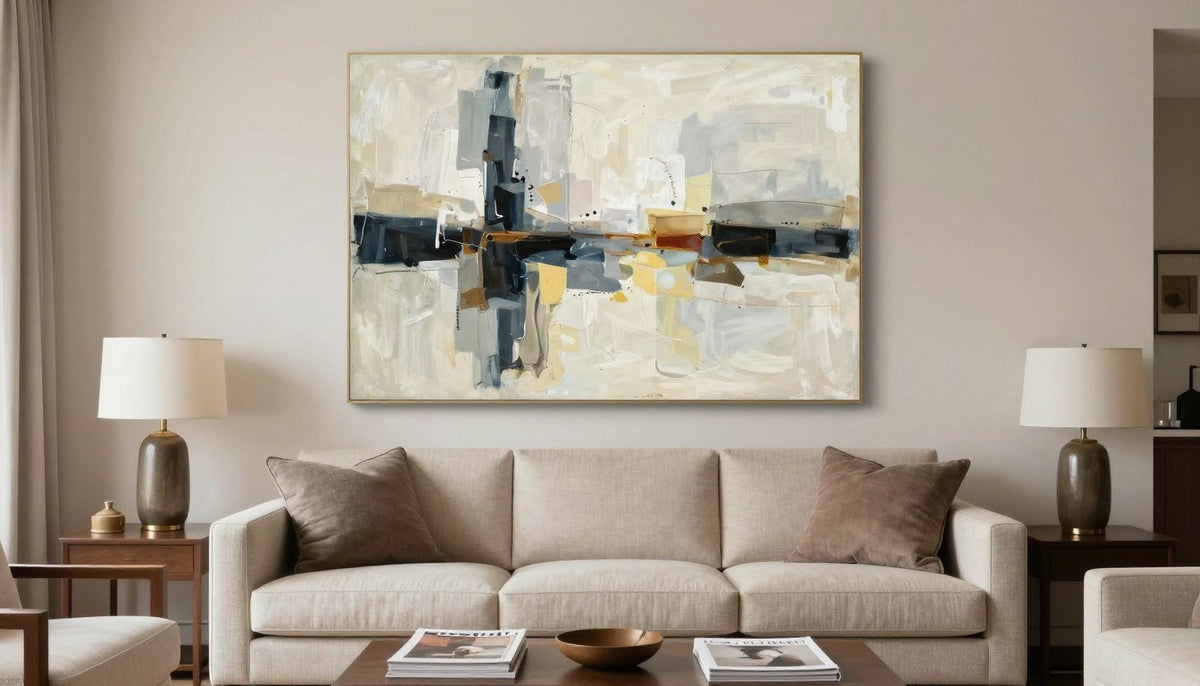
For art above a sofa, bed, console, or sideboard, use the two-thirds-width rule. The total width of one piece or a group of pieces should usually be about 65% to 75% of the furniture below it. This proportion creates a comfortable visual relationship.
One statement piece or a gallery wall?
A single oversized statement piece often works best when the wall is broad and the room has simple furniture. It gives the eye one clear focal point. A gallery wall can suit a collected room, a narrow stair wall, or a group of smaller pieces with a shared story.
Do not choose a gallery wall only because one small frame feels safer. Several small pieces still need enough total width and visual weight. If you want a calmer, more current look, one large canvas can create impact with less visual noise.

Consider negative space and visual weight
Negative space is the breathing room around an object. It helps a strong subject feel intentional. Leave enough space at the sides of art so it does not appear pressed against corners or architectural features.
Visual weight also depends on color, contrast, frame depth, and subject matter. A dark painting may feel larger than a pale one of the same size. A detailed work can carry more weight than a quiet, minimal composition.
Ceiling height matters too. In a room with tall ceilings, a vertical piece or stacked arrangement can use the height well. In a low room, a horizontal work may make the wall feel wider without drawing attention upward. Architectural Digest's hanging-art guidance offers another useful reference when you are comparing proportion and placement.
How to Measure a Wall Before You Buy Art
Measuring takes a few minutes and can prevent an expensive mistake. Use a tape measure, a pencil, and painter's tape. Record the height and width in inches.
- Measure the full wall width and height.
- Subtract areas blocked by windows, doors, shelves, or lighting.
- Measure the furniture beneath the planned art.
- Multiply the furniture width by 0.66 to find a useful starting width.
- Check the available height from the furniture to the ceiling or trim.
- Mark the proposed size with painter's tape before ordering.
For example, an 84-inch sofa suggests an art width of about 55 inches. A 60-inch wide canvas would also work if the wall has enough side space. A 24-inch piece would probably feel too small unless it begins a larger gallery wall.
Use paper templates for confidence
Cut kraft paper or newspaper to the size of the artwork. Tape it to the wall and live with it for a day. View it from the doorway, the sofa, and the side of the room.
This test reveals problems that a product photo cannot. You may notice that a landscape orientation suits the wall better than a portrait shape. You may also find that a diptych or a single statement piece fills the space more naturally.

For general museum and home guidance, review the Smithsonian's art-hanging resources. It is also wise to check the hanging hardware and wall type before selecting a heavy frame.
Living Room Art Sizes: Build Around the Sofa
The living room is often the best place for a strong focal point. Start with the sofa or console, then work outward. Art above a sofa should usually span about two-thirds of its width, with a little room on both sides.
Good starting sizes
- For a 72-inch sofa, try art around 48–55 inches wide.
- For an 84-inch sofa, try art around 55–65 inches wide.
- For a sectional or broad wall, consider a 60–84 inch horizontal canvas.
- For a narrow sofa, use one medium piece or a compact pair.
One wide canvas can calm a room with many lines, such as a sectional, coffee table, shelves, and lamps. If the sofa is visually quiet, a high-contrast statement piece can add energy.
Is your sofa wall wider than your current art?
Compare proportions designed for broad walls and make a confident starting point for your next statement piece.
Explore Living Room Wall ArtFor a more layered look, arrange several pieces with consistent gaps. Keep the outside edge of the group aligned with the sofa's visual footprint. The group should read as one composition, not a row of unrelated objects.

For a bold abstract art moment, consider Monolith Pulse Form. Its large-scale presence can anchor a clean, modern living room without requiring many small pieces.
Bedroom Art Sizes: Create a Calm Anchor
In a bedroom, art often sits above the headboard. The goal is to make the bed feel grounded while preserving a calm sense of space. The artwork or arrangement should usually cover about two-thirds of the headboard width.
Choose a horizontal or stacked shape
A horizontal canvas works well above a wide bed. For a queen bed, a piece between 40 and 60 inches wide may work, depending on the headboard. For a king bed, a 60–80 inch work can feel more balanced.
If the ceiling is tall, two vertically aligned pieces can add height. Keep their combined width moderate and their spacing consistent. Avoid placing art so low that pillows touch it or so high that it floats near the ceiling.

Quiet lines and restrained contrast can support rest. That does not mean the art must be bland. A personal subject, expressive texture, or subtle movement can bring life to the room without making it feel busy.
Echoes of Growth offers a nature-led direction for a bedroom or reading corner. Judge the final size by the bed and wall measurements, not by the product image alone.
Dining Rooms, Entryways, and Home Offices
Smaller or transitional areas need careful scale. The furniture may be narrower, but the wall can still have strong height or width. Use the room's function to decide how much visual energy the art should carry.
Dining room
Above a sideboard, use the two-thirds rule and leave 5–8 inches between the furniture and the bottom of the frame. A wide landscape can emphasize the table's length. Two matching vertical pieces can work when the sideboard is long and the dining room has a more formal feel.
Entryway and hallway
An entryway can handle a confident focal point because it is often viewed from a distance. Choose a piece that leaves clear space around hooks, mirrors, and doors. In a hallway, a series of related pieces may work better than one oversized canvas if the wall is narrow.

Home office
Choose art that supports focus but still feels personal. A medium horizontal piece above a desk can define the work zone. If the desk is against a large wall, a vertical piece may use unused height more effectively.
In all three spaces, avoid selecting art by size alone. A narrow passage, a strong pattern, or a low ceiling may call for more negative space. A small piece can work when it is intentionally grouped with other objects.
| Room or situation | Useful starting proportion | Placement guidance |
|---|---|---|
| Dining sideboard | About two-thirds of sideboard width | Hang 5–8 inches above the furniture |
| Entry console | One-half to two-thirds of console width | Protect door and walking clearance |
| Hallway | Narrow vertical piece or aligned series | Center the composition at eye level |
| Home office desk | One-half to two-thirds of desk width | Avoid glare and monitor obstruction |
Large and Open-Plan Spaces Need More Visual Weight
Open-plan rooms can make correctly sized art look smaller than expected. Furniture is spread apart, sight lines are longer, and the ceiling may be higher. This is where an oversized statement piece can give the room a sense of structure.
Use art to define zones
Place a large canvas behind the sofa to mark the living zone. Use a vertical work near a dining area to create a visual boundary. In a vaulted room, select a tall piece or a substantial stacked arrangement that can meet the scale of the architecture.
Large does not mean filling every inch. Preserve breathing room around the artwork. The best result often comes from one confident piece surrounded by quiet wall space.
Does a broad or vaulted wall need a stronger focal point?
Explore large canvas prints that can define an open-plan room while leaving the surrounding space calm.
Browse Large Canvas Prints
For a softer minimalist direction, look at Ethereal Flow. Its visual movement may suit a tall wall, but the final selection should reflect the room's width, furniture, and viewing distance.
For more guidance on tall architecture, read Vaulted Ceiling Wall Art: How to Choose the Right Scale. House Beautiful's art-placement guide can also help when you are comparing high ceilings, furniture, and viewing angles.
Room-by-Room Wall Art Size Guide
The table below gives practical starting points, not rigid rules. Measure your own room before ordering. The best size may change when the art has a frame, when the furniture is unusually deep, or when several pieces form one group.
| Room | Suggested art size | Best shape or arrangement | Key rule |
|---|---|---|---|
| Living room sofa | About 55–65 inches wide for an 84-inch sofa | Wide canvas or balanced gallery wall | Use roughly two-thirds of sofa width |
| Queen bedroom | About 40–60 inches wide | Horizontal canvas or two-piece stack | Relate the composition to headboard width |
| King bedroom | About 60–80 inches wide | Large horizontal piece | Keep art clear of pillows and lamps |
| Dining sideboard | Two-thirds of sideboard width | Landscape or paired vertical pieces | Leave 5–8 inches above furniture |
| Entryway console | One-half to two-thirds of console width | Portrait or moderate landscape | Keep doors and paths unobstructed |
| Home office | One-half to two-thirds of desk width | Horizontal or vertical focal piece | Check screen glare and seated eye level |
| Open-plan or vaulted space | Large canvas or tall grouped arrangement | Oversized statement piece | Match the architecture without crowding it |
As a general hanging guide, the center of the artwork should sit about 57–60 inches from the floor. When art hangs above furniture, the lower edge usually sits 5–8 inches above it. Adjust these rules for very low furniture, unusually tall viewers, children's rooms, or art that must align with nearby windows and lighting.

Choose Art That Feels Authentic, Not Perfectly Matched
Good styling is not the same as perfect coordination. Many people just want real images, meaningful subjects, and art that gives the home a sense of life. That instinct matters.
Instead of matching a painting to one cushion, ask what you want to feel when you see it each day. A landscape may remind you of a favorite place. Abstract art may express movement, calm, or curiosity. A painting can introduce a new color rather than repeat an existing one.
Let the subject lead, then use scale to support it
Choosing art becomes easier when you separate emotional preference from practical fit. First, find art you love. Next, check its size, orientation, contrast, and placement.
- Choose a subject matter that holds your attention.
- Notice whether the colors support or refresh the room.
- Compare the artwork's visual weight with the furniture.
- Use the wall's dimensions to select the final size.
- Prefer quality and personal meaning over generic mass-produced prints.
This approach opens new possibilities. The art does not have to look like it came with the room. It should look as if it belongs to your life.

Explore Monolith Pulse Form, Echoes of Growth, and Ethereal Flow as examples of how different shapes, movement, and subject matter can change the feeling of a room.
Common Wall Art Sizing Mistakes to Avoid
Most sizing problems come from buying before measuring. A piece can look beautiful online and still feel wrong in a particular room.
Do not confuse empty space with a need for more art
A blank wall is not automatically a problem. Sometimes negative space gives a room needed calm. Add art when it improves the balance, mood, or function of the space, not simply because the wall is empty.
Also consider viewing distance. A detailed small painting may work in a reading nook where people sit close. A large open-plan room needs stronger shapes that can be understood from across the space.

If you prefer several smaller pieces, plan the complete gallery wall first. Keep gaps consistent, align the outer edges, and treat the full arrangement as one piece of art. The Metropolitan Museum of Art provides useful context on caring for and displaying art. For a home gallery arrangement, MoMA's installation advice is another useful reference.
Key Takeaways for Choosing the Right Size Art
- Measure first: Check the wall, furniture, clearance, and viewing distance.
- Use two-thirds: Art above furniture often looks balanced at about two-thirds of its width.
- Place it thoughtfully: Aim for a center point 57–60 inches from the floor.
- Mind the gap: Leave about 5–8 inches above sofas, beds, consoles, and sideboards.
- Think about visual weight: Dark, detailed, or high-contrast art can feel larger.
- Choose with feeling: Select a subject you love, then solve the scale and placement.
- Use large pieces with purpose: Oversized art can anchor broad, tall, or open-plan walls.
- Test before buying: Painter's tape and paper templates reduce uncertainty.
Keep Reading
- Vaulted Ceiling Wall Art: How to Choose the Right Scale
- How to Hang a Gallery Wall: A Step-by-Step Guide
- The Real Guide to Choosing Paintings for Home Decor Without the Guesswork
Frequently Asked Questions
Make the Scale Feel Intentional
Learning how to choose art for your home starts with practical measurements, but it should not end there. Use the two-thirds rule, check the 57–60 inch center point, leave 5–8 inches above furniture, and test the size before you buy.
Then choose the piece that gives you genuine joy. The right artwork balances the wall and the room while bringing something personal into your daily life. Whether you select one oversized canvas, a thoughtful gallery wall, or a smaller painting for an intimate corner, confident scale will help it feel at home.
About the Author — Chiara Rossetti is the founder of Rossetti Art, a canvas print and original art brand. She writes about interior design, wall art styling, and the art of making a home feel alive.

About the Author
Chiara Rossetti
Chiara Rossetti is the founder of Rossetti Art, a canvas print and original art brand. She writes about interior design, wall art styling, and the art of making a home feel alive.


Leave a comment
This site is protected by hCaptcha and the hCaptcha Privacy Policy and Terms of Service apply.