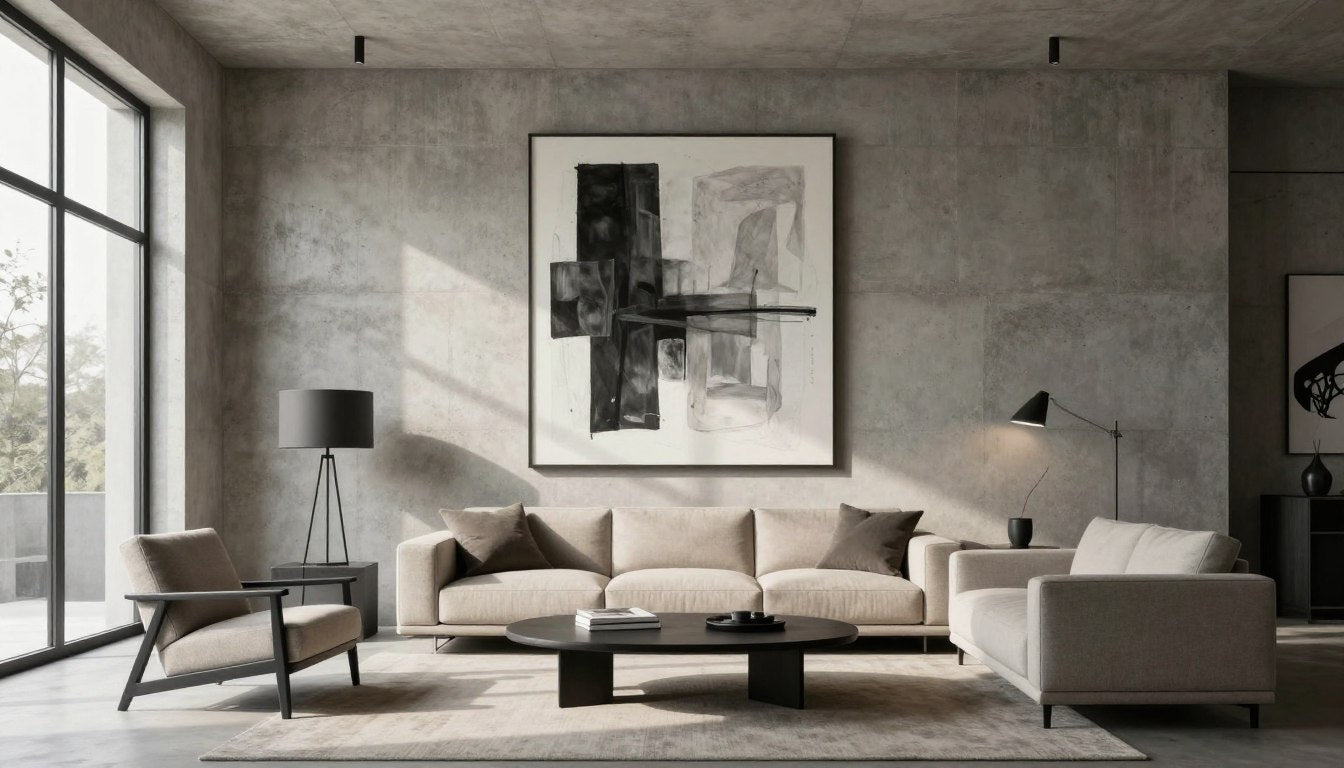
The raw, honest expression of brutalism home design continues to captivate with its bold architectural presence and uncompromising material integrity. Once dismissed as cold and institutional, modern brutalist interiors have evolved into sophisticated living spaces that balance structural boldness with thoughtful design elements. This comprehensive guide explores how to effectively style a brutalist interior with wall art that enhances rather than competes with concrete surfaces, creating spaces that feel both architecturally significant and genuinely livable.

Quick Answers (TL;DR)
What makes a home feel "brutalist"?
Exposed raw materials (especially concrete), honest structural elements, monolithic forms, and a restrained color palette create the brutalist aesthetic. The key is material honesty—letting concrete, steel, and wood express their natural properties without concealment.
The fastest way to warm it up
Introduce natural wood elements, textiles in neutral tones, strategic warm lighting, and large-scale wall art that adds visual interest without disrupting the architectural integrity. Brutalist spaces thrive on contrast—soft against hard, warm against cool.
Best wall art styles for concrete spaces
Monochrome line art, concrete-texture abstracts, geometric grids, and urban silhouettes complement brutalist interiors by echoing architectural elements without competing with them. Scale is crucial—brutalist spaces demand larger pieces that hold their own against expansive concrete surfaces.
The 2/3 sizing rule (1-line formula)
Your wall art should be approximately 2/3 the width of the furniture it hangs above. For example, a 72-inch sofa calls for a 48-inch wide art piece or grouping. This proportion maintains visual balance in the strong geometric spaces of brutalist design.
What Is Brutalism (and what it is NOT)?
Brutalism emerged in the mid-20th century as an architectural movement characterized by the use of raw concrete (béton brut in French, from which the term derives), bold geometric forms, and an unapologetic expression of structure. In home design, brutalism celebrates material honesty—showing rather than concealing the building's construction elements.

Brutalism vs Industrial vs Minimalism (Clear Differences)
| Design Aspect | Brutalism | Industrial | Minimalism |
| Primary Materials | Raw concrete, unfinished surfaces, monolithic forms | Exposed pipes, brick, weathered wood, metal | Clean lines, white spaces, hidden functionality |
| Historical Context | Post-war architectural movement (1950s-70s) | Repurposed factory/warehouse spaces | Japanese influence, "less is more" philosophy |
| Structural Approach | Celebrates structure as the primary aesthetic | Reveals functional elements as design features | Conceals structure for visual simplicity |
| Color Palette | Concrete grays, monochromatic, occasional bold accent | Rust, brown, black, metallic | White, beige, subtle neutrals |
| Texture Emphasis | Strong, deliberate textures (board-formed concrete) | Weathered, worn, utilitarian | Smooth, seamless, tactile |
"Béton Brut" + Material Honesty
The term "brutalism" derives from the French phrase "béton brut," meaning "raw concrete." This terminology captures the essence of brutalist design: an honest expression of materials in their natural state. Unlike styles that hide structural elements behind decorative facades, brutalism in art and architecture celebrates the inherent qualities of materials—the grain patterns left by wooden forms on concrete, the industrial precision of steel beams, the tactile roughness of stone.
This material honesty extends to interior design, where brutalist spaces reject superficial ornamentation in favor of structural integrity and spatial experience. The result is not coldness, as critics often claim, but rather a profound authenticity that forms the perfect backdrop for thoughtfully selected wall art and furnishings.
Brutalist Home Design Checklist (Start Here)

Style Matrix: Pure → Warm → Industrial → Minimal Brutalism
| Sub-style | Key Materials | Best Palette | Best Wall Art Types | Best Frame Choice | Suggested Collection |
| Pure Brutalism | Raw concrete, steel, glass | Charcoal, stone gray, black | Monochrome line art, architectural drawings | Matte black | Black & White Canvas Prints |
| Warm Brutalism | Concrete, oak, linen | Greige, rust accent, cream | Concrete-texture abstracts, organic forms | Raw oak | Original Minimalist & Textured Paintings |
| Industrial Brutalism | Concrete, steel, reclaimed wood | Stone, rust, brass, ink black | Urban silhouettes, geometric grids | Metal float frame | Cityscape & Urban Canvas Prints |
| Minimal Brutalism | Concrete, glass, white oak | Off-white, charcoal, single accent | Geometric abstracts, negative space art | Natural wood | Abstract & Geometric Canvas Prints |
Explore Monochrome & Geometric Art for Brutalist Spaces
Discover our curated collection of black and white canvas prints that perfectly complement the strong architectural elements of brutalist interiors.
Shop Black & White CollectionConcrete Walls & Art Pairing Guide
The tone and texture of your concrete surfaces significantly impact which art styles will create the most effective visual dialogue. This pairing guide helps you select wall art that complements rather than competes with different concrete finishes.

| Concrete Tone | Best Accent Color | Best Art Look | Where to Use | Suggested Collection |
| Cool Grey | Rust, brass | High-contrast monochrome | Living room, entry | Black & White Canvas Prints |
| Warm Greige | Ochre, olive | Textured neutral abstracts | Bedroom, dining | Original Minimalist & Textured Paintings |
| Dark Charcoal | Brass, cream | Urban contour, line art | Office, dining | Line Art Canvas Prints |
| Off-White Plaster | Ink black, deep blue | Muted geometry, grids | Living room, bedroom | Abstract & Geometric Canvas Prints |
Find the Perfect Art for Your Concrete Walls
Our textured and geometric collections are specifically curated to complement the material honesty of concrete surfaces.
Explore Textured Art CollectionThe Best Wall Art for Brutalist Interiors (Pick Your Look)
Monochrome Line Art (Structure + Calm)
Line art's simplicity creates a powerful dialogue with brutalist architecture, echoing structural elements without competing with them. These pieces work particularly well in living rooms and bedrooms where their minimalist aesthetic promotes calm while maintaining visual interest.

The Noir Weave Abstract Line Art exemplifies how simple black lines against white can create rhythm and movement that complements rather than competes with concrete textures.
Concrete-Texture Abstracts (Material Echo)
Art that mimics or complements concrete's textural qualities creates a sophisticated material dialogue. These pieces extend the language of the architecture into the realm of art, creating visual harmony. Ideal for entryways and transition spaces.

The Industrial Crossfade canvas print creates a perfect material echo, with textures that seem to emerge from the concrete itself.
Geometric Grids (Architectural Rhythm)
Geometric art with strong grid patterns reinforces the mathematical precision often found in brutalist architecture. These pieces add visual rhythm without disrupting the architectural integrity. Perfect for offices and dining areas where structure supports function.

The Brutalist Urban Echo geometric canvas creates architectural rhythm through repeating forms that complement concrete's structural honesty.
Urban Silhouettes (City Energy)
Urban-inspired art connects brutalist interiors to their architectural heritage in city landscapes. These pieces add human scale and narrative to concrete spaces. Most effective in living rooms and offices where they can spark conversation.

The Urban Contour canvas brings city energy into brutalist spaces through abstracted architectural forms.
Room-by-Room Placement + Sizing (So Big Walls Don't Swallow Your Art)
Brutalist spaces often feature expansive concrete walls that can overwhelm standard-sized artwork. Proper sizing and placement are crucial to maintain visual balance and ensure your art makes the intended impact. Follow the 2/3 rule for wall art to achieve perfect proportions.
| Room | Best Placement | 2/3 Rule Example | Recommended Size | Layout Type | Suggested Collection |
| Living Room | Above sofa, 8-10" clearance | 84" sofa = 56" art width | 48-60" (122-152cm) wide | Single hero or triptych | Best Sellers |
| Entryway | Above console, eye level | 48" console = 32" art width | 30-36" (76-91cm) vertical | Single vertical statement | Abstract & Geometric |
| Office | Behind desk, camera view | 60" desk = 40" art width | 36-48" (91-122cm) wide | Grid of 4 or single | Canvas Print Sets |
| Bedroom | Above headboard, centered | 72" bed = 48" art width | 40-50" (102-127cm) wide | Single or pair | Line Art Canvas Prints |
| Dining | Opposite table, eye level | 78" table = 52" art width | 48-60" (122-152cm) wide | Triptych or large single | Canvas Print Sets |
Living Room (Hero Piece Above Sofa / Console)
The living room in brutalist homes typically features the most prominent concrete surfaces, making it crucial to select properly scaled artwork. A hero piece above the sofa should be substantial enough to hold its own against the architectural backdrop while maintaining the standard canvas sizes proportions that work best in these spaces.

Entryway (Vertical Punch; Keep It Clean)
Entryways benefit from vertical statement pieces that draw the eye upward and create an immediate impact. In brutalist spaces, keep the entry art clean and architectural—this is not the place for busy compositions. A single powerful piece that echoes the concrete texture or architectural lines creates a cohesive first impression.
Perfect Your Living Space
Find the ideal statement piece for your brutalist living room with our curated selection of large-format canvas prints.
Shop Best SellersOffice (Camera-Friendly, Minimal Visual Noise)
With remote work becoming standard, brutalist office spaces should feature camera-friendly backdrops. Choose art with strong geometric forms but minimal visual noise—pieces that add interest without distraction during video calls. Grid layouts of four related pieces can create rhythm while maintaining the modern wall art layout principles that work best in brutalist spaces.
Bedroom (Calm Contrast; Avoid Heaviness)
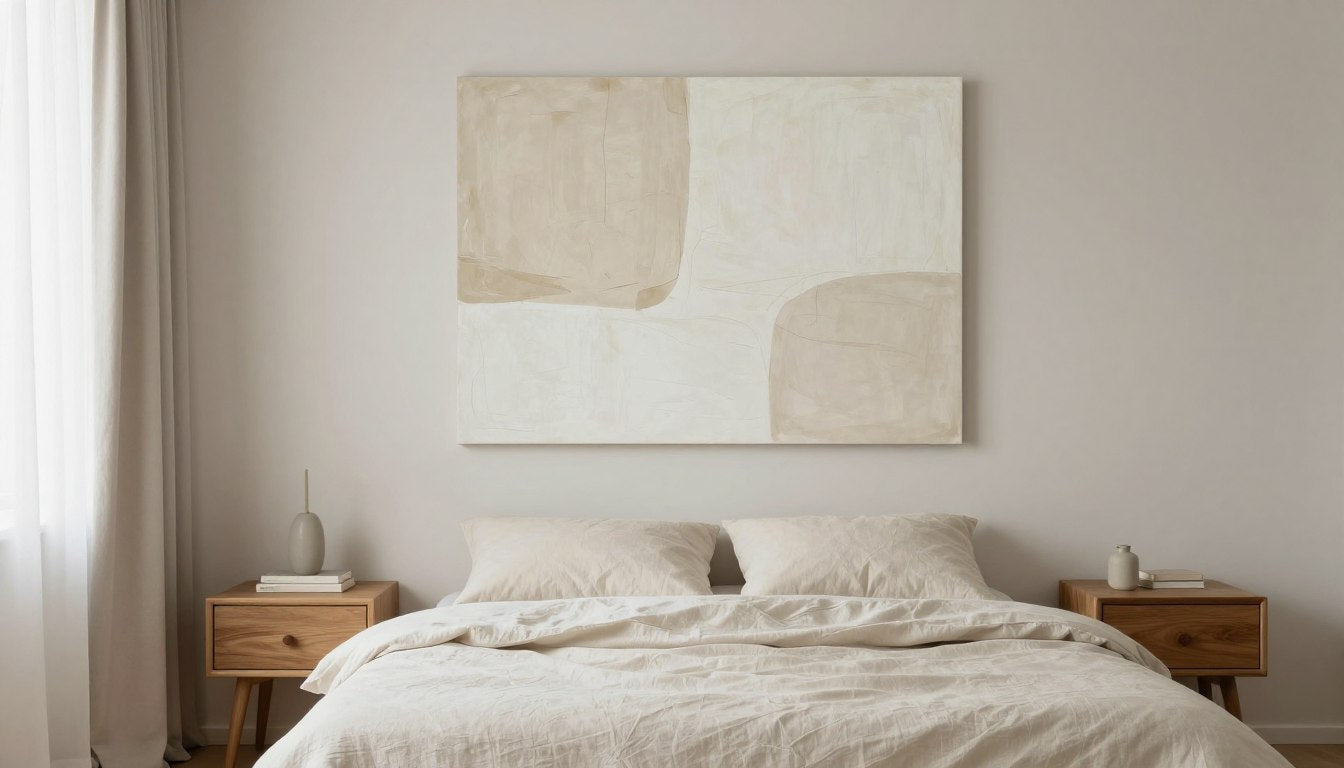
Brutalist bedrooms require a delicate balance—the concrete provides architectural interest, but the space still needs to feel restful. Choose art with softer contrasts and more negative space than you might use in living areas. Line art and minimalist compositions work particularly well to add visual interest without disrupting the calm atmosphere essential for sleep.
Brutalist Lighting Rules (Why Your Art Looks Different at Night)
Warm Bulbs to Soften Concrete
Concrete absorbs and reflects light differently than traditional wall materials, making lighting choices crucial in brutalist interiors. Use warm-temperature bulbs (2700-3000K) to counterbalance the coolness of concrete surfaces. This warming effect is particularly important for properly viewing wall art, as cool lighting can drain color and flatten texture in artwork.

Directional Light for Texture
Brutalist spaces benefit from directional lighting that highlights the textural qualities of both concrete surfaces and wall art. Position track lighting or adjustable fixtures to create intentional shadows and highlights that enhance the differences between plaster wall art and textured art. This approach creates visual depth and prevents the flat, institutional feeling that poorly-lit concrete can produce.
For large textured wall art, position lights at a 30-degree angle to maximize shadow play across the surface, revealing the full dimensional quality of the piece against the concrete backdrop.

Explore Textured Art for Brutalist Spaces
Our collection of textured paintings creates dynamic interplay with directional lighting in concrete-dominated spaces.
Shop Textured Art CollectionCommon Mistakes + Fixes
| Mistake | Why It Fails in Brutalist Rooms | Fix |
| Undersized artwork | Gets visually overwhelmed by expansive concrete surfaces | Scale up—use pieces at least 36" wide for main walls or create groupings that occupy appropriate visual space |
| Busy, colorful art | Competes with rather than complements the strong architectural elements | Choose art with limited color palette and strong compositional structure that echoes architectural elements |
| Uniform lighting | Flattens concrete texture and creates institutional feel | Layer lighting with a mix of ambient, task, and accent sources; use warm temperature bulbs |
| Traditional framing | Ornate frames clash with brutalist minimalism | Use simple float frames, metal frames, or frameless canvas to maintain material honesty |
| Too many small objects | Creates visual clutter against clean architectural backdrop | Curate fewer, larger pieces with intentional placement; embrace negative space |

FAQ
What is brutalism home design?
Brutalism home design is an architectural and interior style characterized by the use of raw materials (primarily concrete), exposed structural elements, and an emphasis on monolithic forms. It celebrates material honesty and functional spaces with minimal ornamentation. Modern brutalist interiors balance the raw architectural elements with thoughtful furnishings and properly scaled artwork to create spaces that feel both bold and livable.
How do you make brutalist interiors feel warm?
Warm up brutalist interiors by introducing natural wood elements, textiles in neutral tones (linen, wool, cotton), warm-temperature lighting (2700-3000K), and large-scale wall art with texture. Strategic use of materials like leather, brass, or copper can add warmth without compromising the brutalist aesthetic. The key is creating contrast between the cool concrete and warmer elements while maintaining material honesty.
What wall art works with concrete walls?
The most effective wall art for concrete walls includes monochrome line art, concrete-texture abstracts, geometric grids, and urban silhouettes. These styles complement rather than compete with concrete surfaces. Large-scale pieces (at least 36" wide for main walls) work best, as undersized art gets visually overwhelmed by expansive concrete. Simple framing or frameless canvas maintains the material integrity that brutalist spaces demand.
Are brutalist interiors the same as industrial?
No, brutalist and industrial interiors are distinct styles. Brutalism focuses on raw concrete, monolithic forms, and architectural honesty, originating as a post-war architectural movement. Industrial style emphasizes exposed pipes, brick, weathered wood, and metal elements, drawing inspiration from repurposed factory spaces. While both celebrate structural elements, brutalism is more architectural and monolithic, while industrial is more utilitarian and weathered.
What colors go best with brutalist decor?
Brutalist decor works best with a restrained palette centered around concrete's natural tones: charcoal, stone gray, greige, and off-white. Accent colors should be used sparingly—rust, ochre, olive, brass, and ink black complement concrete without overwhelming it. Limit your palette to 3-5 tones total to maintain the clean, architectural aesthetic that defines brutalist spaces.
How big should art be above a sofa in a brutalist living room?
In a brutalist living room, art above a sofa should follow the 2/3 rule—approximately 2/3 the width of the sofa. For an 84" sofa, aim for artwork around 56" wide. Given the expansive nature of concrete walls, err on the larger side (48-60" or 122-152cm wide) to ensure the piece holds its own against the architectural backdrop. Maintain 8-10" clearance between the sofa and the bottom of the artwork.
What frames look best in brutalist rooms?
Brutalist rooms call for frames that maintain material honesty: matte black metal frames, raw oak, natural wood float frames, or frameless canvas. Avoid ornate, decorative frames that clash with brutalist minimalism. The frame should complement both the artwork and the architectural elements without drawing attention away from either.
Can brutalism work in small apartments?
Yes, brutalism can work effectively in small apartments through thoughtful implementation. Rather than full concrete walls throughout, consider a single concrete feature wall paired with white or neutral walls. Use the principles of material honesty with smaller-scale furniture that maintains clean lines. Properly sized wall art becomes even more crucial in small brutalist spaces—choose fewer, more impactful pieces rather than multiple small works.
Embrace the Raw Beauty of Brutalism with Curated Wall Art
Brutalism home design offers a unique opportunity to create spaces of architectural significance and material honesty. When complemented with thoughtfully selected wall art that respects the scale, texture, and geometric principles of the style, these interiors become both visually striking and genuinely livable. Rossetti Art offers collections specifically curated for brutalist spaces—from monochrome line art that echoes structural elements to textured abstracts that create material dialogue with concrete surfaces. Explore our best-selling pieces to find the perfect artistic complement to your modern brutalist interior.


About the Author
Chiara Rossetti
Chiara Rossetti is the founder of Rossetti Art, a canvas print and original art brand. She writes about interior design, wall art styling, and the art of making a home feel alive.


Leave a comment
This site is protected by hCaptcha and the hCaptcha Privacy Policy and Terms of Service apply.