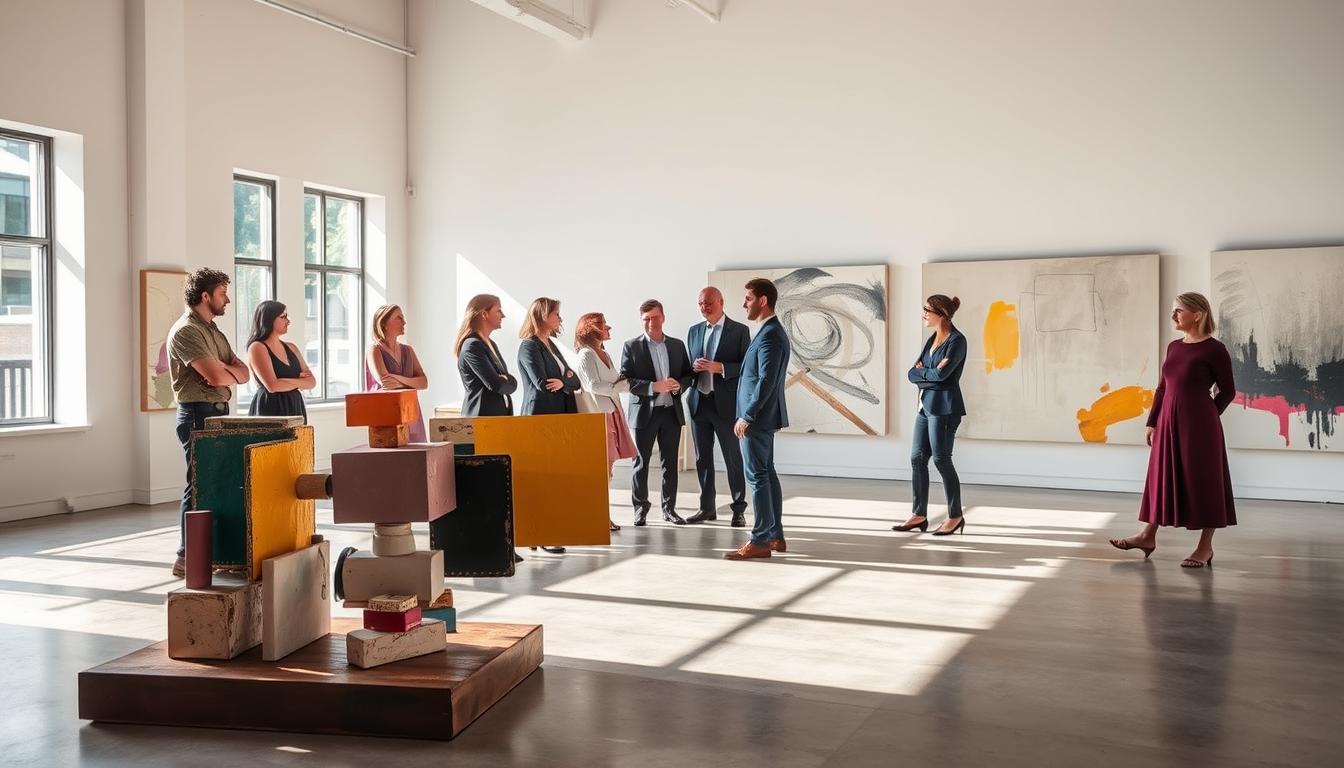

What does the work on your wall say about today’s world—and why does it matter? I open this guide with a clear definition: contemporary art is the visual language of our era, born after the 1970s and shaped by global culture, tech, and shifting histories.
Here I map how this living category blends styles, materials, and themes—identity, migration, memory, and institutional critique—so you can see why certain pieces feel museum-quality yet personal.
Expect a museum-style tour—accessible and refined. I’ll show how artists use painting, installation, video, and digital media to translate big ideas into elegant pieces for the home.
Key Takeaways
- Contemporary art is the visual voice of the present era.
- It uses diverse materials and methods—no single rule or "-ism."
- Core themes include identity, culture, technology, and memory.
- Understanding the art world helps you choose pieces that change a room.
- This guide pairs definition with practical examples for confident collecting.
Contemporary Art Meaning
I frame the term as a flexible window—work made from the late 20th century into the present—so you can read each piece against its time and ideas.
Definition and timeframe: Many scholars and galleries locate this era from about the 1970s onward. Some extend the range to roughly the past 70 years; others define it as work by artists living today. The boundary with modern art is blurred—shifts after World War II and the 1960s help explain the change.
Why the label shifts: The word "contemporary" moves forward as years pass. What once felt like the present becomes history. Museums and dealers sometimes set tighter windows—some even start at 2000—for clarity.
Quick reference:
- Core idea: concepts can be as central as media—works test what counts as an artwork.
- Common media: painting, sculpture, installation, video, digital.
- Artists today foreground identity and current themes in living practice.
How institutions mark time
Use timeframe as a guide, not a cage—focus on how a piece engages its day and history. For a broader overview, see this profile on contemporary art.
| Period | Typical Focus | Representative Media | How Institutions Treat It |
|---|---|---|---|
| Late 20th (1970s–1990s) | Conceptual shift; questioning the object | Installation, performance, photography | Often grouped with modern or early contemporary |
| 2000s–Today | Digital practices; global identities | Video, digital, mixed media | Galleries may label strictly as contemporary |
| Living artists | Ongoing responses to current events | Any medium; hybrid approaches | Curators highlight relevance to today |
Modern Art vs Contemporary Art
Let’s contrast the timelines and impulses that separate modern practice from what artists make today. I keep this clear so you can spot period, style, and intention at a glance.
Key differences in period, movements, and ideas
Period and pivot: Modern art generally refers to work produced from the 1860s to the 1970s. By contrast, contemporary art refers to work made from the 1970s to the present — a useful pivot point when reading history.
Movement versus plurality: Modern practice was movement-driven — Impressionism, Cubism, Minimalism, Pop. The later era resists one dominant art movement. It favors plural media and open-ended ideas.
- Modern asks how to depict — it reinvented form and color.
- Present-day practice often asks what a work is — concepts lead the experience.
- Late 20th shifts — performance, postmodern critique, and new media — set the stage for experimentation.
| Aspect | Modern Art (c.1860s–1970s) | Contemporary Art (1970s–today) |
|---|---|---|
| Primary focus | Form, representation, named movements | Concept, status of the work, hybrid practices |
| Typical media | Painting, sculpture, print | Installation, video, digital, performance |
| How to read it | Follow movement history and style | Use the 1970s as a point — read context and intent |
Takeaway: Use the 1970s as a rule of thumb. Style and date can diverge — a work that looks modern may be produced today. Read the context, and you’ll speak about works with real confidence.
From the 1970s to the Present: A Brief Timeline of the Contemporary Art World
I chart how the field moves—from experimental postwar gestures to the digitally connected styles of the 2000s and beyond. This compact timeline highlights key moments that reshaped practice, institutions, and how audiences see works.
Late 20th century shifts after World War II
The postwar decades fueled bold experiments. From Abstract Expressionism and Fluxus to Minimalism and Conceptual practice, artists questioned the object and the gallery.
Land art, performance, and feminist projects in the 1970s pushed public space and social context into view. Museums and fairs grew—expanding public access and gallery-quality presentation.
From postmodernism to postinternet and beyond
The 1980s and 1990s brought neo-expressionism, appropriation, and relational practices that tied culture and society to exhibition rooms.
In the 2000s and 2010s, network culture and technology reshaped methods—postinternet sensibilities, Superflat, and AI-based image-making widened the studio's toolkit.
- Quick scan: 1950s–60s: Fluxus, Minimalism; 1970s: Land art, feminist work.
- 1980s–90s: Appropriation, street interventions, relational art.
- 2000s–2010s: Postinternet, Altermodern, digital and AI practices.
Takeaway: The timeline reads less like a single movement and more like a braided history—artists, museums, and markets mixing styles and genres across years.
Materials, Media, and Methods: How Artists Work Today

Materials and methods set the mood. Painting, sculpture, installation, and video all offer different spatial and emotional effects. I describe how each choice reads in a home or gallery so you can match a piece to your space.
Painting remains foundational—gestural canvases, minimalist color fields, or photoreal panels. Painting brings warmth and tactile surface to a room.
Installation and video transform rooms into experiences—light, sound, and projection create immersive environments that demand presence.
Photography and performance anchor clarity and temporality. Photographic series suit clean, luxury interiors. Performance often survives as striking documentation.
Digital and AI-based works use screens, generative visuals, and code to reflect current technology and offer a sleek, modern glow.
| Media | Typical Effect | Where it Fits | Notes |
|---|---|---|---|
| Painting | Warmth, texture | Living rooms, lounges | Versatile—gestural to photo-real |
| Installation | Immersive, architectural | Museum rooms, large residences | Scale and site matter—1970s expanded this |
| Video / Digital | Time-based, luminous | Minimalist interiors, media walls | Looped projections and generative pieces |
Practical tip: Match media to mood—choose painting for intimacy, photography for crisp sophistication, and installation or video when you want dramatic presence.
For a deeper primer on how the term evolved and how institutions frame works, see my short guide on how to define contemporary in art.
Core Themes and Ideas in Contemporary Art
I frame key themes as a practical lens—they help you read a piece quickly and choose works with intention.
Identity, the Body, and Culture
Identity anchors much of today’s practice—race, gender, and sexuality give work its human pulse.
The body appears as medium and message—performance, portraiture, and absence make statements that feel intimate and bold.
Globalization, Migration, and Society
Global flows and migration recast how culture is shown. Artists translate hybridity and urban life into pieces that ask who belongs in a room.
Institutional Critique and Concepts
Many creators challenge who decides value. Museums and markets become subjects; concepts test what an artwork can be.
"Artists often turn the gallery into both stage and critic—provoking how people see systems and taste."
Time, Memory, and Reality
Time and memory surface in archives, reenactments, and traces. Such work layers history and makes reality feel mutable.
| Theme | Typical Focus | How it reads at home |
|---|---|---|
| Identity | Personal histories, representation | Warmth and narrative—invites conversation |
| Institutional Critique | Value, display, power | Minimal, cerebral—adds refined clarity |
| Time & Memory | Archives, reenactment, traces | Ethereal, layered—gives depth to a room |
Takeaway: Read themes first—identity and culture guide emotion; critique and time guide form. Your selections become more intentional, more luxurious.
Inside the Contemporary Art World: Institutions, Markets, and Careers

The ecosystem that sustains creative practice mixes public museums, private galleries, and artist-run spaces—each shaping how works reach an audience.
Museums anchor scholarship and public trust. They give exhibitions provenance and long-term visibility.
Galleries create market momentum—representing artists, producing catalogues, and placing works in collections.
Makers, Markets, and Mobility
Fairs and auctions accelerate discovery. They convert exposure into valuation and fast-track careers through visibility.
Corporate collections and sponsorships add resources and prestige—often steering which works enter broader culture.
| Role | Primary Function | Impact |
|---|---|---|
| Museums | Research & public access | Long-term credibility |
| Galleries | Market placement | Sales and representation |
| Artist-run | Experimentation | Early-stage exposure |
Paths, Prizes, and Practical Advice
Careers start in schools, residencies, and small shows. Grants and prizes—Turner Prize, Hugo Boss, Venice Lions—signal impact.
Practical tip: Build relationships—visit institutions, attend fairs, and follow prize shortlists to spot artists at pivotal moments.
Contemporary Art in Practice: Notable Works, Artists, and Movements
I turn to notable works and movements that made debates about labor, value, and mortality visible to wide audiences.
Ai Weiwei’s Sunflower Seeds: Installation and Labor
Sunflower Seeds filled the Turbine Hall with millions of hand-painted porcelain seeds. The scale translated industrial labor into a poetic field of tiny, human-made pieces.
The work foregrounds craft and collective labor—each seed a touchpoint of skill and community.
Banksy’s Girl with Balloon → Love in the Bin: Spectacle and Value
When the canvas shredded mid-auction, the stunt became its own performance. The viral video lifted the work’s profile and redefined how spectacle affects market value.
Damien Hirst’s Shark: Life, Death, and Controversy
The suspended shark forces a stare at mortality—an ethereal museum-quality presence that asks ethical questions about display, the body, and preservation.
Selected Movements and Styles
Street practice, Neo-conceptual strains, Relational projects, Superflat, Postinternet, and AI visual work all shaped how pieces circulate today.
- Technology and NFTs altered ownership and access.
- Photography, video, painting, and installation each deliver different dramatic effects.
- Clear concept, striking form, and timing explain why certain works resonate.
Practical tip: Let one powerful artwork lead a calm interior—pair bold pieces with quiet surroundings for maximum impact.
Conclusion
In summary: the work you choose joins a conversation that spans decades, places, and ideas. I define this practice as a living dialogue—rooted roughly in the 1970s to the present—where form and concept meet daily life.
The map I’ve given shows how artists, museums, galleries, and markets intersect. Use that map as a tool: pick an artwork that matches your vision—minimal calm, a bold statement, or a clear concept.
Let themes guide you—identity, society, and time make pieces last beyond trends. Visit institutions, look closely, and trust your response. Keep exploring: the contemporary art world keeps offering new ways to see and live beautifully.
Enhance Your Space with Unique Modern Masterpieces by Chiara Rossetti

Are you inspired by the innovative mediums and conceptual depth highlighted in our exploration of contemporary art? You’re not alone! Today’s art enthusiasts are seeking cultural relevance and emotional connections in their artwork. However, finding pieces that resonate with modern themes and fit your unique style can be a challenge. That’s where we come in!

At Rossetti Art, we specialize in canvas prints, original paintings, and modern sculptures that celebrate the spirit of now. Each piece created by Chiara Rossetti brings a personal touch that connects deeply with current social narratives—just like the modern masterpieces discussed in the article. Don’t miss out on the chance to elevate your home decor with breathtaking artwork that speaks to your values and aesthetic. Explore our collection today and find your perfect piece! Act now, and transform your space into a gallery of inspiration!

FAQ
What does the phrase "understanding the meaning of contemporary art" refer to?
It refers to looking at works made from the late 20th century to today — the ideas, materials, and social questions artists use to shape visual culture. I describe how artists respond to technology, identity, and institutions, and how museums and galleries present those responses.
How is contemporary art meaning defined and what is its timeframe?
The definition centers on artwork produced from roughly the 1970s onward and continues into the present day. It’s less about a single style and more about practices that reflect current ideas, technologies, and cultural debates.
Why does the label "contemporary" shift with time and context?
Labels shift because culture and technology evolve. What feels current today may seem historical tomorrow. Institutions and critics update categories as movements, media, and social concerns change, so the term remains fluid.
How does modern art differ from contemporary work?
Modern work generally spans the late 19th century through mid-20th century and centers on movements such as Impressionism, Cubism, and Abstract Expressionism. Contemporary work follows — it is defined by pluralism, new media, and a focus on concept and context rather than a consistent aesthetic.
What major shifts happened in the art world after World War II?
After World War II, centers of influence moved — New York rose as a major hub. Abstract Expressionism, then Pop, Minimalism, and Conceptual practices transformed how artists thought about material, audience, and meaning, setting the stage for later pluralism.
How did postmodernism lead to today's postinternet and other movements?
Postmodernism questioned singular narratives and embraced irony, appropriation, and fragmentation. From there, artists engaged with globalization, digital culture, and networked life, giving rise to postinternet practices and hybrid genres that blend physical and virtual methods.
What materials and media do artists use today?
Work spans painting and sculpture to installation, video, and performance. Artists mix traditional craft with new materials — found objects, live bodies, moving image, and code — to expand how meaning is made in a space.
How do photography, performance, and conceptual practices fit into current practice?
Photography documents and constructs identity; performance foregrounds the body and temporality; and conceptual work prioritizes ideas over technique. Each practice interrogates representation, truth, and social systems in distinct ways.
What role do digital art, AI, and new media technologies play?
They reshape production and display. Artists use software, generative algorithms, virtual reality, and AI to create interactive, time-based, and networked pieces — expanding both method and audience engagement.
Which core themes appear across contemporary works?
Recurring themes include identity and the body, global migration, institutional critique, and explorations of memory and time. These topics reflect social tension and lived experience, often blending personal narrative with broader political issues.
How do globalization and migration influence subject matter?
They broaden perspective. Artists address transnational identities, diasporic histories, and cultural exchange — revealing how mobility and displacement shape memory, belonging, and representation.
What is institutional critique and why does it matter?
Institutional critique examines how museums, galleries, and markets shape value and visibility. Artists challenge authority, question acquisition practices, and call attention to who is included or excluded from the cultural canon.
How do museums, galleries, and artist-run spaces differ in role?
Museums preserve and contextualize work for broad publics. Commercial galleries represent and sell artists. Artist-run spaces offer experimental platforms and community-driven programs — each contributes distinct ecosystems for making and seeing work.
How do art fairs, auctions, and corporate collections affect the market?
Fairs accelerate visibility and sales; auctions set public market values; corporate collections signal brand taste and support large acquisitions. Together, they influence prices, careers, and what the public sees.
What pathways and supports exist for an artist’s career?
Pathways include residencies, grants, prizes, exhibitions, and gallery representation. Networks, critical writing, and teaching also shape careers. Institutional recognition and commercial success follow varied, often nonlinear routes.
How do public attitudes and debates shape the art world?
Public debate over funding, censorship, and representation pressures institutions to be more transparent and inclusive. Conversations in media and social platforms influence exhibition choices and how artists respond to social issues.
Can you name notable contemporary works that illustrate key ideas?
Yes — Ai Weiwei’s Sunflower Seeds addresses labor and mass production through installation; Banksy’s Girl with Balloon and its shredding moment critique spectacle and market value; Damien Hirst’s preserved shark confronts life, death, and commodification.
Which movements and styles shaped the late 20th and early 21st centuries?
Important movements include Minimalism, Conceptualism, Neo-Expressionism, Relational Aesthetics, and postinternet practices. Each contributed strategies for material, audience interaction, and critique that remain influential.

About the Author
Chiara Rossetti
Chiara Rossetti is the founder of Rossetti Art, a canvas print and original art brand. She writes about interior design, wall art styling, and the art of making a home feel alive.

Leave a comment
This site is protected by hCaptcha and the hCaptcha Privacy Policy and Terms of Service apply.