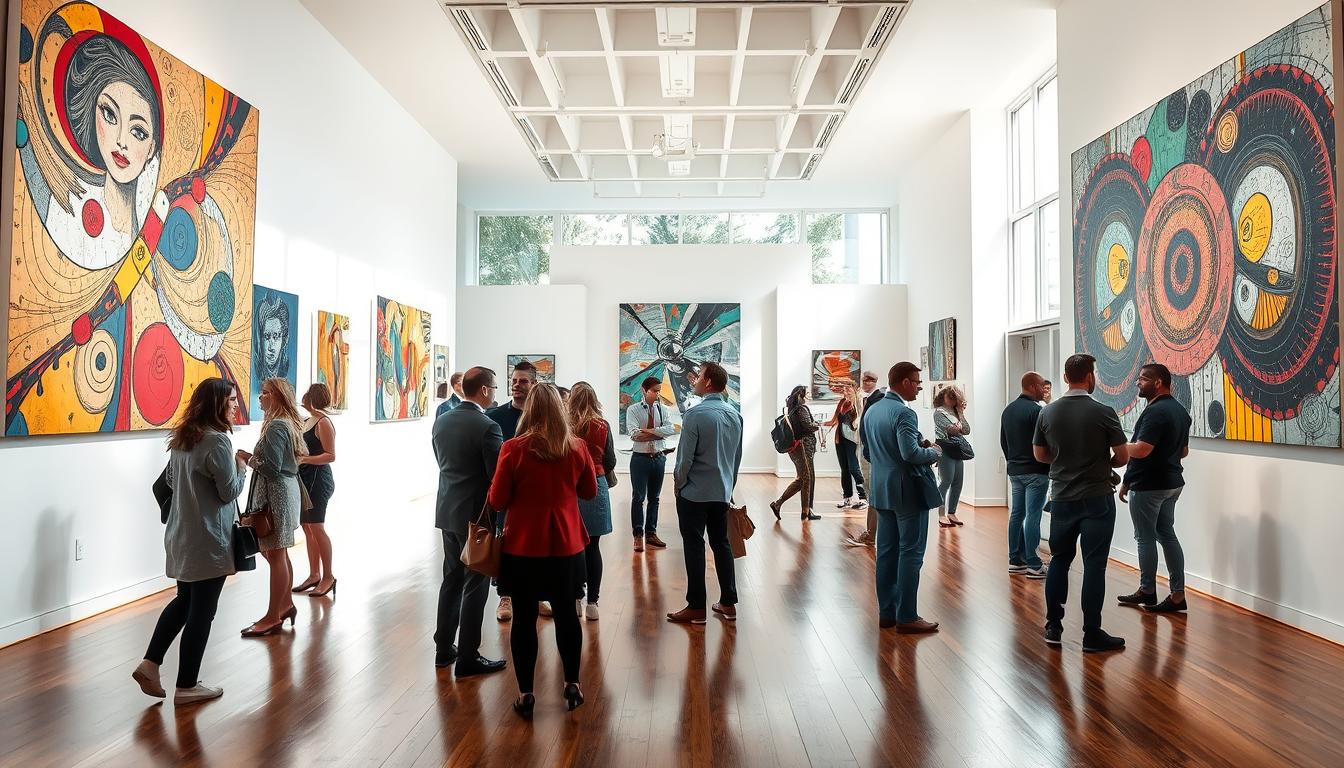

What if the work on the gallery wall could change how you see your own home?
I invite you to look closer—at pieces that feel immediate, bold, and thoughtful. I set the stage: museum-quality creativity that belongs in living rooms and public spaces alike.
Today’s scene blends global voices, new technologies, and a refusal to fit any single movement. I’ll show how living artists turn big ideas into tactile, display-worthy objects that draw attention and spark conversation.
Follow a clear guide that names key traits while honoring rich diversity. Expect vivid examples, practical tips for choosing works, and a confident voice to help you talk about styles with ease. For background on the era and its influences, see this concise glossary.
Key Takeaways
- Diversity matters: many materials and perspectives shape what you see today.
- Concept first: meaning often drives form and finish.
- Global context: world events and tech reshape the field.
- Display-ready: pieces aim for museum quality and home harmony.
- Names to know: iconic artists anchor the ideas in real examples.
What Is Contemporary Art Today?
Contemporary practice traces what artists make now and how they answer the present moment.
I define contemporary art as the work made from the late 20th century into the present—shaped by a globally connected century, new media, and shifting cultural context.
Think living makers and living ideas. Many definitions start in the late 1960s or 1970s; some note 1989 as a turning point. The label is flexible—time and spirit matter more than strict dates.
How it differs from modern art
Modern art (roughly the 1860s–1970s) pushed painting and representation in radical ways. Contemporary art builds on that legacy but resists a single style.
| Aspect | Modern Art | Contemporary Today |
|---|---|---|
| Timeframe | Late 19th–mid 20th century | Late 20th century to present |
| Focus | Form, painting, new media emergence | Global voices, tech, ideas, mixed media |
| Display tip | Pair with mid-century pieces | Mix sculpture and painting for layered rooms |
Context is central—where and why a piece was made adds museum-quality depth to how you display it at home.
I show how contemporary artists respond to the world in materials, subject, and tone—so your choices feel informed and timeless today.
The 5 characteristics of contemporary art
Here I separate the guiding pillars that shape how artists respond to our moment. Each pillar helps you read a work—what it says, how it’s made, and why it matters in a room.
Diversity Across Styles, Cultures, and Materials
Diversity is visible in mixed media, bold objects, and varied form. Works range from spare abstraction to tactile installations. This variety invites many perspectives into a single collection.
Reflection of Society, Politics, Identity, and Environment
Many pieces mirror social life—identity, politics, and ecology appear as central themes. Meaning lifts a work beyond décor and into conversation.
Multimedia and Cross-Disciplinary Approaches
Video, performance, and digital media sit alongside painting and sculpture. These cross-disciplinary methods create immersive, museum-quality experiences at home.
Conceptual Focus and the Primacy of Ideas
Ideas guide craft. Process and interpretation often outweigh surface finish—inviting viewers to complete the work with their gaze.
Continuous Evolution in a Global, Tech-Driven World
New media and global exchange keep the field fresh. Contemporary artists adapt movements and materials, reshaping boundaries for what a work can be.
- Practical tip: Read a piece through materials, movement, and message to choose works that match your space and sensibility.
Diversity: Styles, Movements, and Materials That Redefine Boundaries
I map a wide visual spectrum—from serene abstraction to warm figuration—so your collection reads with clarity.
Styles range from minimalist gestures to richly detailed portraits. These approaches borrow from modern art and go beyond it. That gives decorators more freedom when pairing pieces with interiors.
Global perspectives reshape how makers work. Artists blend local craft and global techniques—creating cultural dialogue that crosses borders and renews meaning.
Materials matter. Beyond painting and sculpture, I point to thread installations, steel, found objects, and textiles. Think about how scale, finish, and light change a piece’s presence.
Consider how works interact with space: Richard Serra’s steel alters movement; Chiharu Shiota’s threads reframe everyday items; Gerhard Richter shifts between photorealism and abstraction.
- Practical tip: Mix abstraction and figuration for balance—form and narrative work together to expand boundaries.
Reflecting Society: Identity, Culture, and the Contemporary Art World

Artwork often acts as a mirror—reflecting who we are and where we come from.
I show how artists use portrait, object, and performance to name identity and history. These works place personal memory next to public debate—quiet and fierce at once.
Time and memory reappear in many practices. Louise Bourgeois turns private life into monumental forms that feel intimate in a room. Cindy Sherman questions media roles and how identity is staged.
Social critique also shapes refined forms. Ai Weiwei’s readymades challenge who decides what holds value. That challenge matters when you choose artwork for a home meant to provoke thought.
"Elegance and critique can coexist—pieces can be beautiful and demand attention."
| Theme | How it appears | What to look for |
|---|---|---|
| Identity | Portraiture, staged photography, bodies | Faces, costume, constructed scenes |
| Memory | Sculpture, textiles, personal symbols | Tactile surfaces, repetition, intimate scale |
| Institutional critique | Readymades, site-specific works | Appropriation, materials with history |
Context matters: where a work comes from and who speaks through it deepen meaning. Live with pieces that invite curiosity and compassion—design with conscience.
- Practical tip: Choose work that sparks conversation—subtle color, tactile detail, and layered ideas reward slow looking.
Multimedia and Technology: New Media Transforming Artworks and Spaces
Light, code, and motion now share the studio with paint and bronze.
Video, performance, installation, and digital media reshape what a work can be—living, responsive, and quietly immersive. I describe how these formats expand meaning: a looped video adds rhythm; performance invites presence; an installation remakes a room into an experience.
Technology becomes material—projection, sensors, and custom code sit beside canvas and steel. Collaborations with engineers, designers, and scientists are common. These teams build seamless, museum-quality pieces that feel effortless to the viewer.
Immersive exhibitions blend light, sound, and data to change how you move and breathe in a space. Think Ryoji Ikeda's data-driven screens or the luminous rooms by James Turrell and Olafur Eliasson—works that move from modern art into present practice.
- Placement tip: plan power, ambient light, and sightlines before installation.
- Scale & acoustics: balance sound and motion for a calm, refined result.
- Mood: video loops can animate a minimalist interior without dominating it.
"Thoughtful technology can be serene—not loud—bringing museum-quality grace into everyday spaces."
Concept Over Craft: How Ideas Lead Modern Contemporary Art
Ideas now steer the studio—concepts set materials, not the other way around.
Conceptual practice began in the 1960s–70s and still shapes how makers work today. Artists prize intention and invite the viewer to finish the meaning.
Process matters: traces of method, repetition, and time become the work’s visible history. That slow logic reads as subtle beauty—less polish, more resonance.
Participatory pieces respond to presence. Your view is part of the composition—movement, choice, or touch can alter the piece.
"Collect ideas you can live with—works that breathe and ask for quiet attention."
For the home, concept-forward works offer calm. Pair them with warm woods or soft textiles to balance head and heart.
| Aspect | What to expect | How to display |
|---|---|---|
| Concept | Idea-led, often documented | Minimal framing, explanatory note |
| Process | Visible marks, repetition | Soft lighting, tactile pairing |
| Participation | Responsive or performative elements | Clear sightlines, safe interaction |
- Documentation: keep notes, editions, and certificates with the work.
- Tip: choose pieces that invite contemplation—quiet luxury endures.
Always Evolving: Movements, Globalization, and Today’s Art World
Global exchange and new tools keep the field in motion—no single moment holds sway for long. I trace arcs from postmodern dialogues through postinternet aesthetics to AI-assisted image-making.
Movement lineage matters: 20th century breakthroughs seed ideas that reappear as hybrid practices today. Postmodern skepticism gave way to networked practices that borrow freely across media and geography.
Technology expands how works are made and seen. Video, code, and machine learning reshape form—creating pieces that react, loop, or generate imagery in real time.
The contemporary art world thrives on shifting centers and fresh voices. Galleries, fairs, and online platforms circulate work faster—so trends diffuse globally and local perspectives gain new weight.
"Evolution is the constant—embrace it as a design asset, refreshing your spaces with elegant, current energy."
- How to spot a movement: read materials, concept cues, and formal strategies in one work.
- Collecting tip: balance timeless materials with forward-looking media for a collection that ages gracefully.
- Display note: plan mounts, screens, and discreet cable runs so media pieces feel seamless in the room.
Modern Art vs. Contemporary Art: Key Differences and Overlaps

One era reshaped how we see; the next questions what an object can be.
I trace a clear line: modern art — born in the 20th century — broke representation with Impressionism, Cubism, and Dada. It remade form and foregrounded abstraction as a language for the new age.
Contemporary art shifts the question further. It experiments with participation, site, and media—testing the boundaries of what counts as an artwork.
Both periods prize experimentation. But while modern art often reworked painting and sculpture, contemporary practice folds painting into installation, photography, and digital works.
Key contrasts:
- Modern art shaped new visual grammar in a changing 20th century.
- Contemporary work stretches conventions—editions, instructions, and experience can be the piece.
- Abstraction persists, now layered with social and conceptual perspectives.
"Movement labels guide, they do not confine."
For display: pair modern icons with present experiments to create elegant contrast. Consider form, context, and the way a piece invites viewers to stay a while.
Artists and Iconic Works: Examples That Define the Present
I turn to artists whose standout works shift how we read space and meaning. Each example offers a model—how scale, repetition, or a provocation can change a room.
Yayoi Kusama — immersive repetition
Kusama’s rooms and polka-dot environments wrap viewers in pattern and light. The result is poetic and minimalist—an immersive experience that draws national attention.
Jeff Koons — Neo‑Pop reflection
Koons’ Rabbit mirrors the room and the viewer—luxury and consumer culture folded into one gleam. It asks you to see yourself in the work.
Ai Weiwei — readymades and critique
Ai Weiwei stages gestures that question value and power. A photographic action can reframe history—provocative, direct, and culturally sharp.
Louise Bourgeois — memory made monumental
Bourgeois’s spiders fuse memory and the body. Monumental yet intimate—these sculptures feel protective and quietly fierce.
Richard Serra — space as experience
Serra’s steel pieces alter movement—walking becomes part of the work. Scale and phenomenology command attention.
Cindy Sherman — identity as performance
Sherman’s staged photographs turn persona into subject. Her series reframes media roles and how we see faces in a frame.
Chiharu Shiota — presence in absence
Shiota suspends found objects in thread networks—absence becomes a felt presence. The result is poetic tension and slow looking.
Gerhard Richter — between modes
Richter moves from photoreal painting to soft abstraction with calm control. His range proves that technique and idea can coexist.
- Display tip: plan scale, sightlines, and light so a statement piece feels integrated.
- Practical note: mix painting, sculpture, and video for layered museum-quality rooms.
"Great works ask you to stay a while—then change how you see a space."
The Role of the Viewer: Participation, Context, and Meaning-Making
Your presence completes how a work speaks—seeing is an active, shaping act.
I believe viewers are not just observers; they are part of the experience. In immersive installations and light-and-space pieces, movement and memory shape what you take away.
Walking, pausing, and shifting perspective change how a piece reads. Exhibitions offer fresh readings each day—new light, new mood, new perspective.
Participation can be subtle: a reflection in a polished surface, a color shift as you move, a whispered echo in a room. These quiet moments feel like luxury—an intimate dialogue between you and the work.
At home, I suggest arranging sightlines that reward slow viewing. Curate pathways so guests pause naturally—place seating where a view unfolds, not where it ends.
| Viewer Action | Effect on Piece | At-Home Tip |
|---|---|---|
| Walk around | Reveals hidden surfaces and shifts scale | Leave room to circle a sculpture |
| Pause and reflect | Deepens meaning and uncovers detail | Provide a quiet seat with soft lighting |
| Return often | Shows how context and light change interpretation | Rotate seasonal placement to refresh view |
The contemporary art world prizes dialogue—questions you ask become part of a piece’s life. Keep documentation and notes nearby; they enrich context and deepen daily engagement.
"Your daily view becomes the finishing touch."
For deeper reading on the role of interpretation in exhibitions, see this role of interpretation.
Conclusion
This is how you make museum-quality thinking part of daily life.
I close with clarity: use the five pillars as a simple guide to choose pieces that change mood and meaning. I advise slow collecting—favor materials and media that age well and reward repeated viewing. Artists now mix technology and handcraft; let ideas lead while you balance warm finishes for home comfort.
Your home becomes an intimate gallery—plan light, sightlines, and pacing so each day reveals more beauty. Stay curious about movements and time; pair modern influences with present practice to keep a collection alive for any century.

Are you inspired by the innovative mediums and conceptual depth highlighted in our exploration of contemporary art? You’re not alone! Today’s art enthusiasts are seeking cultural relevance and emotional connections in their artwork. However, finding pieces that resonate with modern themes and fit your unique style can be a challenge. That’s where we come in!

At Rossetti Art, we specialize in canvas prints, original paintings, and modern sculptures that celebrate the spirit of now. Each piece created by Chiara Rossetti brings a personal touch that connects deeply with current social narratives—just like the modern masterpieces discussed in the article. Don’t miss out on the chance to elevate your home decor with breathtaking artwork that speaks to your values and aesthetic. Explore our collection today and find your perfect piece! Act now, and transform your space into a gallery of inspiration!
FAQ
What do we mean by the five defining traits in modern creative practice?
I describe five core traits that shape today’s work — diversity in style and materials, social reflection, multimedia methods, idea-led practice, and constant evolution driven by global exchange and technology.
How does contemporary art today differ from 20th-century modernism?
Contemporary practice expands modernism’s experiments. It keeps abstraction and formal risk but adds global perspectives, digital media, social critique, and concept-first approaches that privilege idea over pure form.
In what ways do artists reflect society and identity in their work?
Artists use personal history, cultural memory, and political critique to address race, gender, migration, and environment. Works often prompt viewers to confront institutions, power, or cultural narratives.
How important are new materials and media in today’s artworks?
Very. Painters still work in oils and acrylics, but creators also use video, installation, found objects, performance, and digital fabrication. Materials become part of the concept and sensory experience.
What is meant by “concept over craft” in this context?
Ideas often lead the work — the concept frames choice of medium and display. Craft remains vital, but intention, process, and audience engagement can outweigh traditional notions of beauty.
How do immersive and tech-driven exhibitions change the viewer’s role?
Immersive shows — from Yayoi Kusama rooms to VR projects — invite participation. Viewers become active makers of meaning, moving through space and influencing emotional and interpretive outcomes.
Can you give examples of artists who illustrate these trends?
Yes. Ai Weiwei blends political critique with readymades; Jeff Koons interrogates consumer culture; Cindy Sherman explores identity through staged photography; Gerhard Richter moves between figuration and abstraction.
What does globalisation mean for movements and styles?
Global exchange dissolves strict regional schools. Movements now cross borders rapidly — postinternet and AI-informed projects, biennials, and online platforms create hybrid aesthetics and shared dialogues.
How do museums and galleries respond to these shifts?
Institutions adapt with interdisciplinary shows, site-specific installations, and programing that foregrounds social issues and tech-driven work. Curators reframe collections to reflect plural voices.
How can a home decorator bring museum-quality pieces into a living space affordably?
Look for limited editions, fine prints, or handcrafted reproductions that echo museum standards. Mix large-scale focal works with tactile objects — textiles, ceramics, or small sculptures — to create layered, luxury-driven interiors.
Are interactive or participatory works suitable for private spaces?
Absolutely. Scaled-down immersive pieces, sound works, and modular installations translate well to homes. They invite daily engagement and shift a room from static to experiential.
How do I choose a piece that fits both aesthetic taste and concept?
Consider the room’s light, scale, and color palette — then align the work’s idea with your values or memory. A piece that resonates conceptually will sustain interest beyond mere decoration.

About the Author
Chiara Rossetti
Chiara Rossetti is the founder of Rossetti Art, a canvas print and original art brand. She writes about interior design, wall art styling, and the art of making a home feel alive.

Leave a comment
This site is protected by hCaptcha and the hCaptcha Privacy Policy and Terms of Service apply.