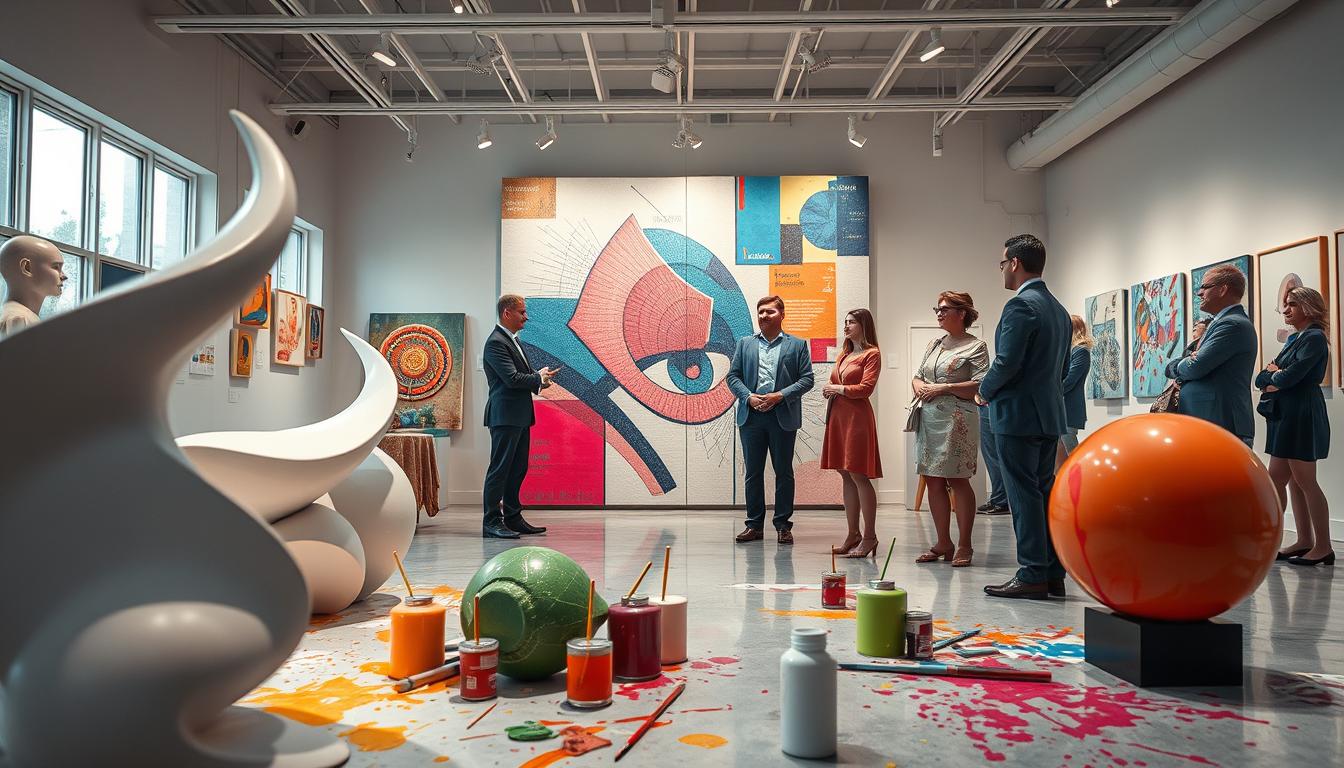

Can a single rule help you spot a museum-quality piece in your living room? I open with that challenge because clear signs make selection simpler. Here I name a concise definition and give a calm, stylish way to read a work at a glance.
Contemporary art — and yes, I’ll answer what are the elements of contemporary art — lives in a recent era, shows clear artist intent, and engages time and history.
Practice spans painting, sculpture, photography, video, installation, performance, land work and digital forms. Look for strong lines, mindful use of space, and an idea that links to our world now.
Quality matters even when materials surprise you. I will show how intention, craft, and atmosphere combine so a piece feels museum-quality in your home.
Key Takeaways
- Recognize works by era, intent, and dialogue with recent history.
- Spot quality via craft, composition, and material choice.
- Read lines and space to gauge a piece’s aesthetic way.
- Expect media breadth—mixed forms and performance included.
- Use clear definitions to choose art that lifts a room.
Defining Contemporary Art in the Present Era
A clear timeline helps you place a work between modernism, postmodern turns, and today. I offer a compact map so your eye reads date, intent, and reference with confidence.
From modernism and postmodernism to today
Modern art roughly runs from mid‑19th century to the mid‑20th. Postmodern shifts begin in the mid‑20th and overlap into our present era around 1960–1970. That gray zone explains why movements change fast and why styles cross boundaries.
Four core conditions for recognition
- Timeframe: production date anchors order and context.
- Artist intention: considered purpose separates a work from a casual image.
- Time‑bound aesthetics: lines, materials, and references that dialog with recent history.
- Subject matter: themes tied to current life and cultural debate.
Use this checklist to scan a piece—date, craft, visual cues, and subject—so you can place it in the continuum with ease.
what are the elements of contemporary art
I begin with idea and context—how meaning steers choices of form, material, and display. Concept leads; process clarifies why a work looks, sounds, or moves as it does.
Concept first: privileging ideas, context, and process
Idea over mere decoration. An artist may favor a gesture or research over traditional beauty. That intent shapes every decision and sets order for perception.
Medium openness and interdisciplinarity
Canvas sits beside video, VR, AI, and social practice. Creators blend sound, code, and performance so hybrid forms read as one language.
Engagement, participation, and critique
Works often invite you in—your movement completes the piece. Many interrogate markets, institutions, and global perspectives while addressing identity and climate.
Read lines and materials for meaning. Choose pieces whose concept matches your space—this is how a collector finds museum-quality results for everyday life.
Time and Intention: The Non‑negotiables That Define “Contemporary”
Dates are a starting line, not a verdict. I ask readers to pair chronology with context—so a piece from 1968 may read modern, minimal, or plainly of our day depending on aim and reception.
Why the 1960s–1970s form a gray zone in history
The years around 1960–1970 host overlapping movements. Abstract Expressionism still signals modern art, while Minimal and Conceptual practices begin to feel current.
That overlap means you must read order, references, and ongoing dialogue—not rely on date alone.
Intention as a pretext: turning objects into artwork
Intentionality matters more than material. A casual snapshot stays personal. Wolfgang Tillmans’ YOUR DOGS (2008) becomes a public artwork through artist purpose and presentation.
"Intention separates image from artwork; authorship and declared aim give cultural weight."
| Instance | Clues | Why it counts |
|---|---|---|
| Tillmans, YOUR DOGS | Artist statement, edition, gallery display | Declared aim transforms a photo into artwork |
| Street intervention | Placement, messaging, documented process | Intent and context distinguish practice from vandalism |
| 1968 minimal piece | Materials, spare lines, institutional reception | Continues to speak in our era due to concept and form |
Ask three short questions when you look: Who made this? What was intended? How does time shape its reading? Those answers—plus lines and materials—set the order for classification.
Takeaway: time and intention are non‑negotiable. Without both, contemporary status does not hold—context and purpose confirm it.
Aesthetics, Form, and Style: When “Looking Contemporary” Matters
Look to line, edge, and space to judge whether a piece speaks to this century. Form and finish give quick signals—bold lines, spare space, and crisp contrast often read as current. I use these clues first when I assess a painting or sculpture.
Time‑bound aesthetics vs. nostalgia
Lines, contrast, and negative space can anchor an object in now. A technically flawless academic nude may still feel 19th‑century if its line work and palette echo older practices.
By contrast, oil on canvas by Michaël Borremans or imagery by Neo Rauch keeps classic craft but adds a conceptual twist that signals contemporary art.
Traditional media with a modern sensibility
Photorealism—flat surfaces and everyday subjects—links technical skill to present visual culture. Prints and small sculpture find freshness through context and idea, not just material choice.
Quality matters: museum‑level craft must meet an idea that expands meaning. Read form and elements together; that pairing tells you whether artworks truly belong in our time.
Subject Matter and Meaning in Today’s Artworks
I find subject and context to be the quickest clues that place a work in our time. An artwork earns its moment when its topic links to current life, history, or public debate.
From public events to intimate stories
Politics, identity, and climate change often ground a piece in now. A canvas that references 9/11 or a sculptural protest about migration speaks to shared memory and civic life.
Personal narratives matter too. Family portraits, domestic objects, and oral histories can carry the same urgency as large events when the artist frames them with intention.
When quiet genres feel current
A still life or soft abstraction becomes present through title, media, or context. Material choice and subtle lines of meaning—symbols, found objects, photographic process—shift reading from past to now.
| Theme | How it anchors meaning | Instance |
|---|---|---|
| Politics | Public events, protest imagery, journalistic framing | Gallery pieces referencing 9/11 or voting rights |
| Identity | Personal narrative, portraiture, community practice | Artist-led oral histories and family tableaux |
| Ecology | Materials, site, and urgent messaging | Works addressing climate change with reclaimed materials |
Perspective matters: the way an artist frames a topic often counts more than subject alone. Balance theme with craft—lines, finish, and presentation—to spot museum-quality choices that speak to your world.
Media, Materials, and Modes: Expanding the Field of Practice

How an artist chooses surface and time can rewrite how you read a work in a room. I map core modes so you can spot craft and intent across varied practice.
Painting, sculpture, and installation
Paintings still teach us about surface, brushwork, and scale. Canvas can be intimate or monumental.
Sculpture and installations extend that lesson into space—materials, balance, and sightlines matter. Sculptures often respond to architecture; installations invite movement.
Photography, video, and performance
Time becomes a material in photography and video. Duration, sequencing, and light shape meaning.
Performance folds audience action into the piece, so movement reads as language rather than mere display.
Digital, VR/AR, and AI
Digital art, VR, and AI expand what counts as an artwork. A Christie’s sale at $432,500 signaled institutional recognition for coded practice.
Quality now asks for concept, technical skill, and context—regardless of medium. Read lines, surface, and systems together to find museum-quality pieces that suit your space.
Global Voices, Movements, and Markets in Contemporary Art
A widening map shows voices outside Western centers steering fresh visual vocabularies.
Decentering the West: inclusivity, decolonization, and cross‑cultural aesthetics
I chart a wider map where artists bring distinct perspectives that refresh history and broaden definitions. Museums and collectors now face active calls to decolonize displays and to invite non‑Western narratives into permanent holdings.
Inclusivity shifts taste and value—work once sidelined moves into major shows. Lines of influence crisscross geographies; familiar techniques meet local ritual and new context.
From street art to social practice: movements that define the century
Street work and social practice expand where art lives. Public murals, community projects, and mobile exhibitions reach audiences beyond galleries.
- Movements give place to urgent voices.
- Artists often build bridges—local stories meet global platforms.
- Markets adapt as access and critique reshape demand.
Takeaway: this era rewards curiosity. Seek works that speak across cultures—craft plus context will show museum‑quality promise.
Audience, Context, and Experience: How Meaning Is Co‑Created

I believe meaning emerges when you meet a work—your attention, movement, and choice complete it.
Context changes reception. A piece staged in a white cube reads small gestures as deliberate. The same object in a plaza becomes civic. In your home, scale and sightlines alter how lines and detail register.
Many installations invite participation—sound, light, or motion that responds to your presence. Artists often design for immersion so viewers shape outcome as much as makers do.
Practical tips: place a work where sightlines flow. Let scale breathe—avoid cluttered walls. Use light to reveal texture and to lift museum-quality presence.
Order and harmony matter for daily living. Pair energetic objects with quieter pieces. Balance material, color, and form so a room feels calm and curated.
| Setting | How meaning shifts | Placement tip |
|---|---|---|
| Gallery | Focused viewing—concept foregrounded | Provide clear sightlines; neutral walls |
| Public plaza | Social context—interaction and scale | Consider circulation and durability |
| Home | Intimate reading—domestic resonance | Match scale to furniture; adjust light |
Conclusion
I close by offering a short checklist you can use when you judge any work for your home or collection.
Anchor time and intention first: confirm date, artist purpose, and whether the piece speaks to our moment. Read form next—lines, contrast, and material choices should match how it thinks and feels in your space.
Check subject: identity, climate change, and people‑centered narratives often tie an artwork to life today. Balance artist vision with your taste; judge painting, sculpture, print, video, or digital art by concept and craft. For a quick refresher on key elements, see this key elements. Curate confidently—select works that lift a room and hold up through time.
Enhance Your Space with Unique Modern Masterpieces by Chiara Rossetti

Are you inspired by the innovative mediums and conceptual depth highlighted in our exploration of contemporary art? You’re not alone! Today’s art enthusiasts are seeking cultural relevance and emotional connections in their artwork. However, finding pieces that resonate with modern themes and fit your unique style can be a challenge. That’s where we come in!

At Rossetti Art, we specialize in canvas prints, original paintings, and modern sculptures that celebrate the spirit of now. Each piece created by Chiara Rossetti brings a personal touch that connects deeply with current social narratives—just like the modern masterpieces discussed in the article. Don’t miss out on the chance to elevate your home decor with breathtaking artwork that speaks to your values and aesthetic. Explore our collection today and find your perfect piece! Act now, and transform your space into a gallery of inspiration!
FAQ
What defines contemporary art in the present era?
I describe contemporary practice as work made now — by artists responding to current life, technology, and politics. It often privileges ideas and context over strict craft, blends media, and reflects global perspectives rather than a single canon.
How did modernism and postmodernism shape today’s timeline?
Modernism set formal experiments; postmodernism loosened grand narratives. Together they opened space for plural styles, conceptual priorities, and institutional critique that inform how artists work and how audiences read pieces today.
Which four conditions help identify a piece as contemporary?
I look for time frame (created in recent decades), artist intention (conceptual clarity), time-bound aesthetics (visual language tied to now), and subject matter that engages present realities like identity or climate change.
Why is concept often privileged over form?
Concept-first work values process, context, and meaning. While form — painting, sculpture, or print — matters, many artists place idea and research at the center, using visual language to test or transmit that idea.
How open is the field to different media?
Extremely open. Traditional painting and sculpture sit alongside video, photography, performance, VR/AR, digital art, and AI-generated pieces. Material choice is part of an artwork’s argument.
What does interdisciplinarity look like in practice?
Artists collaborate with scientists, technologists, and communities — producing hybrid works that live in galleries, public space, and online. This cross-pollination expands how we experience and interpret work.
How do contemporary artworks engage society?
They address urgent topics — identity, migration, race, gender, and climate change — often inviting dialogue or activism. Many pieces aim to shift perspective, not just decorate walls.
In what ways do audiences shape meaning?
Participation and immersion make interpretation collaborative. Interactive installations, performance, and social-practice projects rely on viewer response to complete the work’s intent and impact.
What is institutional critique and why does it matter?
Institutional critique examines museums, markets, and gatekeeping. Artists question who owns narratives, whose history is shown, and how value is assigned — reshaping policy and public perception.
Why are the 1960s–1970s a gray zone in art history?
That era saw rapid shifts — Fluxus, conceptual art, performance — which blurred boundaries between object and action. It marks a transition from medium-specific practice to idea-led approaches that still influence today.
How does intention distinguish art from everyday objects?
Intention — the artist’s stated or demonstrable purpose — helps differentiate an artwork from a found object or image. Context, presentation, and narrative clarify whether an object operates as art.
When does a work “look contemporary”?
Visual cues — minimalism, fragmented narratives, mixed media, digital aesthetics, or socially engaged content — can signal a contemporary sensibility, but appearance alone isn’t definitive without context and intent.
How do traditional media remain relevant now?
Painting and print endure because artists reframe them with current concerns — new materials, layered processes, and digital hybridization — producing museum-quality results that feel timely.
What themes anchor works in the present?
Political events, climate anxiety, personal narrative, and collective memory frequently root works in the present, giving viewers an entry point to connect art with lived experience.
How have forms like installation and sculpture evolved?
Sculpture and installation now engage space, sound, light, and technology. They often create environments rather than singular objects — emphasizing visitor movement and perception.
What role do photography and video play?
They document, stage, and construct time-based narratives. Video and performance extend duration; photography interrogates truth, memory, and circulation in an image-saturated world.
How are digital, VR/AR, and AI reshaping standards?
New media demand updated conservation, curatorial, and market approaches. They raise questions about authorship, reproducibility, and long-term preservation while expanding creative possibility.
How is the global art scene changing market and movement?
Decentering the West has diversified aesthetics and markets. Cross-cultural exchange, decolonial practice, and regional biennials broaden who participates and what histories gain visibility.
Which movements define the century so far?
Street art, social practice, and digital collectives stand out — each foregrounding public engagement, accessibility, and new economies alongside gallery-based work.
How does context affect interpretation?
Context — gallery, museum, public space, or online platform — frames meaning. Presentation, texts, and audience expectations steer reading and can reframe an object’s significance.
How can collectors bring museum-quality pieces into a home?
I recommend investing in well-made, provenance-backed works or limited editions from reputable galleries. Consider scale, light, and how a piece will dialogue with living space for a refined, accessible result.
How should climate change influence material choices?
Artists and collectors increasingly choose sustainable materials, low-impact processes, and ethical sourcing. Conservation strategies now factor environmental responsibility into long-term care.
What questions should guide acquisition for a private collection?
Focus on meaning, craft, and alignment with your aesthetic. Verify provenance, artist reputation, and condition. Think about how a piece will live in your home — in scale, light, and conversation with other works.
How do I learn to read contemporary work?
Spend time with texts, curator essays, and catalogues; attend talks and studio visits. Look for artist statements and process documentation — they unlock layers beyond first impressions.

About the Author
Chiara Rossetti
Chiara Rossetti is the founder of Rossetti Art, a canvas print and original art brand. She writes about interior design, wall art styling, and the art of making a home feel alive.


Leave a comment
This site is protected by hCaptcha and the hCaptcha Privacy Policy and Terms of Service apply.