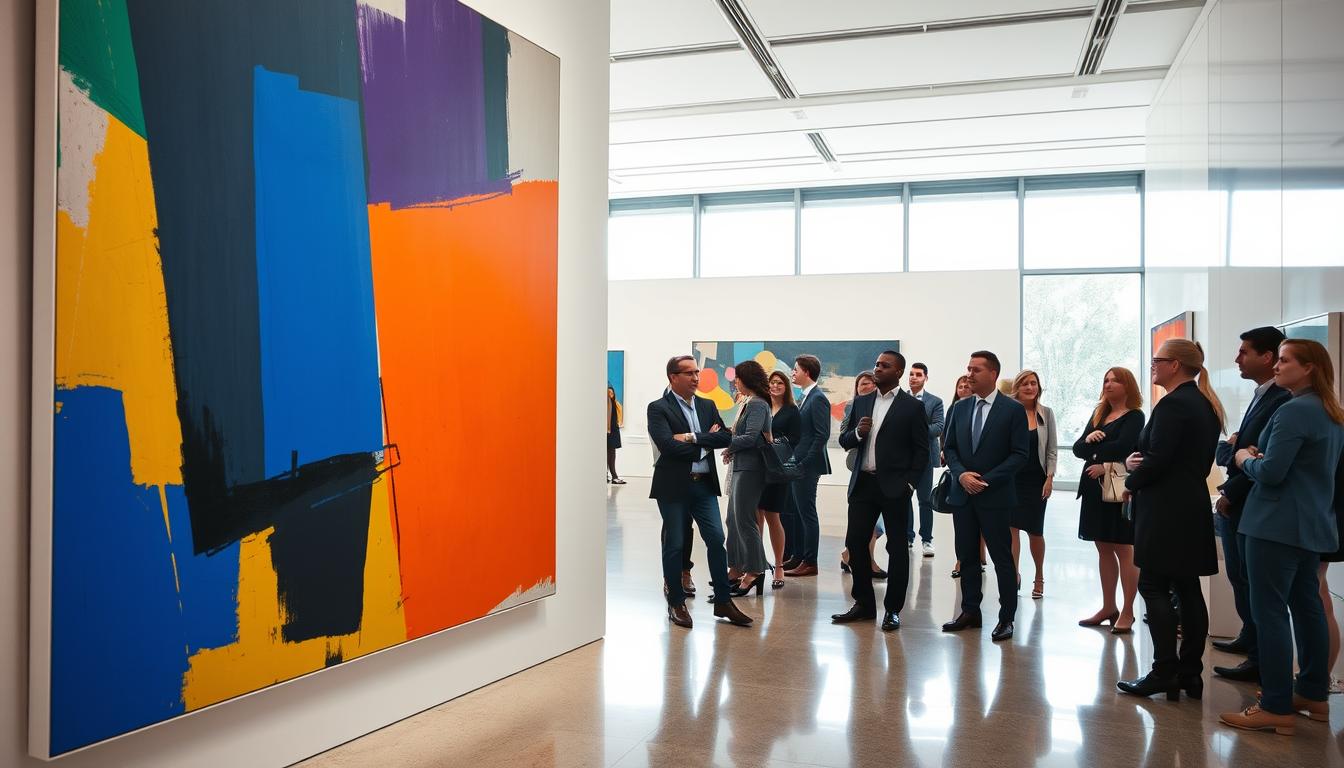

Have you ever wondered why certain works stop us in our tracks and change how we see the world?
I invite you on a curated tour of gallery-quality art—icons that shaped the 20th century and beyond. I trace how Pollock’s gesture, Rothko’s color fields, Warhol’s Pop, and Hockney’s cinematic quietude moved from studios into major institutions and popular culture.
These pieces capture moments in time while feeling timeless. You’ll find clear, elegant insight on why these works matter—how technique and vision raised everyday objects and emotion into enduring artwork.
From New York lofts to Los Angeles studios, the artists reshaped scale, subject, and color. Expect concise notes to inspire your space—museum-quality ideas that feel accessible and refined.
Key Takeaways
- Gallery-quality pieces set new standards in technique and influence.
- Iconic works connect personal feeling to broad cultural shifts.
- Artists transformed scale and subject across the 20th century and beyond.
- Major institutions helped cement the value and reach of these works.
- Use these examples to bring approachable luxury into your home.
Why These Captivating Examples Define Contemporary Painting Today
A handful of radical works redefined what a canvas can be and how we live with art. I trace how Warhol’s serial Pop images questioned consumer life; Pollock made gesture the subject; Rothko invited intimate, slow looking. These shifts helped reshape how we see color, scale, and image today.
The art world began to read paintings as proposals—ideas that cross media and spark debate. Kusama expanded rooms into immersive fields, and Banksy moved political images from streets into critical history. Together, these pieces stretched the boundaries of the movement and how viewers engage.
These artists mapped a modern history of innovation—gesture, color fields, Pop language, and street interventions traveling across the world. Their impact is visible in exhibitions, collections, and how we bring museum-quality ideas into the home.
- Precision and presence: clear ideas, vivid execution.
- Viewing habits: closer, slower encounters that enrich daily life today.
contemporary painting examples
This curated list highlights landmark works that turned bold ideas into clear visual language.
I name pieces you likely recognize—Warhol’s Campbell’s Soup Cans, Lichtenstein’s Look Mickey, Ruscha’s word paintings—alongside Pollock’s Autumn Rhythm and Rothko’s Orange, Red, Yellow. Each work reframes color, scale, and everyday subjects into striking images.
From Pop to abstraction—Basquiat, Haring, Kusama, Hockney, Murakami, Ai Weiwei, and Banksy—these creators show how a single image can become a series that deepens meaning. Koons, Saville, Tanning, and Stella add nuance: playful objects, intense figuration, surreal doorways, and structural geometry.
Why this matters: these works offer practical cues for interiors—palettes to borrow, compositional moves to echo, and series-based cohesion for a room. Use this distilled set as a guide to collect prints or editions that bring museum-quality presence into your home and the wider world.
- Distilled impact: clear titles that teach visual economy.
- Practical inspiration: palettes, form, and rhythm for interiors.
Pop Art Power: Warhol, Lichtenstein, and the Language of Mass Media
Pop Art reframed the everyday—turning brand packaging and comic strips into critical, museum-ready statements.
I look at three voices who made mass media the subject and the method of modern art.
Andy Warhol, Campbell’s Soup Cans, 1962
Andy Warhol used thirty-two panels to make repetition a language. The Soup Cans turned consumer goods into a cool, serial piece that both admired and questioned retail culture.
Roy Lichtenstein’s early comic-derived works
Lichtenstein’s Look Mickey and later canvases used industrial Ben-Day dots and comic contours. The sharp graphics read like critique and celebration—comic art scaled for the gallery.
Ed Ruscha and words-as-image
Ruscha shifted from abstraction to advertising tropes. His word paintings treat words as visual material—clean phrases on canvas that read as both sign and subject.
- Series logic: repetition and variation make each piece feel decisive.
- Visual strategy: color blocking and graphic line bring minimalist luxury to interiors.
- Cultural reach: these images travel across the world—magazines, galleries, and homes.
New York to Los Angeles: City Scenes That Shaped the Art World
From subway sketches to museum walls, the city taught a new visual language. I track how urban urgency turned quick marks into works that still hum with life.
Jean-Michel Basquiat’s transition from street symbols to museum-scale works
Jean-Michel Basquiat moved from SAMO graffiti into studio canvases in the early 1980s. He layered words, signs, and mixed media—then made paintings that felt like living documents.
Untitled (1981) reads as energetic and enigmatic—an emblem of a scene that mixed race, history, and urgency. New York’s energy forged his language; street-born symbols migrated quickly into powerful museum-scale work within years.
Keith Haring’s figures and icons traveling from the subway to the global stage
Keith Haring began with subway drawings—bold line and dancing figure. His icons—hearts, radiant babies—moved from public trains to global walls and refined gallery spaces.
Haring used simple, readable signs for activism—especially on AIDS and social causes—so his work kept clarity and a civic pulse even as it entered collections.
- City to institution: New York made the scene urgent and visible.
- Graphic clarity: figures and symbols read well at scale in homes and halls.
- Westward reach: Los Angeles exhibitions and collectors amplified market confidence and world visibility.
| Artist | Origin | Visual Signature |
|---|---|---|
| Jean-Michel Basquiat | New York (SAMO → studio) | Layered signs, words, mixed media |
| Keith Haring | New York (subway drawings) | Bold line figures, hearts, radiant babies |
| Scene Impact | 1980s New York → Los Angeles shows | Street sensibility formalized for museums |
Abstract Energies: Pollock, Rothko, and the Figure of Feeling
Gesture and hush coexist in two mid-century works that ask viewers to shift how they feel art. One moves with active motion; the other invites close, silent presence.
Jackson Pollock’s Autumn Rhythm and the power of gesture and scale
Autumn Rhythm (1950) shows Pollock’s drip method—dripping, pouring, and splashing paint while working on the canvas on the floor. The result is a restless field of line that reads like motion frozen in midair.
Mark Rothko’s Orange, Red, Yellow and intimate color fields
Orange, Red, Yellow (1961) is a room-sized color field that asks viewers to step close.
"We are to light a fire in the viewer,"
- Pollock’s work makes gesture the figure—paint as pictorial energy.
- The scale creates immersion—ideal for expansive walls.
- Rothko’s calm rectangles slow time and hold quiet power.
- Together they move abstraction from image toward distilled form.
These works anchor a century-long lineage—emotion rendered with restraint. For interiors, their palettes and proportions translate into serene, museum-quality statements that change the world of a room.
Icons and Images: Jasper Johns to Ellsworth Kelly
Jasper Johns and Ellsworth Kelly taught us to see the ordinary as a formal idea.
Johns elevated everyday symbols—flags, targets, numerals—into images that read as concept and surface. His encaustic textures and repeated motifs make each work feel like a study in memory and mark.
Kelly answered with calm rigor: crisp panels, pure color, and found shapes reduced to quiet form. His multi-panel logic and chance-based decisions refined how seriality could feel lyrical.
- Series and repetition: both artists returned to motifs to sharpen perception.
- Bridge across movements: work that links Abstract Expressionism, Minimalism, and Conceptual art.
- Home guidance: chromatic restraint and clean edges translate to minimalist interiors.
| Artist | Signature | Why it matters |
|---|---|---|
| Jasper Johns | Flags, targets; encaustic surface | Turns symbols into lasting icons |
| Ellsworth Kelly | Monochrome panels; found shapes | Distills form for serene presence |
| Legacy | Series across media | Museum surveys confirm world impact |
Monumental Imagination: Hirst, Koons, and the Question of “What Is Art?”
Certain monumental gestures in the late 20th century rewrote how the world values spectacle and finish.
Damien Hirst’s The Physical Impossibility of Death in the Mind of Someone Living—an actual shark suspended in formaldehyde—forced a debate about whether unusual media can be an artwork.
Jeff Koons’s Balloon Dog embraced fabrication and sheen—studio-made, mirror-like surfaces that trade subtlety for spectacle. His approach made pieces that read as luxury objects and public icons.
Both artists ask the perennial question: what is art? Their works split opinion and command attention. They belong to a broader movement of spectacle—post-20th century icons that own the room.
- Studio as engine: fabrication and finish become the creative language.
- Material matters: resin, steel, glass, and preserved organic matter alter meaning.
- Interior guidance: mirror-like surfaces and bold forms read as statement sculpture—playful yet polished.
"Imagination at monumental scale invites us to reconsider value, authorship, and audience."
The takeaway is simple: scale and choice of media change the conversation. Hirst and Koons show how style and studio practice shape a scene and how the world argues over what counts as art.
Immersion and Infinity: Yayoi Kusama’s Mirror Rooms

Step into a chamber where light and reflection erase edges—and make you part of the image.
Yayoi Kusama’s Infinity Mirror Room (1965) uses mirrors, tiny lights, and repeating dots to envelope a visitor. The effect multiplies images to the horizon. The intimate room meets cosmic scale.
Repetition holds quiet power—patterns dissolve time and open a contemplative place in life. Kusama’s motifs show how painting ideas expanded into immersive environments.
Viewers become part of the work—an image within images. The rooms feel playful and profound at once. They invite slow looking and a sense of presence as form.
- Transformative viewing: simple dots and light become endless vistas.
- Home inspiration: glow, reflection, and rhythmic pattern translate into ethereal accents.
- Museum to everyday: infinity rendered with elegant restraint.
| Work | Key Elements | Takeaway for Interiors |
|---|---|---|
| Infinity Mirror Room (1965) | Mirrors, lights, repeated motifs | Use reflective surfaces and small lights to suggest depth |
| Viewer Role | Participation; image becomes layered | Arrange seating to include the observer in the composition |
| Atmosphere | Playful, meditative | Balance glow with calm furnishings for museum-quality moments |
Bodies, Beauty, and the Brush: Jenny Saville and Cecily Brown
Two painters reframe the body—making flesh and gesture into a language of presence. I look at how scale and touch turn portraiture into something that feels both personal and public.
Jenny Saville’s Propped (1992) confronts beauty norms with frank, lush handling. Her figure asserts presence—thick brushwork and candid scale that recall Freud and Bacon while remaining unmistakably new.
Cecily Brown’s The Girl Who Had Everything (1998) dissolves boundaries. Her style blends abstract swirls and biomorphic, erotic forms so subjects emerge from movement and texture.
Both artists expand what figurative paintings can hold—psychology, desire, and vivid life lived in paint. Their works revel in materiality: brush, scrape, and glaze compose pieces of rare depth.
- Body as landscape: volumes and temperatures feel present across the room.
- Palettes for interiors: blush, umber, and cream bring warmth and museum-quality calm.
- Through the years: painting stays a living practice—modern, rooted in history, and open to ambiguity.
"Beauty expands when the brush speaks honestly—figure and form aligned."
Global Currents: Takashi Murakami’s Superflat to Ai Weiwei’s Remembering
Across borders, artists compress history and feeling into bold visual statements. I look at two decisive voices who link local memory to a global audience.
Takashi Murakami — Flower Ball and Superflat
Murakami coined Superflat by fusing anime, manga, and traditional Japanese two-dimensional art. Flower Ball (2002) pairs buoyant color with a glossy, flat finish.
The repeating flowers make a playful series—cheerful yet critical of postwar culture. These polished artworks travel easily and bring gallery-quality finish into private collections.
Ai Weiwei — Remembering and the politics of scale
Ai Weiwei used 9,000 children’s backpacks in Remembering (2009). The backpacks spelled out a mother’s words—a public sentence that the world could not ignore.
By choosing scale as a tool, he gives memory and loss an unmistakable image and moral power. The work asks viewers to hold fact and feeling at once.
- Local to global: both artists connect national histories to an international world.
- Craft meets message: the century’s technology refines tradition into polished statements.
- Collector note: Superflat palettes energize interiors; Weiwei’s restraint inspires spare, thoughtful displays.
"Art shapes the world—and the world shapes art."
Street to Gallery: Banksy’s Provocations and Political Images
Street stencils compress argument and wit into a single, unforgettable gesture. Banksy made the public wall an active forum—quick icons that stop passersby and ask for thought.
Love Is in the Air (Flower Thrower)
First painted in Bethlehem in 2003, Love Is in the Air swaps a thrown weapon for a bouquet. The shift reframes protest as a choice—grace instead of harm.
Jack & Jill (Police Kids)
In Jack & Jill, carefree children wear bulletproof vests labeled “POLICE.” The scene uses innocence and sparse words to question surveillance and authority.
"The provocation is measured—wit and empathy shaping how we engage with power."
- Public to private: Banksy turned the street into a gallery—images that read like museum-quality statements.
- Visual clarity: black, white, and a pop of color carry immediate punch in any place.
- Collectible restraint: limited prints keep lines crisp—these works travel from walls to auction rooms and homes.
- Scene and world: the interventions show that a façade can be a canvas—and meaning follows location.
Displayed at home, these pieces punctuate a room—quiet statements that begin thoughtful conversation about society and power.
Portraits, Pools, and Place: David Hockney’s Modern Life on Canvas

David Hockney made Los Angeles light into a visual language—sunlit pools, clear planes, and staged moments that read like film stills.
Portrait of an Artist (Pool with Two Figures) (1972) combines staged photographs into a sunlit composition. At auction it became the most expensive work by a living artist at the time—proof that a single image can reshape the market and the world of art.
Hockney distilled Los Angeles into clean blues, lush greens, and poised figures by the pool. His film sensibility—framing, edits, and staged references—guides how each work feels composed and effortless.
The result: a serene style that crystallizes place—sun, water, reflection rendered with calm luxury. Over the years his series celebrate modern life: friendships, rooms, gardens shown with clarity and warmth.
- Palette: luxurious yet calm—ideal for bright, airy interiors.
- Composition: horizontal planes and crisp edges that expand a room’s world.
- Collecting tip: prints from related series offer iconic imagery at approachable scales.
Forms, Symbols, and Series: Frank Stella and Cy Twombly
When form meets lyric, the result is a quiet revolution on canvas and beyond. I look at two careers that trace rule and breath through decades of work.
Frank Stella began with the Black Paintings—pinstriped patterns that made method visible. Ifafa II (1964) shows pattern and metallic acrylics moving into shaped canvas and relief.
Cy Twombly answered with loose, written gestures—blackboard loops, later Bacchus pieces, and poetic inscriptions that read like private history. His words and marks create atmosphere rather than literal narrative.
Both artists treat a single idea as a series—one method unfolds into many pieces over time. Their movement across paper, canvas, and relief keeps inquiry fresh and rigorous.
- Stella: system as beauty—precision, edge, and evolving form.
- Twombly: breath and myth—marks that summon memory.
- For interiors: graphic rhythm and airy grounds bring refined dynamism to walls.
"Series invite collecting—distinct episodes that hold together elegantly."
Women, History, and Life: Frida Kahlo and Dorothea Tanning
Frida Kahlo and Dorothea Tanning show how private vision can steer public history. Kahlo’s 1948 Self‑Portrait foregrounds the Tehuana dress and a stark gaze—an image born of pain and cultural pride. It binds personal life to national history with museum‑quality presence.
Dorothea Tanning moves across the century—from Birthday and Eine Kleine Nachtmusik to Door 84 (1984). That later door segment marks a shift toward luminous abstraction and hybrid form.
Their work claims narrative with careful symbols. Kahlo’s self‑portraiture blends cultural dress and bodily truth. Tanning’s compositions fold surreal figure into ether‑like space.
- Autonomy: self as subject—painted with museum‑quality detail.
- Palettes: earth, jewel, and shadow for nuanced drama.
- Legacy: exhibitions and scholarship secure their place in history.
"Vision anchored in selfhood alters the course of history."
| Artist | Key Work | Takeaway |
|---|---|---|
| Frida Kahlo | Self‑Portrait (1948) | Personal life, cultural dress, unflinching presence |
| Dorothea Tanning | Door 84 (1984) | From Surrealist figure to abstract, luminous space |
| Impact | Selected pieces | Images that shape history and keep speaking to the world |
Scale, Media, and Movement: How Today’s Artists Shape Subjects and Style
Today artists move between small panels and room-sized pieces—so scale becomes a language. I trace how intimate canvases and monumental installations create different presence and pace.
Media now includes mirrors, objects, and text—tools that extend painterly concerns of form, color, and composition. Rauschenberg’s assemblage and Kusama’s rooms show how material choices amplify a subject’s meaning.
Movement between the street, the gallery, and the home reshapes how subjects land. Banksy’s public gestures and Hirst or Koons’s monumental works ask the art world to meet viewers in different rooms and moods.
I look for disciplined style—clarity of edge, balanced color, compositional poise—that keeps painting’s core intact even as techniques hybridize. For decorators, these ideas translate into clear choices: pick scale to set presence, choose surface for finish, and borrow a palette to harmonize a room.
"Hybrid practice makes elegant variety—visual languages that feel at home in modern life."
For a practical guide on living with hybrid work, see artists to watch at artists to watch.
Conclusion
,What holds across eras is a clear image—one that reshapes rooms and the conversations inside them.
I see how works from Warhol to Banksy, Pollock to Hockney, Murakami to Ai Weiwei keep guiding the way we live with art today. Over time each piece reveals layers of history and craft. They teach balance, color, and scale for any place—home or museum.
Collect with calm confidence: choose work that feels immediate and lasting. For more on artists shaping the world now, explore a concise guide to the most famous painters today.
I close with an invitation: live with art today that will still move you tomorrow.
Enhance Your Space with Unique Modern Masterpieces by Chiara Rossetti

Are you inspired by the innovative mediums and conceptual depth highlighted in our exploration of contemporary art? You’re not alone! Today’s art enthusiasts are seeking cultural relevance and emotional connections in their artwork. However, finding pieces that resonate with modern themes and fit your unique style can be a challenge. That’s where we come in!

At Rossetti Art, we specialize in canvas prints, original paintings, and modern sculptures that celebrate the spirit of now. Each piece created by Chiara Rossetti brings a personal touch that connects deeply with current social narratives—just like the modern masterpieces discussed in the article. Don’t miss out on the chance to elevate your home decor with breathtaking artwork that speaks to your values and aesthetic. Explore our collection today and find your perfect piece! Act now, and transform your space into a gallery of inspiration!

FAQ
What makes these captivating contemporary works worth admiring?
I look for pieces that combine strong concept and craft — works that reshape familiar images, explore scale, or use media in surprising ways. Museum-quality technique, evocative symbolism, and emotional clarity help a work feel both timeless and of the moment.
How do Pop Art pieces by Warhol and Lichtenstein still influence art today?
Their use of mass-media imagery and commercial techniques redefined the relationship between high art and everyday life. Warhol’s repetition and Lichtenstein’s comic-book language introduced visual vocabularies that artists still remix to critique media, celebrity, and consumer culture.
Why are New York and Los Angeles so important to the art scene?
Each city created conditions where street culture, galleries, and film intersected. New York gave rise to figures like Jean-Michel Basquiat and Keith Haring; Los Angeles fostered artists responding to film, architecture, and suburban flux. Both cities shaped careers and global narratives.
How do abstract works by Pollock and Rothko communicate feeling without figures?
Through gesture, scale, and color. Pollock’s energetic marks convey motion and chaos; Rothko’s fields invite quiet, inward attention. Both rely on viewer presence — the body and the gaze become part of the experience.
What role do text and vernacular play in Ed Ruscha’s and Jasper Johns’s work?
Words and familiar symbols collapse private and public meaning. Ruscha’s word paintings highlight American language and signage; Johns’s targets and flags make viewers question how objects accrue cultural weight.
How do contemporary artists challenge the question “What is art?”
Artists like Damien Hirst and Jeff Koons provoke by elevating readymades, spectacle, or commodities. Their work blurs commerce, concept, and craftsmanship — forcing institutions and collectors to debate value, ethics, and authorship.
Why is Yayoi Kusama’s immersion important for viewers today?
Kusama’s mirror rooms dissolve boundaries between object and observer. They offer a contemplative, almost spiritual encounter with repetition and infinity — a sensory way to experience scale, light, and pattern.
How do contemporary painters address bodies and beauty now?
Artists such as Jenny Saville and Cecily Brown reclaim the figure through materiality and presence. They use brushwork and scale to confront idealization, celebrating flesh, vulnerability, and painterly truth.
In what ways do global voices like Takashi Murakami and Ai Weiwei reshape narratives?
Murakami blends pop aesthetics with Japanese history, while Ai Weiwei addresses politics and memory at monumental scale. Both show how local cultures and global media create new visual languages and civic dialogues.
How has street art moved from walls to major museums?
Street artists such as Banksy translated urgent public images into works that museums preserve and debate. That shift raises questions about context, authorship, and the politics of display — while bringing activist energy into institutional spaces.
What should collectors consider when choosing museum-quality works for the home?
Think about scale, light, and how a piece will converse with your space. Prioritize craftsmanship and provenance. I recommend selecting works that inspire daily — pieces that feel both refined and emotionally resonant.
How do artists use series and repetition to develop ideas?
Series let artists explore subtle shifts in form, color, or symbol. Frank Stella and Cy Twombly used serial approaches to refine visual language; repetition can intensify meaning and reveal structure over time.
What is the value of images from film and mass media in modern art?
Film and media provide a shared visual vocabulary. Artists mine those images to question memory, identity, and power — turning familiar motifs into tools for critique or nostalgia.
How can someone new to art start building a thoughtful collection?
Begin with works you live with — focus on quality rather than trend. Visit galleries, read artist statements, and ask about editions and framing. I suggest starting with limited, meaningful purchases and growing the collection intentionally.

About the Author
Chiara Rossetti
Chiara Rossetti is the founder of Rossetti Art, a canvas print and original art brand. She writes about interior design, wall art styling, and the art of making a home feel alive.

Leave a comment
This site is protected by hCaptcha and the hCaptcha Privacy Policy and Terms of Service apply.