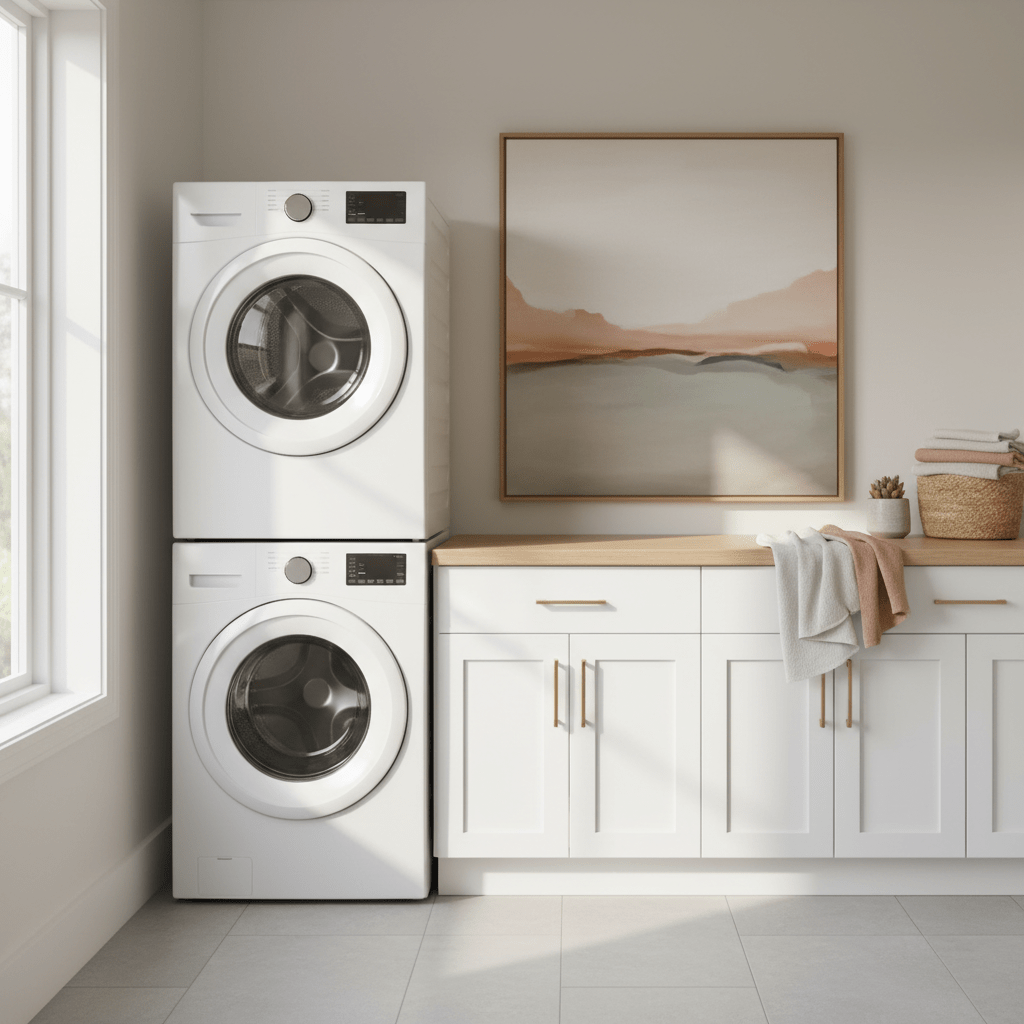
The laundry room is usually the last space anyone decorates — and often the first one people forget to enjoy. It gets a washer, a dryer, maybe a folding counter, and then nothing else, as if the room's only job is to be functional. But you probably spend more time in there than you think: sorting colors, waiting on a cycle, folding towels while half-listening to a podcast. That adds up to real time in a room most homes treat as an afterthought. A well-chosen piece of laundry room wall art changes that — not by making the room fancier than it needs to be, but by making it feel like part of the house instead of a leftover utility closet.
Why Laundry Rooms Deserve Real Wall Art
Most laundry rooms share the same three problems: they're small, they're plain, and they're lit by a single overhead bulb that flattens everything in the room. That combination actually works in your favor when it comes to decorating, because it means one well-placed piece of art can do an enormous amount of visual work. You don't need a gallery wall or a coordinated theme — you need one piece that's confident enough to hold its own against white cabinets and stainless appliances.
A good canvas print in a laundry room does three things at once. First, it softens all those hard, straight lines — cabinet edges, machine doors, shelving brackets — that otherwise make the room feel sterile. Second, it introduces color into a space that's almost always painted a safe, neutral shade, since laundry rooms rarely get the same design attention as a living room or bedroom. Third, and maybe most importantly, it signals that this room was actually considered, not just plumbed and forgotten. Guests notice small, purposeful touches like this more than you'd expect, and it changes how the whole house reads.
Choosing the Right Print for a Small, Humid Room
Laundry rooms run warmer and more humid than the rest of the house, especially right after a dryer cycle finishes, and that has real consequences for what kind of art actually survives there long-term. Material matters more here than in almost any other room in the house.
Canvas handles heat and humidity far better than framed paper prints or posters. Paper under glass can trap moisture and start to ripple, warp, or even develop faint water spotting near a dryer vent, especially in a room without great ventilation. Canvas, on the other hand, is a woven fabric stretched over a frame — it flexes slightly with humidity instead of buckling, and a properly finished print won't show the same damage over time.
When you're shopping, look specifically for a giclée canvas print with a moisture-resistant coating. Giclée printing uses archival, fade-resistant inks and produces sharper, richer color than standard inkjet reproductions, which matters in a room that often only gets a few hours of bright light a day. For the finish, choose a gallery-wrapped or floating-frame canvas rather than anything under glass or acrylic — glass fogs with steam and is one more surface that can crack or get knocked loose near a laundry basket in transit.

5 Style Ideas That Actually Work in a Laundry Room
Not every style translates well to a small utility space. Here are five that consistently do.
Botanical line art. Simple, single-line botanical illustrations — a fern, an olive branch, a loose floral sketch — keep a small room feeling calm and uncluttered rather than busy. Because the line work is minimal, it doesn't compete with the visual noise of shelving, detergent bottles, or an open cabinet.
Soft abstract prints in warm neutrals. An abstract piece in cream, warm terracotta, or soft sage adds real color to an all-white room without ever feeling like it's trying too hard. This is often the easiest style to place because it doesn't need to "match" anything specific — it just needs to feel warm.
Black-and-white photography. A black-and-white cityscape, a close-up botanical photo, or an abstract textural print reads clean and modern against white subway tile, shiplap, or plain painted drywall. It's a reliable choice if the rest of your laundry room is already fairly minimal.
Coastal blues. A single wave study, a blue-toned abstract, or a soft ocean horizon print brings a fresh, almost spa-like feeling into a room that's otherwise all business. This works especially well if your laundry room has any natural light at all — blue tones read best with a little daylight.
One oversized statement piece. Rather than assembling a small gallery wall, laundry rooms usually look better with a single larger piece. Floor space and wall space are both limited, so one confident canvas print does more for the room than three or four smaller frames competing for attention in a tight area.
"Low Horizon," a quiet black-and-white landscape canvas print, is the kind of single statement piece that works beautifully above a washer and dryer without competing for attention.
Explore Low Horizon →
Where to Hang It
Placement in a laundry room is a little different from placement in a living room, mostly because you're working around fixed appliances and plumbing. As a general rule, center the piece above the folding counter if you have one, or above the washer and dryer if you don't, at roughly eye level for someone standing in front of it — typically 57 to 60 inches from the floor to the center of the piece, the same standard used in galleries.
Keep the print at least a foot away from any direct water source: a utility sink, an exposed pipe joint, or anywhere a hose connection lives. Small leaks happen, and canvas near a slow drip is the one scenario that actually can cause lasting damage. Also leave a little breathing room around dryer vents and exhaust points — not because the heat itself is dangerous to canvas in short bursts, but because concentrated heat exposure over months and years can gradually dull ink saturation faster than normal ambient warmth would.
If your laundry room doubles as a mudroom or hallway pass-through, consider hanging the piece where it's visible from the doorway rather than tucked behind a door swing — you want the art doing its job even when you're just walking past, not only when you're standing at the machines.
Will Humidity Damage a Canvas Print?
This is the question we hear most often, and the honest answer is: not under normal conditions. A quality canvas print with a proper protective coating is built to handle everyday humidity swings — the kind that come from a dryer cycle or an open door on a rainy day. What actually causes damage is direct water contact (a splash from an overflowing washer, a leaking connection) or placing a print so close to a steam vent that it's essentially sitting inside a small, repeated sauna. Keep a reasonable distance from both of those specific hazards and a well-made canvas print will hold its color and shape for years, the same as it would in any other room of the house.
What Size Should I Choose for a Small Laundry Room?
Sizing wall art for a small room trips people up more than any other decision, mostly because the instinct is to go smaller to "match" the room. In practice, the opposite usually looks better. As a rule of thumb, choose a print that covers roughly two-thirds of the available wall width above your counter or machines — not the full width, but more than half. In most laundry rooms, that lands somewhere between 16x20 and 24x36 inches, which is large enough to feel intentional and confident without overwhelming a small footprint. A print that's too small just reads as an afterthought pinned to a big blank wall, which defeats the whole purpose of adding art in the first place.
If your laundry room is unusually narrow — a closet-style setup rather than a full room — a vertical orientation almost always outperforms a horizontal one, since it works with the shape of the space instead of against it.
Matching Your Laundry Room Art to the Rest of Your Home
One mistake people make with laundry room decor is treating it as a completely separate design decision from the rest of the house — picking whatever's cheapest or whatever happens to be on sale, since "it's just the laundry room." The problem is that laundry rooms are rarely fully closed off anymore. In a lot of homes built or renovated in the last decade, the laundry room sits just off the kitchen, opens onto a mudroom, or is visible from a main hallway. That means it's part of the visual flow of the house whether you plan for it or not, and art that clashes badly with your kitchen or living room palette will stand out in the wrong way every time someone walks past.
You don't need to match perfectly — in fact, a laundry room is actually a good place to introduce a slightly bolder color or style than you'd use in a more formal room, since it's low-stakes and easy to change later. But it helps to at least stay in the same general family. If your kitchen leans warm and neutral, a soft abstract in cream and terracotta will feel like a natural extension of the space rather than an interruption. If your home has a lot of black-and-white or high-contrast accents already, a black-and-white photographic print in the laundry room will read as intentional rather than random. Coastal blues work best in homes that already lean toward a relaxed, airy palette — dropping a beach-toned piece into an otherwise dark, moody interior can feel out of place.
A simple gut check: stand in the doorway of the laundry room and look back toward the kitchen or hallway it connects to. If the art you're considering would look reasonable hanging in that adjoining space too, it's a safe choice for the laundry room as well.
Common Mistakes to Avoid
A few small missteps show up again and again in laundry room decorating, and they're easy to avoid once you know to look for them.
Going too small. As covered above, undersized art is the most common mistake by far. A small 8x10 print on a large blank wall doesn't read as minimalist — it reads as an afterthought that got left there by accident.
Choosing a busy, high-detail piece. Laundry rooms are functional, high-traffic spaces, and busy, highly detailed artwork (dense patterns, cluttered scenes, very saturated maximalist prints) tends to compete with the visual noise already in the room — baskets, detergent bottles, hanging racks. Simpler compositions with a clear focal point hold up better over time.
Ignoring the humidity and heat issue entirely. This is the one that causes real, avoidable damage. A beautiful paper print in a thin frame might look perfect on install day and start rippling within a few months. Spending a little more on a proper canvas print upfront saves you from replacing a ruined piece later.
Hanging too high or too low. Because laundry room walls are often broken up by shelving, cabinets, or a folding counter, it's tempting to just hang the art wherever there's empty space, even if that's well above or below eye level. Stick to the standard 57-60 inch center-height guideline whenever the wall allows it, and adjust only if a fixed appliance genuinely forces your hand.
Forgetting the room needs a focal point at all. The most common "mistake," honestly, is doing nothing — leaving the laundry room as four plain walls because it feels like a lower priority than the rest of the house. Given how much time most people actually spend in there, it's one of the easier rooms to notice a change in.
Budget-Friendly Ways to Get Started
You don't need to commit to your largest or most expensive piece of laundry room wall art to start improving the space. A single mid-size canvas print in the 16x20 to 20x30 range is usually enough to transform the room without a major investment, and it's a low-risk way to test a style or color direction before committing to something larger elsewhere in the house. Because laundry rooms are relatively small and enclosed, they're also a good place to experiment with a bolder color or more unusual composition than you might choose for a living room — if it doesn't work, it's an easy, inexpensive swap later, and if it does work, you'll have a genuine head start on figuring out what style suits your home.
Ready to find the right piece? Browse Rossetti Art's laundry room wall art collection for sizes and finishes that hold up beautifully in any room of the house, from the living room to the laundry room.
Frequently Asked Questions About Laundry Room Wall Art
Will humidity from the dryer ruin a canvas print?
Not under normal conditions. A quality canvas with a protective coating handles everyday humidity swings well — the real risks are direct water splashes and placing a print too close to a steam vent.
What size laundry room wall art should I buy?
As a rule of thumb, choose a print covering roughly two-thirds of the wall width above your counter or machines — typically 16x20 to 24x36 inches for most laundry rooms.
Is canvas better than a framed paper print for a laundry room?
Yes. Canvas flexes with humidity rather than rippling or warping the way paper under glass can, especially near a dryer vent.
Where's the best spot to hang art in a laundry room?
Centered above your folding counter or washer and dryer, at roughly 57-60 inches from the floor to the center of the piece, and at least a foot away from any water source or vent.
Keep Reading

About the Author
Chiara Rossetti
Chiara Rossetti is the founder of Rossetti Art, a canvas print and original art brand. She writes about interior design, wall art styling, and the art of making a home feel alive.

Leave a comment
This site is protected by hCaptcha and the hCaptcha Privacy Policy and Terms of Service apply.