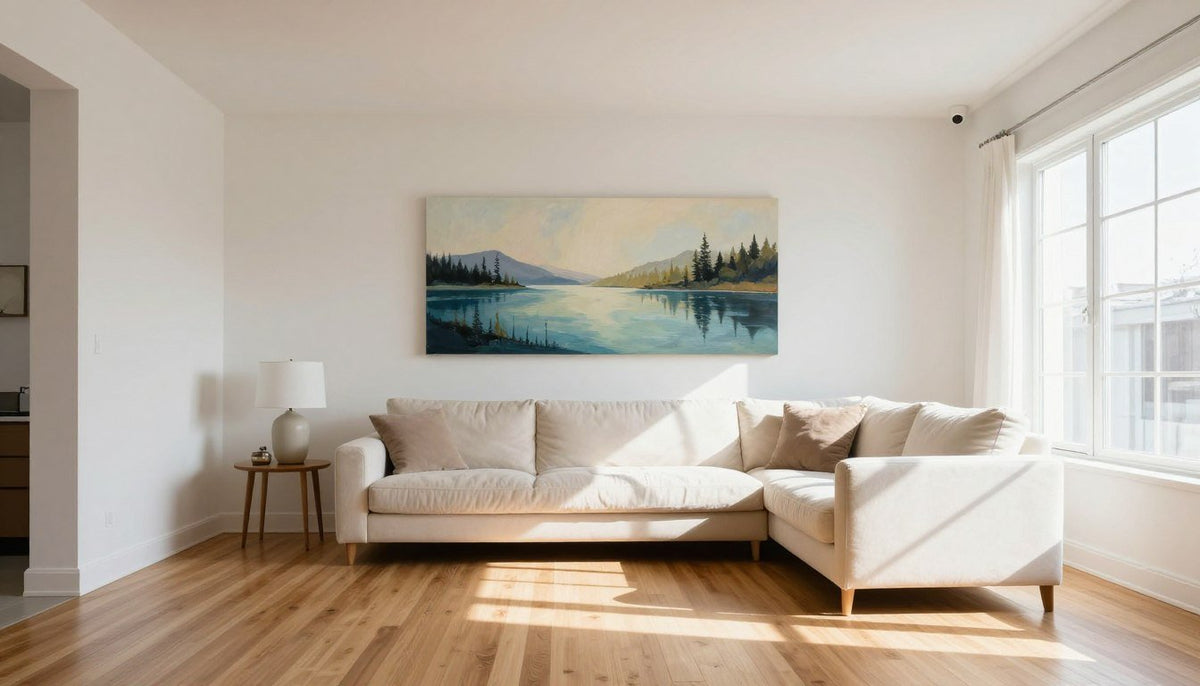
Decorating an expansive partition requires anchoring the vertical space so the room feels cohesive rather than empty. When deciding how to decorate a long wall in living room layouts, the most dependable strategy combines an oversized horizontal canvas with intentional furniture layering. Establishing a clear focal point immediately prevents the space from resembling an endless hallway.
Quick Answer
To decorate a long wall in a living room, anchor it with one wide horizontal canvas that spans about two-thirds to three-quarters of the sofa or console below it. Then layer in a lamp, shelf or console so the wall connects to the room, and keep the palette calm and neutral.
The overall width of your seating, the ceiling height, and the natural traffic paths determine whether a single statement piece or a curated grouping works best. Balancing proportion and texture allows the entire surface to support your daily living activities comfortably.
Rossetti Art
Explore Oversized Statement Artwork
Find expansive proportions designed specifically for wide walls and open living spaces, with free worldwide shipping on every canvas.
Shop Long Horizontal Wall Art →
Why Long Walls Feel Hard to Decorate
A wide, uninterrupted wall often disrupts the proportion of a living area by creating too much visual silence. Without deliberate anchor points, the expanse makes nearby furniture appear miniature and leaves the seating arrangement feeling disconnected. Standard wall decor ideas for long wall spaces fail when they rely on standard retail frame sizes that quickly get lost across twenty feet of drywall.
Human vision naturally searches for resting points across open architecture. When an expanse lacks defined breaks, the eye wanders aimlessly, which makes living areas feel cold, unfinished, or overly commercial. Treating the wall as an architectural feature rather than empty background helps integrate it directly into your everyday layout.
Large partitions require visual weight to feel grounded. Choosing substantial pieces that match the physical length of your room establishes comfortable sightlines from every entryway.

Open sightlines along continuous living room walls require deliberate visual anchors to feel comfortable and complete.
Start with One Long Horizontal Statement Piece
A single panoramic canvas provides immediate stability across an extended perimeter. Selecting one commanding artwork solves the scale problem in a single design choice, keeping the area sophisticated and free of visual clutter. To achieve proper balance, review The 2/3 Rule for Wall Art: What You Need to Know to verify that your selected canvas spans roughly two-thirds to three-quarters of the furniture piece sitting beneath it.
This sizing principle creates a unified vertical unit between the wall and your primary seating or credenza. Placing an undersized frame over an expansive sofa creates an awkward disconnect that emphasizes the emptiness of the surrounding drywall. A substantial horizontal canvas bridges that gap smoothly, establishing an undeniable anchor for the entire interior.
- Measure the full width of your sofa or sideboard before choosing art dimensions.
- Select artwork that spans approximately two-thirds to three-quarters of that furniture width.
- Hang the piece so the bottom edge rests six to ten inches above the furniture back.
For extensive spaces that demand both scale and subtle depth, consider Whispering Horizon. This horizontal piece offers sizes up to 81 x 54 in and incorporates a serene palette of ivory, warm beige, taupe, misty grey, and deep charcoal. Printed on poly-cotton canvas using UV- and fade-resistant HP latex inks that carry UL GREENGUARD Gold certification, it is hand-stretched over a 1.25-inch hardwood frame with a satin-matte low-glare finish and arrives ready to hang, with an optional handcrafted poplar hardwood floater frame available.

A wide canvas anchored directly over a main sofa establishes immediate proportion and visual structure.

“Whispering Horizon”: a wide neutral canvas for long living room walls. View the piece →
Wall Length and Furniture Width: Art Size Guide
Choosing proper dimensions prevents the frustration of unboxing prints that look diminutive on an expansive partition. The guide below demonstrates how standard furniture lengths pair with ideal horizontal art spans across different layouts.
| Furniture or wall width | Art width to aim for | Best layout | Our example |
|---|---|---|---|
| 72 in | 48 to 54 in | Single centered canvas | Sand Drift in cream, warm sand-beige, and pale silver-grey |
| 84 in | 56 to 63 in | Horizontal statement piece | Low Horizon in warm cream, near-black, charcoal, and mid-grey |
| 96 in | 64 to 72 in | Oversized canvas | Still Divide in deep charcoal, graphite, warm cream, and pale beige |
| 120 in | Up to 81 in, or a custom size | Panoramic format | Open Plains in golden amber, warm cream, raw sienna, and soft grey, or Whispering Horizon up to 81 x 54 in |

Layer with a Console, Shelf or Lamp So the Wall Feels Connected to the Room
Wall decor should never float in isolation from the remainder of your furnishings. Adding floor-based elements such as a low wooden console table, an architectural floor lamp, or a sculpted accent chair anchors the vertical plane directly to the ground. This multi-tiered arrangement bridges the distance between baseboards and ceiling lines.
Applying the composition principles described in the Rule of thirds helps establish natural visual rhythm across long physical surfaces. By offsetting a tall ceramic lamp to one side while centering artwork above a console, you generate dynamic interest that keeps the wall engaging from multiple viewing angles.
Grounding Credenzas
Positioning a long wooden sideboard beneath your display grounds the expanse and provides a sturdy horizontal foundation.
Flanking Illumination
Installing wall sconces or placing a tall floor lamp at the boundary softens corners and illuminates textural artwork finishes evenly.

Layering low consoles and accent lighting ties elevated wall displays directly into the surrounding room layout.
Break Up the Wall with a Gallery Arrangement or a Pair
When a single panoramic print is not desired, dividing the expanse into a balanced set creates rhythm without sacrificing scale. A diptych, triptych, or structured grid divides broad square footage into digestible focal points while preserving overall cohesion. For advice on balancing frame finishes, consult How to Mix and Match Art Prints for a Stunning Gallery Wall.
The key to executing multi-piece installations on long surfaces lies in maintaining consistent spacing between frames. Keeping margins tight, typically between two and four inches, allows the individual components to register visually as one unified installation. Spreading smaller pieces too far apart makes them appear untethered and dilutes their decorative presence.
Structured Diptychs
Pairing two complementary prints side by side spans significant horizontal width while introducing a clean vertical seam that breaks monotonous wall space.
Harmonious Triptychs
Spanning three matched pieces across an extensive wall creates visual tempo, guiding the eye smoothly across the length of the living area.
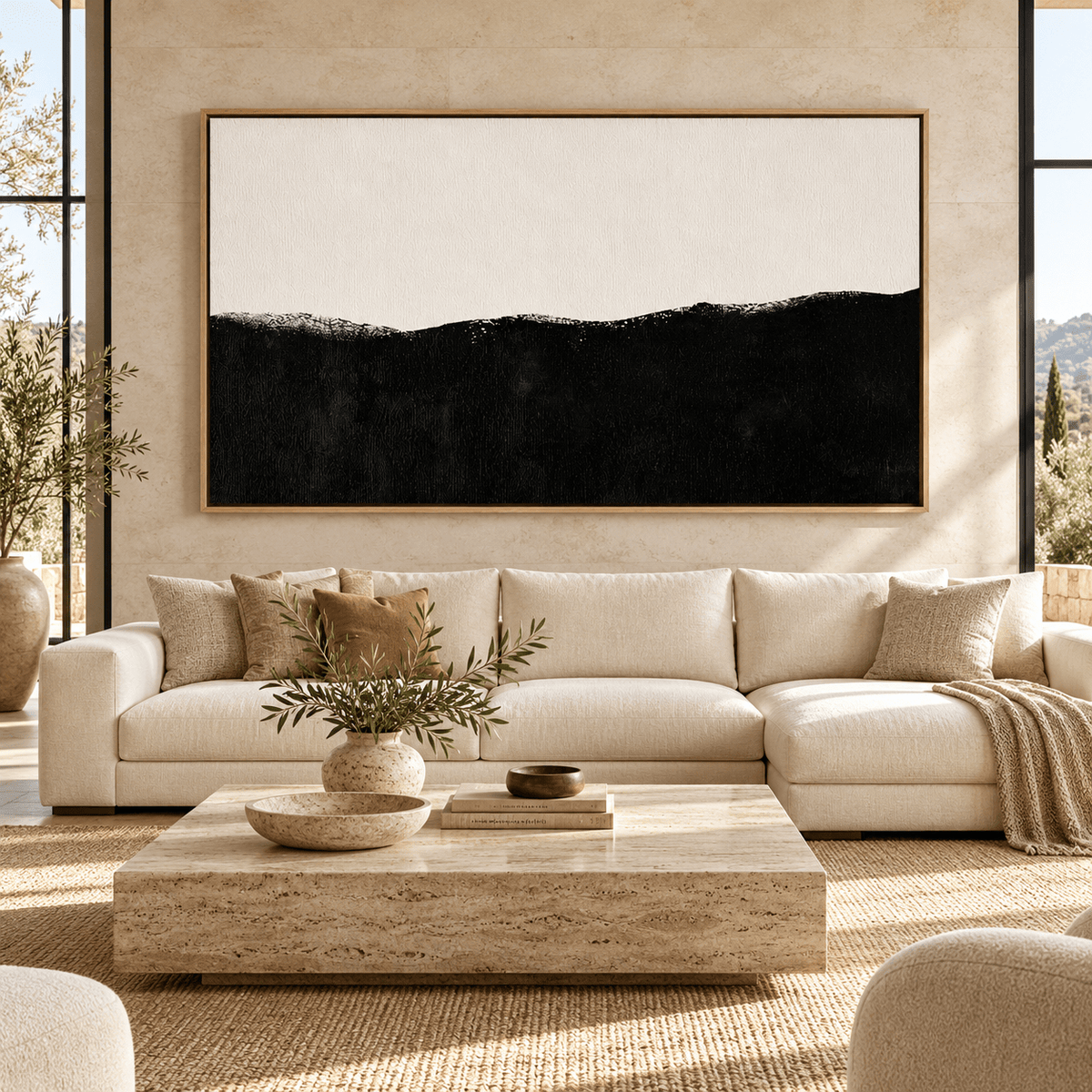
A striking option for pairing or standalone horizontal balance is Low Horizon. Styled with balanced tones of warm cream, near-black, charcoal, and mid-grey, it delivers strong structure to open walls. Made to order on durable poly-cotton canvas, this piece includes 30-day returns and free worldwide shipping.

“Low Horizon”: warm cream, near-black and charcoal in a wide horizontal format. View the piece →
Keep the Colors Calm: Neutral Palettes for Long Walls
Because an expansive wall occupies a huge portion of your field of view, aggressive color patterns can overwhelm the living space. Soft hues featuring ivory, taupe, misty grey, and muted stone provide visual presence while letting natural daylight move through the room. Review the Guide to Choosing and Styling Abstract Wall Art to understand how quiet textures enrich open layouts.
Neutral tones also give you flexibility when updating soft furnishings, rugs, or seasonal accessories throughout the year. Subdued horizontal artwork creates an elegant backdrop that complements natural materials like wood, stone, and woven textiles without visual conflict.
Subtle color transitions create enduring visual comfort. Choosing gentle earth tones prevents expansive statement art from dominating your everyday living environment.
A prime example of soothing minimalism is Sand Drift. Two wide diagonal brushstrokes, one warm sand-beige and one pale silver-grey, cross a near-bare cream canvas and bring quiet texture to wide surfaces. Each print is hand-stretched over a 1.25-inch hardwood frame with a satin-matte low-glare finish, keeping reflections minimal under bright living room lighting.
Rossetti Art
See It on Your Wall Before You Buy
Every product page has a Live Preview button that shows the artwork on your own wall, so you can check size, lighting and palette before you order.
Try Live Preview →
Calm palettes create a spacious atmosphere across large wall surfaces without conflicting with adjacent furnishings.

“Sand Drift”: two brushstrokes on a cream canvas. View the piece →
FREE ROOM-BY-ROOM ART GUIDE
Get our free guide to choosing art size and placement for the living room, bedroom, office and entryway.
Download Free →Common Mistakes
Decorating a massive surface requires avoiding disproportionate sizing and haphazard placements that detract from your home. Stepping back to inspect the entire room from primary seating positions reveals whether your wall arrangement aligns naturally with architectural sightlines.
Focusing on foundational scale rules prevents common styling missteps that make beautiful rooms feel awkward or disjointed.
Art Too Small
Hanging a standard medium frame on a vast partition leaves vast negative space, making the artwork appear lost and the entire wall look incomplete.
Art Hung Too High
Mounting canvases near the ceiling disconnects them from furniture lines, creating uncomfortable neck strain and severing visual flow.
Too Many Small Frames
Scattering dozens of small frames across an open perimeter generates visual noise that fragments sightlines instead of anchoring the room.

Frequently Asked Questions
How to break up a very long wall?
Breaking up a very long wall works best by dividing the perimeter into functional zones. Combine an oversized horizontal canvas above your sofa with a secondary grouping, such as a tall shelving unit or a reading nook with an accent chair and floor lamp, to establish comfortable visual pacing.
How to decorate a 20 ft long wall?
Decorating a 20 ft long wall requires substantial scale so the perimeter does not feel cavernous. Position a generous horizontal canvas spanning at least 60 to 80 inches above your primary credenza or seating, then flank the arrangement with tall potted greenery, structural wall sconces, or vertical display shelving.
What is the 3-5-7 rule in decorating?
The 3-5-7 rule is a styling guideline recommending that accessories and decorative items be arranged in odd-numbered groupings. Arranging three, five, or seven objects together creates natural asymmetry, encouraging the viewer's eye to move across a console table or shelf rather than locking onto rigid, paired symmetry.
What size wall art should I hang above a sofa?
Wall art hanging above a sofa should measure approximately two-thirds to three-quarters of the sofa's overall width. For example, an 84-inch sofa pairs naturally with artwork between 56 and 63 inches wide, positioned six to ten inches above the back of the sofa to preserve unified vertical balance.
Can I get wall art in a custom size?
Yes, every piece is made to order in any dimension. Because our canvas prints are individually produced, custom proportions can be tailored to match the unique dimensions of your living room wall. Simply message us for a quote with your specific sizing requirements before placing your order.
Bringing Balance to Your Living Room Wall
Transforming an extensive partition begins with respecting scale and establishing a commanding visual anchor. By combining expansive horizontal artwork with grounded furnishings and soothing neutral palettes, your living area gains enduring warmth and architectural harmony.
Ready to choose? Browse long horizontal wall art for walls that need 60 inches or more, or explore our large canvas prints.
Keep Reading
About the Author: Chiara Rossetti is the founder of Rossetti Art, a canvas print and original art brand. She writes about interior design, wall art styling, and the art of making a home feel alive.

About the Author
Chiara Rossetti
Chiara Rossetti is the founder of Rossetti Art, a canvas print and original art brand. She writes about interior design, wall art styling, and the art of making a home feel alive.


Leave a comment
This site is protected by hCaptcha and the hCaptcha Privacy Policy and Terms of Service apply.