
Geometric abstract art represents one of the most influential visual languages in modern aesthetics. Using precise mathematical shapes—circles, triangles, squares, and lines—artists create compositions that balance structure with emotional impact. This art form strips away representational elements to focus on the pure relationships between forms, colors, and spaces.
Whether you're looking to understand this compelling art movement or seeking the perfect geometric piece for your home, this guide explores everything from its foundational principles to practical tips for selecting and displaying these striking works.
Quick Answers: Geometric Abstract Art
- Geometric abstract art uses precise mathematical shapes arranged in non-representational compositions
- Key elements include clean lines, bold shapes, controlled color palettes, and deliberate composition
- Best recognized by crisp edges, repeated patterns, visual rhythm, and mathematical precision
- Works well in modern, minimalist, and contemporary interior spaces
- Larger pieces create dramatic focal points; smaller works add subtle geometric accents
- Consider room function and existing color palette when selecting geometric art
- Most versatile in living rooms, home offices, and hallways where visual impact is appreciated
What Is Geometric Abstract Art?

Geometric abstract art emphasizes precise shapes, clean lines, and deliberate composition
Geometric abstract art is defined by its use of precise, mathematical forms arranged in non-representational compositions. Unlike figurative art that depicts recognizable objects or scenes, geometric abstraction focuses on the relationships between shapes, lines, and colors to create visual harmony and emotional resonance.
This art form feels inherently modern because it embraces clarity, precision, and architectural sensibilities. The mathematical foundation creates a sense of order that resonates with our built environment, while the abstract nature allows for personal interpretation and emotional connection.
Core Principles of Geometric Abstract Art
Balance
Geometric art often achieves visual equilibrium through symmetrical arrangements or by carefully balancing asymmetrical elements. This creates a sense of stability that feels both satisfying and sophisticated.
Rhythm
Repeated shapes and patterns establish visual rhythm, guiding the viewer's eye through the composition. This creates movement and energy, even within static forms.
Negative Space
The areas between shapes are as important as the shapes themselves. Effective use of negative space creates breathing room and highlights the geometric elements.
Contrast
Strong contrasts—whether in color, size, or orientation—create visual tension and interest. This principle helps geometric compositions avoid feeling flat or predictable.
How to Recognize Geometric Abstract Art (A Quick Checklist)

Various examples of geometric abstract art showcasing different approaches to the style
- Crisp, clean edges defining shapes
- Mathematical precision in form and arrangement
- Repeated geometric elements creating patterns
- Deliberate use of negative space
- Non-representational composition (no recognizable objects)
- Controlled color palette with clear boundaries
- Visual rhythm through repetition or progression
- Balance achieved through symmetry or careful asymmetry
- Emphasis on spatial relationships between elements
- Often creates optical effects or illusions of movement
Geometric Abstract Art Styles (with Vivid Examples)
Hard-Edge Geometry

Hard-edge geometry emphasizes crisp boundaries and bold color relationships
Hard-edge geometry embraces precision with razor-sharp boundaries between color fields. These works feature clean lines, flat color application, and a sense of architectural clarity. The style creates a sense of order and mathematical certainty while allowing for bold color relationships.
Imagine pristine triangles in navy and crimson arranged with mathematical precision, or perfect circles intersecting to create new forms, each color area meticulously separated from its neighbor. The effect is both meditative and energizing—a visual statement of controlled harmony.
Placement tip: Hard-edge geometric pieces work beautifully in minimalist spaces where they can command attention without competing with busy décor. Consider placing above a clean-lined sofa or in an entryway where their precision sets the tone for your space.
For a stunning example of flowing hard-edge geometry, Geometric Flow from Rossetti Art demonstrates how precise edges can still create a sense of movement and energy.
Op-Art & Optical Line Illusions

Op-art creates dynamic visual effects through precise geometric patterns
Op-art (optical art) uses geometric precision to create stunning visual illusions. These works seem to vibrate, pulse, or move as you observe them, creating an active viewing experience that engages the eye and mind.
Picture a grid of black and white lines that appears to ripple across the canvas, or concentric circles in contrasting colors that create a pulsating effect. Some op-art pieces use subtle gradations within geometric forms to create the illusion of three-dimensionality from completely flat surfaces.
Placement tip: Op-art creates dynamic energy, making it ideal for spaces where you want to stimulate conversation and engagement. These pieces demand attention, so give them breathing room and avoid placing them in already visually busy areas.
Bauhaus-Inspired Forms

Bauhaus-inspired geometric art often features primary colors and fundamental shapes
Bauhaus-inspired geometric art celebrates fundamental shapes and primary colors with a playful yet disciplined approach. This style draws from the influential German design school that merged fine art with functional design principles.
Envision bold red circles, yellow triangles, and blue squares arranged with mathematical precision yet playful intent. These works often feature a white or neutral background that allows the pure geometric forms to stand out. The composition may appear simple at first glance but reveals thoughtful balance and rhythm upon closer inspection.
Placement tip: Bauhaus-inspired pieces bring energy and a touch of design history to any space. They pair particularly well with mid-century modern furniture and look striking against white walls where their bold colors can truly pop.
Minimal Geometry

Minimal geometry creates impact through restraint and careful composition
Minimal geometric art achieves maximum impact through restraint. These compositions use limited elements, often in monochromatic or restricted color palettes, to create works of quiet power and contemplative beauty.
Imagine a single perfect circle centered on a vast white field, or a series of thin lines creating subtle intersections across a canvas. Some minimal works use tone-on-tone approaches—perhaps cream shapes on an off-white background—creating pieces that reveal their complexity slowly, rewarding patient observation.
Placement tip: Minimal geometric pieces excel in serene spaces like bedrooms or meditation areas. Their quiet presence creates a sense of calm while still offering visual interest. Consider larger minimal pieces for maximum impact in minimalist interiors.
Color-Block Compositions

Color-block geometric art uses bold color relationships to create visual impact
Color-block geometric compositions leverage the emotional power of color relationships within structured geometric frameworks. These bold works create visual impact through carefully arranged color fields that interact in harmonious or deliberately contrasting ways.
Picture interlocking rectangles in teal, magenta, and gold creating a dynamic composition, or gradient-filled triangular segments transitioning from deep indigo to vibrant turquoise. These works often play with color temperature, using warm and cool tones to create depth and visual movement within the geometric structure.
Placement tip: Color-block pieces make excellent focal points in neutral rooms where they can inject personality and energy. They also work well in spaces where you want to reinforce or pull together an existing color scheme.
For a striking example of bold geometric shapes with modern appeal, Abstract Geometric Shapes from Rossetti Art showcases how color and form create powerful visual statements.
Grid & Pattern-Based Abstraction

Grid-based geometric art creates visual rhythm through structured repetition
Grid and pattern-based geometric abstractions use systematic repetition to create works of mesmerizing complexity. These pieces often build from simple geometric units arranged in rhythmic patterns that create a sense of order and progression.
Envision a canvas divided into a precise grid with each cell containing a small square that gradually shifts in color from one end to the other. Or imagine a honeycomb pattern of hexagons where subtle variations in size or color create an organic feeling within the rigid structure. These works reward both distant viewing (to appreciate the overall pattern) and close inspection (to discover the subtle variations).
Placement tip: Grid-based geometric art works beautifully in spaces where you spend time and can appreciate their detail—home offices, reading nooks, or dining areas. Their ordered nature creates a sense of calm while their complexity provides ongoing visual interest.
Geometric Abstract Art Style Matrix
| Substyle | Key Visual Cues | Mood | Best Rooms | Palette Match | Best Size/Placement Tip |
| Hard-edge | Sharp boundaries, flat color fields, precise edges | Architectural, bold | Living room, entryway | High contrast, bold colors | Large scale for maximum impact on feature walls. |
| Op-art | Visual illusions, vibrating patterns, movement | Energetic, dynamic | Dining room, creative spaces | Black & white, limited palette | Medium size at eye level where optical effects can be appreciated. |
| Bauhaus-inspired | Primary colors, basic shapes, playful arrangements | Playful, disciplined | Home office, children's spaces | Primary colors, neutrals | Works at any scale; group smaller pieces for collective impact. |
| Minimal geometry | Limited elements, significant negative space, restraint | Calm, contemplative | Bedroom, meditation space | Monochromatic, neutrals | Larger pieces allow negative space to create maximum impact. |
| Color-block | Bold color fields, strong contrast, geometric divisions | Vibrant, expressive | Living room, creative studio | Bold, complementary colors | Medium to large as a focal point in neutral rooms. |
| Grid-based | Repetitive elements, systematic arrangement, pattern | Ordered, rhythmic | Home office, dining room | Gradients, tonal variations | Choose size based on grid scale—larger grids need more space to be appreciated. |
| Line illusion | Intersecting lines, moiré effects, dimensional illusions | Intellectual, engaging | Study, conversation areas | Limited palette, often monochromatic | Place where viewers can stand at different distances to experience changing effects. |
| Geometric portrait | Facial features suggested through geometric forms | Intriguing, narrative | Living room, personal spaces | Varied, often with skin tone hints | Eye-level placement allows connection with the suggested portrait. |
| Organic geometry | Flowing lines within geometric constraints, natural curves | Balanced, harmonious | Transitional spaces, bedrooms | Nature-inspired colors | Works well in spaces where softening geometric precision is desired. |
| Black-red minimal | Stark contrast, limited palette, bold statements | Dramatic, powerful | Dining room, entryway | Black, white, red | Large scale for maximum dramatic impact in minimal spaces. |
| Warm neutrals | Earth tones, subtle geometry, textural elements | Welcoming, grounded | Living room, bedroom | Earth tones, warm neutrals | Medium to large pieces add warmth without overwhelming natural spaces. |
| Bold primaries | Primary colors, strong shapes, graphic quality | Energetic, confident | Creative spaces, children's rooms | Red, blue, yellow with black/white | Small to medium pieces provide color pops without overwhelming. |

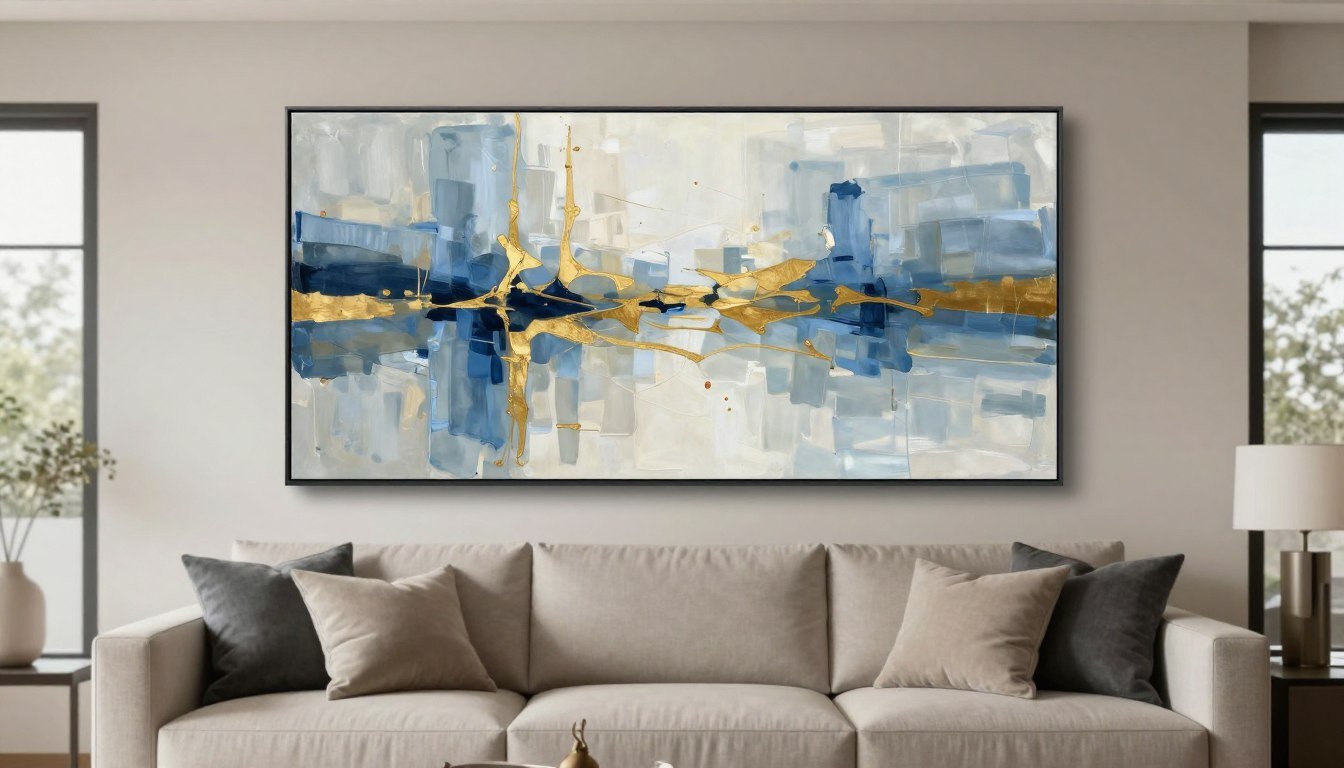
Geometric abstract art creates a striking focal point in contemporary interiors
How to Choose Geometric Abstract Art for Your Space (Simple Framework)

A thoughtful selection process ensures geometric art enhances your space
Step 1: Consider Room Function
Begin by thinking about how the space is used. Active areas like living rooms can handle more dynamic, colorful geometric pieces, while restful spaces like bedrooms may benefit from more subdued, minimal geometric works.
Step 2: Define Your Desired Mood
Identify the feeling you want to create. Bold, high-contrast geometric pieces energize a space, while subtle, monochromatic geometric works create calm. Consider how the artwork's mood will complement the room's purpose.
Step 3: Analyze Your Palette Undertones
Look at your existing color scheme. Effective geometric art either complements your palette (picking up existing colors) or provides deliberate contrast. Pay special attention to undertones—warm or cool—to ensure harmony.
Step 4: Determine Appropriate Scale
Geometric art is particularly sensitive to scale. Too small, and the impact of the geometric pattern may be lost; too large, and it might overwhelm. As a general rule, art should occupy about 2/3 to 3/4 of the wall space above furniture.
Step 5: Assess Your Lighting
Geometric art often plays with perception and optical effects that are influenced by lighting. Consider how natural and artificial light will interact with the piece throughout the day. High-contrast geometric works need adequate lighting to show their full effect.
Step 6: Select Complementary Framing
The frame choice can enhance or detract from geometric art. Clean, minimal frames often work best, allowing the geometric precision to shine. Consider whether a floating frame, simple gallery frame, or frameless canvas best suits the style.
Do:
- Choose scale appropriate to your wall space
- Consider how lighting will affect the piece
- Look for pieces that create conversation
- Balance complex geometry with simpler décor
Don't:
- Place competing patterns too close to geometric art
- Choose colors that clash with your existing palette
- Select pieces too small for their intended wall
- Hang geometric art in poorly lit areas
Size & Placement Guide (Practical + Shareable)

Proper sizing and placement enhances the impact of geometric abstract art
Wall Width to Artwork Size Ratio
| Wall Width | Ideal Artwork Width | Notes |
| 24-36 inches | 16-24 inches | Small geometric pieces work well in narrow spaces |
| 36-60 inches | 24-40 inches | Medium pieces balance negative space with impact |
| 60-96 inches | 40-65 inches | Larger pieces create stronger geometric presence |
| Over 96 inches | 65+ inches or multiple pieces | Consider a triptych or gallery arrangement |
Placement Rules for Common Areas
Above Sofas
Center the artwork with the sofa, not the wall. The piece should be approximately 2/3 the width of the sofa and hung 8-10 inches above it. Geometric art above sofas benefits from being slightly larger rather than smaller.
Above Beds
Similar to sofas, artwork should be centered with the bed and be approximately 2/3 its width. For geometric pieces with strong horizontal elements, lower placement (6-8 inches above the headboard) often works best.
In Hallways
Hang at eye level (57-60 inches from floor to center). In narrow hallways, geometric pieces with depth or perspective can create the illusion of more space. Series of smaller geometric works can create rhythm along a hallway.
Near Desks
Position where visible while seated but not directly behind computer screens. Geometric art with calming patterns works well in work areas, while avoiding overly stimulating optical illusions that might distract.
Common Sizing & Placement Mistakes
- Too small for the wall: Undersized geometric art loses impact and can look disconnected from the space
- Hanging too high: Artwork centered above eye level disconnects viewers from the geometric details
- Insufficient lighting: Geometric art needs proper lighting to showcase its precision and detail
- Competing patterns: Placing geometric art against busy wallpaper or textiles creates visual confusion
- Improper spacing in groupings: Multiple geometric pieces need consistent spacing (2-4 inches) to create cohesion
- Ignoring scale relationships: Geometric art should be proportional to nearby furniture and architectural elements
Frequently Asked Questions
What is geometric abstract art?
Geometric abstract art is a style that uses precise mathematical shapes—circles, squares, triangles, and lines—arranged in non-representational compositions. It focuses on the relationships between forms, colors, and spaces rather than depicting recognizable objects or scenes. This art form emphasizes order, precision, and the emotional impact of pure geometric relationships.
Is geometric art considered abstract?
Yes, geometric art is typically considered a form of abstraction because it doesn't represent recognizable objects from the physical world. However, it's a specific subset of abstract art characterized by its use of precise mathematical forms rather than organic or gestural abstraction. Some geometric art may incorporate representational elements, but pure geometric abstraction focuses entirely on non-representational forms.
What's the difference between geometric abstraction and op-art?
While both use geometric elements, op-art (optical art) specifically aims to create visual illusions of movement, vibration, or depth through precise geometric patterns. Geometric abstraction is the broader category focused on non-representational compositions using geometric forms. Op-art can be considered a specialized subset of geometric abstraction that emphasizes perceptual effects and viewer interaction.
What size artwork should I hang above a sofa or bed?
For sofas and beds, the artwork should be approximately 2/3 the width of the furniture piece (not the wall). For example, a 72-inch sofa would pair well with a 48-inch wide artwork or grouping. Hang the piece 8-10 inches above the sofa or 6-8 inches above the headboard. For geometric art specifically, slightly larger pieces often work better than smaller ones to showcase the patterns and relationships between forms.
Which colors work best in modern interiors?
In modern interiors, geometric art with high contrast (black/white), monochromatic schemes, or limited color palettes often works best. Bold primary colors (red, blue, yellow) create a classic modernist feel, while muted tones (sage, terracotta, navy) offer contemporary sophistication. The key is to either complement your existing color scheme or create deliberate, controlled contrast rather than random color clashes.
How do I style multiple geometric prints together?
When grouping geometric prints, create cohesion through one unifying element—similar color palette, complementary shapes, consistent frame style, or related scale of patterns. Maintain consistent spacing between pieces (2-4 inches) and arrange them to create balanced visual weight. Consider mixing different geometric styles while keeping one element consistent, such as combining a color-block piece with a line-based work that shares the same color palette.
Does geometric abstract art work in warm, classic homes?
Yes, geometric abstract art can work beautifully in warm, classic interiors when thoughtfully selected. Choose pieces with warmer color palettes (amber, terracotta, navy) rather than stark black and white. Consider geometric art with softer edges or organic elements that bridge the gap between precision and warmth. Traditional framing can also help integrate geometric pieces into classic décor, creating an interesting juxtaposition of traditional and modern elements.
Are canvas prints a good choice for geometric art?
Canvas prints are excellent for geometric abstract art, particularly for larger pieces where framing would be costly. The texture of canvas adds subtle dimension to geometric works while maintaining their clean lines. Wrapped canvas edges can either continue the pattern (gallery wrap) or feature a solid complementary color. High-quality canvas prints preserve the crisp edges essential to geometric art while offering a lightweight, frameless presentation option.
Conclusion

Geometric abstract art adds sophistication and visual interest to contemporary spaces
Geometric abstract art offers a perfect balance of intellectual precision and emotional resonance. Its clean lines and mathematical foundations create order and harmony, while its abstract nature allows for personal interpretation and connection. Whether you're drawn to the bold statements of hard-edge geometry or the subtle complexity of minimal compositions, geometric art brings a timeless yet contemporary presence to any space.
When selecting geometric abstract art for your home, remember to consider not just the visual appeal of the piece itself, but how it will interact with your space, lighting, and existing décor. The right geometric artwork can transform a room, creating a focal point that anchors your design while adding depth, movement, and sophisticated visual interest.
Explore Geometric Abstract Art
Discover a curated collection of geometric abstract canvas prints that bring mathematical precision and artistic expression to your walls. From bold color-block compositions to subtle minimal forms, find the perfect piece to elevate your space.
Browse Geometric Collection
About the Author
Chiara Rossetti
Chiara Rossetti is the founder of Rossetti Art, a canvas print and original art brand. She writes about interior design, wall art styling, and the art of making a home feel alive.

Leave a comment
This site is protected by hCaptcha and the hCaptcha Privacy Policy and Terms of Service apply.