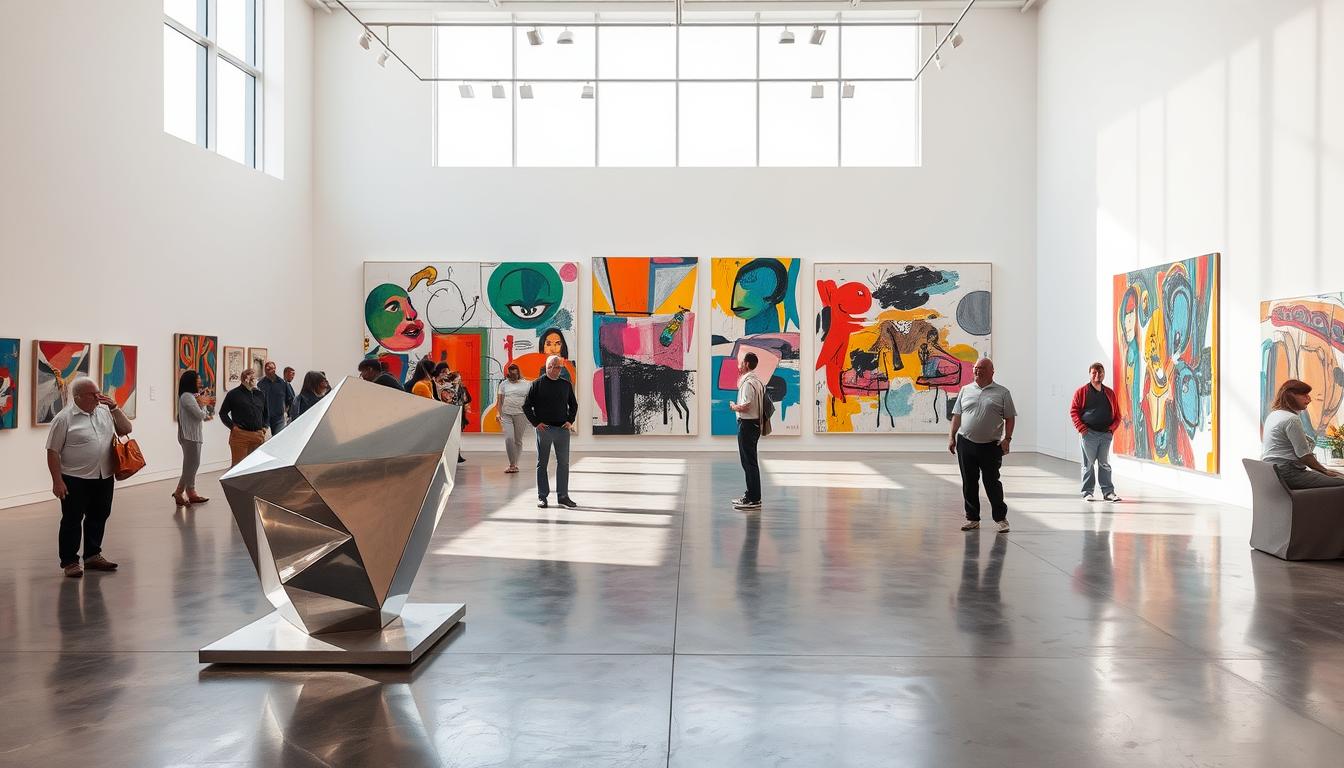

Can one work change how you see the world? I ask that because a single piece can remake an artist's reputation and reshape a place's visual language.
I invite you on a museum-quality tour that traces Pop Art’s bold gestures to conceptual moves that still provoke today. From Warhol’s repetition to Pollock’s sweep, each work marks a clear moment in time.
We will visit landmark pieces and the movements they defined — Hirst's controversy, Bourgeois' scale, Rothko's color fields — and note why originals and editions ripple across cities from New York to London.
This guide connects iconic works to the scene they changed, offers refined facts, and shows how public pieces translate into décor inspiration.
Key Takeaways
- Each work reframes visual culture — understanding context deepens appreciation.
- Iconic pieces link to their movement and a specific moment in years past.
- Originals and editions travel—affecting cities, collectors, and public places.
- Look for recurring themes: identity, memory, the body.
- Learn key facts to place a piece in your home and in history.
Why these contemporary art examples matter now
These works matter because they do more than decorate — they hold a conversation with our moment. I mean that literally: pieces respond to identity, migration, technology, and the pulse of global culture.
The field stretches from the 1950s to our day and includes Pop, Conceptualism, Minimalism, Performance, Street, Installation, and Land practices. Each movement shifts focus—sometimes from object to idea, sometimes from seeing to lived experience.
- Dialogue over display: works act as ongoing questions, not museum relics.
- Audience completes the piece: participation and context shape meaning.
- Endurance by relevance: artworks age well when they address memory and the concerns of their years.
- From gallery to home: knowing materials and scale helps translate museum-quality impact into interiors.
Readers who value precision will find timelines and context essential — dates, movements, and makers place each work in living history. I aim to make that information both beautiful and exact.
Pop Art to Conceptualism: movement-defining pieces that changed the game
A handful of breakthrough pieces rewired what an artist could say—and how the public would listen. I sketch four landmark moments that made movements into movements, and that still shape taste, markets, and interior design.
Andy Warhol — Campbell’s Soup Cans, 1962
Warhol used repetition as critique—rows of identical cans that read like a minimalist luxury. The crisp, serialized approach turned commerce into commentary and made a single work read as mass culture itself.
Roy Lichtenstein — Look Mickey, 1961
Lichtenstein reconstructed a cartoon frame with precise line and flat paint. His move—appropriation polished into high finish—forced critics to reassess what a piece could be.
Damien Hirst — The Physical Impossibility of Death in the Mind of Someone Living, 1991
Hirst put concept first: a shark in formaldehyde commissioned by Charles Saatchi. The replacement of the original in 2004 and the controversy around it show how a work’s material life becomes part of its biography.
Mark Rothko — Orange, Red, Yellow, 1961
Rothko’s vast color fields create an intimate encounter—scale that feels personal. The painting’s record auction in 2012 confirmed how such pieces accumulate value across years and history.
- Reception: each piece moved from shock to canon, reshaping what a movement could demand.
- Decor tip: borrow color, scale, and calm surfaces—these artworks translate beautifully into refined interiors.
New York icons: contemporary art in the world’s most electric art city
New York has always been a pressure cooker for bold visual voices—where urgency meets invention on every block.
Jean‑Michel Basquiat — Untitled, 1981: a raw, vibrant canvas often read as a skull and a self-portrait. The piece pulses with life and doubt—electric marks that ask whether identity is mask or bone.
Keith Haring — Untitled, 1982: bold figures and clear linework move from subway glyphs to gallery stage. Haring’s language stayed urgent—public signals that also read as intimate commentary on sexuality and the AIDS era.
Yayoi Kusama — Infinity Mirrored Room (David Zwirner): a small room becoming infinite light. The installation drew long lines in New York and turned a private visit into a shared moment of wonder.
James Turrell — Skyspace (regional highlight): though sited in Chicago, Turrell’s telescoped sky work reminds us that perception architecture radiates beyond one city. It anchors the wider scene.
- Look for: graphic strength, color harmony, and large gestures—qualities that translate into museum‑quality interiors.
Los Angeles highlights: West Coast works redefining space, light, and life
In Los Angeles the studio answers the skyline—paintings and rooms echo a bright, open life.
Njideka Akunyili Crosby — I Still Face You, 2015
Njideka blends Nigerian motifs with acetone-transfer painting. I Still Face You layers family scenes, home fabrics, and Los Angeles streets into one intimate surface. Her method reads as memory—complex, private, and rooted in city life.
Kusama’s installation at The Broad turns reflection into a shared event. Lights multiply; viewers become part of the room. It feels cinematic—perfect for Los Angeles’ public appetite for immersive moments.
David Hockney — Portrait of an Artist (Pool with Two Figures), 1972
Hockney’s poolside clarity uses crystalline blues and poised composition. An early version was lost to time; the repainted piece later set auction records for a living artist. It captures a certain Los Angeles cool—precision, sun, and calm surface.
- Visual cues: clean palettes and luminous surfaces to expand space.
- Styling tip: pair bold works with minimalist furnishings so color and light lead the room.
- City link: these artists show how life in Los Angeles shapes warmth, openness, and measured glamour.
Tate Modern moments: installations that captivated a global audience
At the Turbine Hall the museum switches roles—installation becomes stage and visitors become cast. I look for projects that turn scale into intimate ritual and that change how a room breathes.
Olafur Eliasson — The Weather Project, 2003
Eliasson filled the hall with an artificial sun and a mirrored ceiling. The engineered glow blurred real sky and simulation. Visitors lay beneath the light—communal, hushed, aware of time.
Ai Weiwei — Sunflower Seeds, 2010
Ai packed the floor with millions of hand‑painted porcelain seeds made by Chinese artisans. Early interaction allowed walking; later restrictions followed for health and dust concerns. The change is a clear factual shift in how an artwork meets its audience.
Louise Bourgeois — Maman, 1999
Stand beneath Maman and feel its scale—steel legs holding 32 marble eggs. The original stainless steel sculpture led to bronze castings in later versions. It reads as homage and as a public sculpture that moves across cities.
- Recreate the glow: Eliasson’s sun and mirrored ceiling made visitors part of the piece.
- Material limits: Ai’s porcelain field—thousands of seeds, then contact limits for health.
- Versions matter: Bourgeois’ multiple castings extend the story across time and place.
Immersive installations: rooms, mirrors, and light that transform your sense of place
When mirrors, LEDs, and architecture meet, a familiar space can become an inward landscape. I look at three works that shape how we move through light and reflection—each one changing public expectation of an installation and the viewer's sense.
Yayoi Kusama — Infinity Mirror Room (1965) & Infinity Mirrored Room (2013)
Kusama pioneered mirrored immersion in 1965 and refined it into LED-lit infinity rooms by 2013. The newer installations drew long lines in New York and Los Angeles—thousands waiting to enter a serene, ethereal field.
Christopher Bauder & Kangding Ray — SKALAR (2021)
SKALAR merges kinetic light sculpture with electronic sound. The touring installation choreographs moving beams and precise audio so the audience becomes part of the composition.
Leo Villareal — Illuminated River (2021)
Villareal's work lights 14 London bridges across 4.5 nautical miles—the longest public artwork commission of its kind. Urban light becomes a patient, architectural artwork that transforms place each night.
- Enter Kusama’s infinity: mirrors and LEDs multiply a single light into thousands.
- Design insight: reflective surfaces and a single sculptural light modernize a room.
- On time: these installations slow perception—experience becomes the work.
Monumental sculpture and installation: scale, materials, and forms that reshape the world
Monumental sculptures rewrite skylines—these works claim space and memory in equal measure.
I look at five public pieces that teach how scale and material make meaning. Each one uses heavy industry and careful shape to hold place and time.
Louise Bourgeois — Maman, 1999
Maman stands over 30 ft high and 33 ft wide with a sac of 32 marble eggs. The stainless steel original and later bronze castings honor Bourgeois’ mother—strength folded into nurture.
Antony Gormley — Angel of the North, 1998
The Angel is 66 ft tall with a 177 ft wingspan. Its forward-angled wings read like an embrace—industrial steel shaped into a civic figure.
Jeff Koons — Balloon Dog, 1994
Jeff Koons turned a playful balloon into a mirror-polished sculpture. Its reflective finish makes the figure both toy and luxury object.
Anish Kapoor & Cecil Balmond — Temenos, 2009
Temenos—an intertwined steel landmark over 110 ft tall—helped regenerate Middlesbrough. Tension and line shape the skyline; engineering becomes poetry.
Claes Oldenburg & Coosje van Bruggen — Bottle of Notes, 1993
This oversized bottle honors Captain Cook and local history. Inscribed messages turn memory into a public narrative.
| Work | Year | Material | Impact |
|---|---|---|---|
| Maman | 1999 | Stainless steel / Bronze / Marble | Mother figure—scale meets intimate memory |
| Angel of the North | 1998 | Steel | Civic embrace—industrial to protective figure |
| Balloon Dog | 1994 | Mirror-polished stainless | Playful figure turned luxury artwork |
| Temenos / Bottle of Notes | 2009 / 1993 | Steel / Mixed media | Urban renewal and sculptural storytelling |
Read scale as poetry: from towering legs to reflective surfaces, these sculptures use steel, bronze, and marble to anchor legacy in place.
Street to gallery: the rise of public, performance, and street art
Street practice moved from back alleys into museums—and it brought its grit with it.
I track three works that show that shift. Each piece keeps its public pulse while entering new contexts.
Banksy — Girl with Balloon, 2002
Banksy’s image—a child and a red balloon—became an icon used in campaigns and protests. In 2018 a framed copy partially shredded at Sotheby’s. The moment became performance; the work was retitled Love is in the Bin and the sale went ahead. The stunt shows how street gestures can rewrite value and time.
Elmgreen & Dragset — Prada Marfa
Prada Marfa sits like a faux boutique in the Texas desert. It reads as satire and as civic sculpture. The piece turns luxury signage into public commentary on consumer culture and place.
SIMPARCH — Silvas Capitalis, 2018
Silvas Capitalis is a colossal timber head along Lakeside Way in Kielder. Built from 3,000 European Larch pieces—no screws or nails—it invites visitors to enter through the mouth and look out. Craft meets myth—an installation that asks audiences to become participants.
"Shredding at auction transformed an image into live performance."
| Work | Year | Material | Public Role |
|---|---|---|---|
| Girl with Balloon / Love is in the Bin | 2002 / 2018 | Stencil / Frame (shredded) | Street icon → auction performance |
| Prada Marfa | 2005 | Concrete / Shop fittings | Faux boutique—satire of luxury |
| Silvas Capitalis | 2018 | European Larch timber | Immersive sculpture—audience activation |
Takeaway: the street-to-gallery movement keeps surprise, message, and participation. For the home, try graphic prints, bold stencils, and raw textures to borrow that urban energy without losing refinement.
Nature and land art: works that use place, time, and the elements
When artists set their work outdoors they invite nature to finish the piece. Land art is site‑responsive—where the landscape is both canvas and collaborator. I value how weather and season rewrite meaning over years.
Robert Smithson — Spiral Jetty (1970)
Smithson’s Spiral Jetty coils rock and salt into the Great Salt Lake. Low water reveals the full spiral; high water softens its edge. The piece measures time by changing lines and crusted salt—an elemental sculpture that ages in public view.
Stuart Ian Frost — Skin Deep (2012)
At Arte Sella Frost built Skin Deep from branches and trunks with almost no man‑made materials. The arrangement honors local textures and quiet forms. It reads as an outdoor study in tactility and restraint.
Jaehyo Lee — 0121-1110=115075 (2015)
Also at Arte Sella, Jaehyo Lee shapes raw wood into refined, geometric sculpture. The work balances craft with landscape—natural materials become formal gestures that respond to light and season.
- Define land practice: site‑specific works where place and time shape outcome.
- Materials honestly: branches, stone, and soil create lasting presence outdoors.
- Translate to interiors: use natural finishes, tactile surfaces, and sculptural forms for calming rooms.
Faces, figures, and the body: identity through paint and line
Faces and figures offer a direct route into how artists record identity and time. I look to works that use paint and line to hold honesty—no artifice, just a clear witness.
Jenny Saville — Propped, 1992
Propped confronts beauty norms with monumental scale and dense oil handling. The canvas reads like presence—flesh rendered with textured surfaces that demand close looking.
Lucian Freud — Reflection, 1985
Freud’s self-portrait records time in every mark. Each visible line maps years; the gaze is candid, almost forensic, and it insists on the truth of flesh.
Frida Kahlo — Self Portrait, 1948
Kahlo’s 1948 self-portrait was the only work she completed that year. The Tehuana dress frames pain with composure—ceremonial costume and private suffering held together in one artwork.
Cecily Brown — The Girl Who Had Everything, 1998
Brown lets suggested figures emerge from painterly swirls—baroque energy meets abstract expression. Erotic forms surface through gesture, a push‑pull of desire and restraint.
Why these works matter: the body becomes language—vulnerability and strength rendered through line, color, and surface. Portraiture adds warmth to interiors and anchors a room with human presence.
| Work | Year | Key Technique | Emotional Focus |
|---|---|---|---|
| Propped | 1992 | Thick oil, large scale | Challenging beauty norms |
| Reflection | 1985 | Detailed impasto, visible line | Time etched in skin |
| Self Portrait | 1948 | Traditional oil, costume detail | Pain framed with grace |
| The Girl Who Had Everything | 1998 | Expressive brushwork, layered gesture | Desire and ambiguity |
Contemporary art examples
Some works act as choreographers of motion—paint mapping the artist’s body across a vast surface. I choose four pieces that make process legible: gesture, surface, and the social life that follows.
Jackson Pollock — Autumn Rhythm, 1950
Autumn Rhythm shows drip technique as choreography—dripping, splashing, scraping paint while the artist moved around the canvas. The result reads like recorded motion; the line becomes history on canvas.
Takashi Murakami — Flower Ball, 2002
Murakami fuses Nihonga training with superflat sensibility. Flower Ball links postwar culture, anime legacy, and vibrant surfaces that read like modern iconography.
Dorothea Tanning — Door 84, 1984
Tanning repurposes a door segment to move from figurative Surrealism toward freer abstraction. Oil and unexpected materials yield surreal forms that feel both intimate and daring.
Francis Bacon — Three Studies of Lucian Freud, 1969
Bacon fractured the figure across three panels—intense rivalry and friendship underwrite the imagery. The triptych sold as a unit in 2013 for a record price; Bacon insisted it remain together.
- Collecting routes: consider prints, catalogues, and inspired pieces that echo these visual languages.
- Technique notes: line, drip, and layered ground pair well with minimalist furnishings and high ceilings or modular panels.
- Global scene: New York and Los Angeles remain key poles—ideas travel fast across the world.
"Process can become presence—gesture writes history on the surface."
Public art that animates cities: seven types and standout artworks

Public projects give cities a nightly heartbeat—light, sound, and form stitched into daily life. I map seven clear types so you can spot them on a walk or plan a city route.
- Sculptures / installations: freestanding forms that shape plazas and sightlines.
- Murals / street work: painted walls that claim façades.
- Land art: earthbound gestures that use nature and season.
- Performance: live events that unfold in public time.
- Interactive: pieces that need audience motion to activate.
- Digital / media‑based: light, projection, and streaming at city scale.
- Functional: benches, sound sculptures, and objects that serve use and symbol.
Olafur Eliasson — The Weather Project
At Tate Modern (2003) Eliasson used a mirrored ceiling and an artificial sun to create a meditative installation. Visitors lay beneath the glow—an experience that turned museum space into shared ritual.
Leo Villareal — Illuminated River
Illuminated River (2021) lit 14 bridges along 4.5 nautical miles—arguably the longest public commission of its kind. Digital lighting stitches architecture into nightly sequence, changing skyline scale over time.
Mike Tonkin & Anna Liu — The Singing Ringing Tree
This wind‑activated structure turns weather into music. Its pipes sing with each gust; the work won a RIBA National Award and stands as a calm, minimalist landmark.
Nic Fiddian‑Green — Still Water
Still Water (2011) is a bronze horse head that reads like a quiet place‑maker. Fiddian‑Green’s equestrian sculptures distill form and spirit—materials and scale that invite slow looking.
Quick facts: public pieces invite the audience to complete the meaning. Use reflective surfaces, functional objects, and controlled light at home to echo these civic gestures.
Controversy and conversation: artworks that challenged sense and category
When an artist stages honesty or a stunt breaks an auction, the conversation becomes the medium. These pieces forced viewers to ask what qualifies as a work, who decides value, and how time shifts outrage into acceptance.
Tracey Emin — My Bed, 1998
My Bed was nominated for the Turner Prize and announced a raw, personal grammar for the artist. Emin laid private depression and recovery on public display—mess and intimacy framed as concept. The piece reframed how a viewer reads confession as museum‑quality statement.
Damien Hirst — The Physical Impossibility of Death in the Mind of Someone Living, 1991
Commissioned by Saatchi, Hirst’s shark in formaldehyde tested materials, mortality, and market logic. The original dated 1991 and was replaced in 2004—an important fact that underlines how maintenance and material life shape an artwork’s history.
Banksy — Love is in the Bin (post‑shredding), 2018
Banksy turned a Sotheby’s sale into live performance when a framed work partially shredded as the gavel fell. Retitled and sold, the act transformed auction protocol into part of the piece—and demanded that the audience finish the meaning.
"Conversation is part of the piece—the audience’s reaction completes the work."
- Facts matter: nominations, collectors, and replacements deepen the story.
- Design note: in interiors, embrace conceptual clarity—minimal arrangements let a provocative piece speak.
- Long view: time softens shock; today’s scandal often becomes tomorrow’s museum touchstone.
From words to worlds: language, culture, and memory in contemporary pieces
Words can be a scaffold—artists turn a single line into rooms, rituals, and communal memory. Language becomes a material that shapes place and time.
Sophie Calle — Prenez soin de vous, 2007
Calle sent a breakup email to a group and invited 107 women to respond. Each reply—legal notes, dance, code, and even a cockatoo eating the note—became a contribution.
The project shows how words multiply into perspectives. A private sentence becomes a chorus that builds a shared world.
Marc Chagall — Ceiling of the Paris Opéra Garnier, 1964
Look up: Chagall painted a luminous collage on the ceiling, layering composers, figures, and color.
Its arrival sparked controversy—panels arrived under tight guard—but the ceiling now reads as a floating manifesto of culture and music.
Ai Weiwei — Remembering, 2009
Ai used 9,000 backpacks to spell a mother’s sentence: “she lived happily in this world for seven years.”
The backpacks scaled grief into a public field—text made visible, memory made civic.
"Words becoming worlds we inhabit together."
- Design moves: typographic prints, lyrical color palettes, and curated quotes to personalize interiors.
- Forms that carry feeling: soft palettes, floating figures, and gentle shapes calm a room.
- Time’s imprint: these works keep loss and love present—history held in visible form.
Small acts of language—an email, a ceiling panel, a sentence spelled in backpacks—become the work that holds a place. Their quiet power reminds us that a single phrase can shape how a world remembers.
How masterpieces meet the audience: experience, versions, shape, and scale
How a work arrives—its size, finish, and site—shapes what the audience remembers. I consider versions, participation, and overhead shape as the mechanics that turn an object into an event.
Multiple versions and materials
Maman began as a stainless steel original in 1999 and now exists in later bronze castings across cities. These versions extend a single idea—same form, varied surface—so the work moves from one place to many.
Materials matter: steel reads industrial and bright; bronze oxidizes with time. Each choice gives the sculpture a different social life while keeping the mother figure at the heart.
Audience participation and limits
Ai Weiwei’s Sunflower Seeds first invited walking. That interaction made the audience a co‑creator.
Later, limits stopped walking to protect visitors and the delicate seeds—dust and conservation became practical concerns that changed how people experience the piece.
Shape and ceiling as instrument
The Weather Project used a mirrored ceiling and an artificial sun to reshape perception. Overhead architecture became the installation’s main medium—light folded into canopy, and visitors slowed their pace.
- Scale slows time and focuses attention.
- Materials age and define tone—steel or bronze read differently in public space.
- Home translation: mirrors, soft light, and sculptural silhouettes recreate museum‑quality calm.
Market milestones and legacy: the works that defined value and time

When a single sale bends the market, a work's story moves from studio to world stage.
David Hockney — Portrait of an Artist (auction landmark)
I note the facts: Hockney’s Portrait of an Artist (Pool with Two Figures) became the most expensive work by a living artist at auction. A first version was destroyed; the 1972 painting carried clean edges, luminous color, and disciplined process across versions.
Rothko at auction — intimacy at monumental scale
Rothko’s Orange, Red, Yellow set auction records in 2012. The painting shows a paradox—monumental scale that yields an intimate, meditative experience. Materials, condition, and scale all shaped its outcome and legacy.
Francis Bacon triptych — value, rivalry, and history
Bacon’s Three Studies of Lucian Freud sold complete in 2013 as the most expensive work by a British artist. Bacon insisted the triptych remain together—rivalry and unity cemented the work’s history and market standing.
| Work | Year / Sale | Why it mattered |
|---|---|---|
| Portrait of an Artist | 1972 / Auction record | Most expensive living-artist sale; versions and process highlighted |
| Orange, Red, Yellow | 1961 / 2012 record | Large scale intimacy; materials and condition influenced price |
| Three Studies of Lucian Freud | 1969 / 2013 record | Triptych sold intact—rivalry and completeness drove value |
Collector insight: provenance, editions, and conservation matter as much as headline prices. Jeff Koons shows how public recognition can lift sculptures into sustained market life.
Conclusion
Great pieces teach us to read line, shape, and light—and then bring that grammar home. I want you to feel confident choosing a work that speaks to your room and your days.
Gather the throughline: New York energy, Tate Modern scale, and quiet nature cues each offer routes into beauty and legacy.
Choose a sculpture or painting for its shape and paint, then arrange space so the piece leads the room. Small, calm choices—soft light, honest materials—keep sense and serenity central.
Let the work meet the place, and let the place meet the world. Over years, thousands of viewers complete the story. Pick what speaks to you; live with it well.
Enhance Your Space with Unique Modern Masterpieces by Chiara Rossetti

Are you inspired by the innovative mediums and conceptual depth highlighted in our exploration of contemporary art? You’re not alone! Today’s art enthusiasts are seeking cultural relevance and emotional connections in their artwork. However, finding pieces that resonate with modern themes and fit your unique style can be a challenge. That’s where we come in!

At Rossetti Art, we specialize in canvas prints, original paintings, and modern sculptures that celebrate the spirit of now. Each piece created by Chiara Rossetti brings a personal touch that connects deeply with current social narratives—just like the modern masterpieces discussed in the article. Don’t miss out on the chance to elevate your home decor with breathtaking artwork that speaks to your values and aesthetic. Explore our collection today and find your perfect piece! Act now, and transform your space into a gallery of inspiration!

FAQ
Which masterpieces from New York and Los Angeles should I prioritize seeing?
Prioritize works that shaped movements and local scenes — Jean‑Michel Basquiat’s Untitled (1981) and Keith Haring’s street‑informed pieces in New York; at The Broad in Los Angeles, Yayoi Kusama’s Infinity Mirrored Room and David Hockney’s Portrait of an Artist (Pool with Two Figures). These pieces offer museum‑quality encounters with scale, color, and cultural context.
Why do Pop Art and Conceptualism still matter today?
Pop and Conceptualism changed how we read everyday objects and ideas. Works like Andy Warhol’s Campbell’s Soup Cans and Damien Hirst’s shark installation shifted focus from handcraft to concept — influencing contemporary makers, collectors, and public perception of beauty and value.
How do immersive installations alter the viewer’s experience?
Installations such as Olafur Eliasson’s The Weather Project or Yayoi Kusama’s mirrored rooms use light, reflection, and scale to transform perception. They invite participation — physically and emotionally — making the audience part of the work and deepening connection to place and moment.
What should I know about monumental sculpture and its public role?
Monumental sculpture — Jeff Koons’ Balloon Dog, Antony Gormley’s Angel of the North, Louise Bourgeois’ Maman — reshapes public space and collective memory. Materials and scale create civic focal points that anchor culture, tourism, and urban identity.
Are museum installations the only way to experience significant works?
Not at all. Street and public art — Banksy’s stenciled works, Elmgreen & Dragset’s Prada Marfa — bring art into daily life. Land art like Robert Smithson’s Spiral Jetty and outdoor commissions animate environments and expand access beyond gallery walls.
How do museums like Tate Modern influence global conversation?
Institutions such as Tate Modern commission ambitious installations and retrospectives that set critical agendas. Exhibitions like Ai Weiwei’s Sunflower Seeds or Louise Bourgeois’ Unilever Series reach wide audiences and shape scholarship, conservation, and curatorial practice worldwide.
What role do material and technique play in value and legacy?
Material choices — bronze, mirrored glass, pigment on canvas — speak to an artist’s intent and conservation needs. Market milestones often follow technical innovation or rarity; for example, large Rothkos and Hockney canvases command attention for scale and craftsmanship.
How can I bring museum‑quality works into my home affordably?
Look for limited editions, high‑quality prints, or original small‑scale pieces from emerging artists. Focus on proportion, lighting, and framing to achieve a refined, gallery‑like effect without the premium of blue‑chip originals.
What should collectors consider about authenticity and provenance?
Verify provenance, condition reports, and exhibition history. Work with reputable dealers, galleries, and auction houses. For high‑value pieces, insist on documentation from museums or recognized catalogues raisonnés to protect investment and history.
How do immersive and digital works affect conservation and display?
Digital and light‑based installations require specialized maintenance, software updates, and climate control. Curators plan for obsolescence and versioning — ensuring the artist’s intent survives technological changes while keeping the experience museum‑quality.
Which contemporary figures fuse public engagement with strong artistic vision?
Artists such as Yayoi Kusama, Olafur Eliasson, and Banksy fuse spectacle with social commentary. Their work blends accessibility with critical depth — inviting broad audiences while prompting questions about culture, consumption, and identity.
How do movement‑defining pieces inform current creative practice?
Historic works from Pop, Minimalism, and Conceptualism provide formal and conceptual templates — from Warhol’s serial imagery to Rothko’s color fields. Contemporary artists borrow, respond, and subvert these legacies to push new forms and narratives.
Where can I find reliable exhibitions and installations right now?
Check major institutions and leading galleries in New York and Los Angeles — Museum of Modern Art, Whitney Museum, The Broad, and David Zwirner — plus Tate Modern for global touring shows. Museum websites and subscription newsletters are the best sources for current programming.
How does public reaction shape an artwork’s meaning over time?
Audience engagement and controversy — whether over Tracey Emin’s My Bed or Banksy’s shredded piece — can redefine a work’s narrative. Public dialogue, media, and institutional response all add layers of meaning and influence a piece’s cultural legacy.

About the Author
Chiara Rossetti
Chiara Rossetti is the founder of Rossetti Art, a canvas print and original art brand. She writes about interior design, wall art styling, and the art of making a home feel alive.

Leave a comment
This site is protected by hCaptcha and the hCaptcha Privacy Policy and Terms of Service apply.