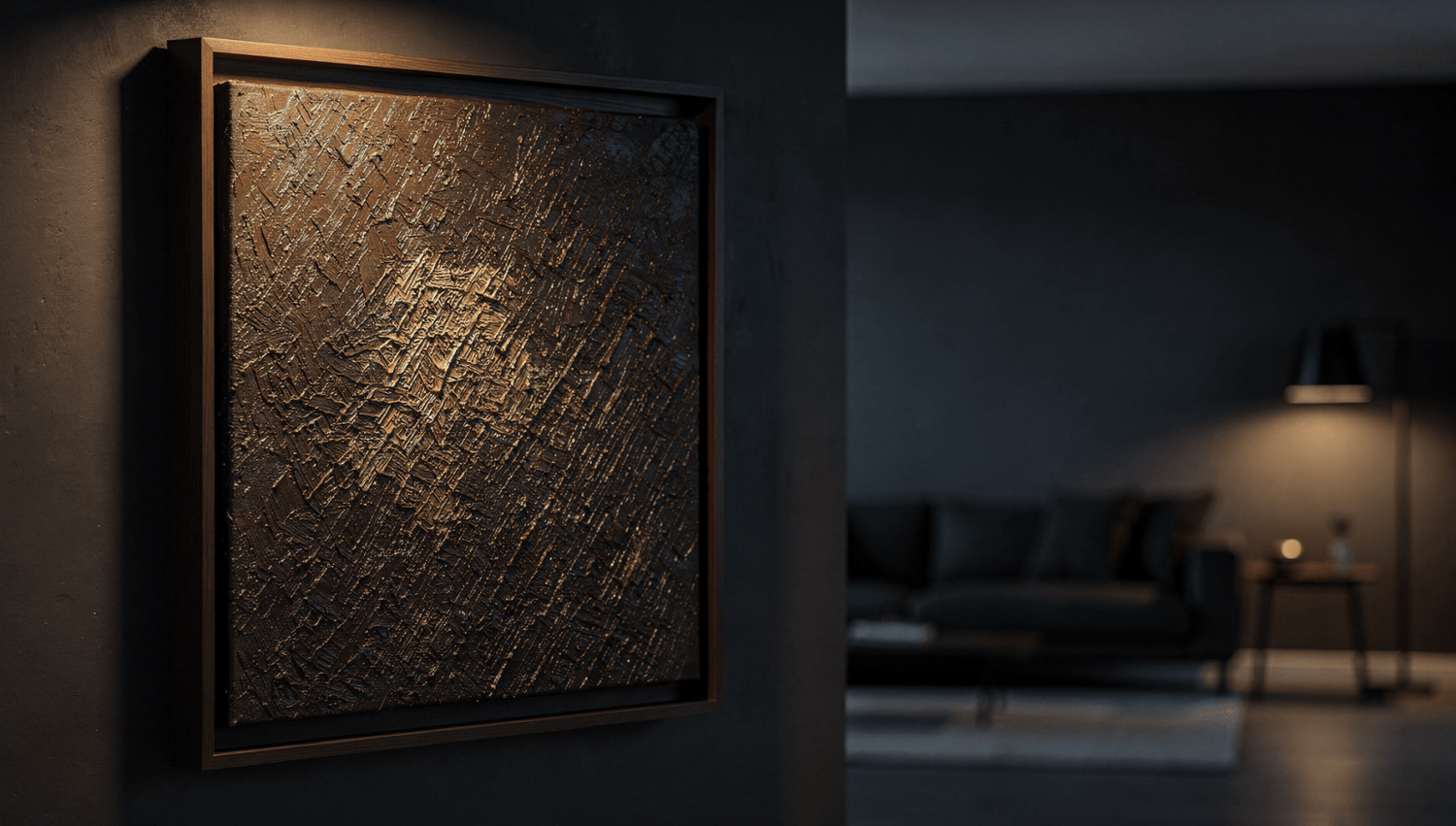
You've seen it happen. A canvas print in one home looks like it came from a gallery — rich, textured, unmistakably painted. In another home, a canvas print looks thin and flat, almost like a photo stuck to cardboard. Same format. Completely different result.

The difference is not luck. It's a set of deliberate decisions — about materials, inks, framing, and the source artwork itself. This guide walks through exactly what makes a canvas print look like a real painting, so you can buy with confidence and stop wasting money on cheap prints that disappoint the moment they go up on the wall.
Quick Answer
A canvas print looks like a real painting when it's printed with archival pigment inks on a textured cotton canvas, hand-stretched over a solid pine wood frame, and displayed in a hardwood floater frame — the same presentation used for original oil paintings in galleries. The artwork source matters too: prints based on original paintings carry the brushstroke character and compositional depth that stock art cannot replicate.

Why Some Canvas Prints Look Like Real Paintings
The short answer is texture, depth, and light interaction. An original oil painting has three-dimensional surface variation — raised brushstrokes, palette knife marks, layered pigment. Light hits it at different angles and the painting shifts. A cheap canvas print, produced on thin synthetic canvas with dye-based inks, is flat. Light hits it and you get a photo.
The gap has closed significantly as printing technology improved. High-quality giclée printing on thick cotton canvas, with archival pigment inks, now produces prints that genuinely fool the eye from a normal viewing distance of one to two metres. Add a hardwood floater frame — the exact frame type used for original paintings — and the illusion is complete. Guests assume it's a painting until they get close enough to inspect it.
What separates the convincing canvas prints from the disappointing ones comes down to five decisions made before the print ever ships.
The 5 Factors That Make the Difference
1. Canvas Weight and Weave
Canvas weight is measured in GSM (grams per square metre). Entry-level canvas prints use 260–300gsm synthetic canvas — it looks plasticky under light and develops a visible sheen. Gallery-quality canvas starts at 380–400gsm cotton, close to artist-grade linen. The cotton weave has natural texture that breaks up the image surface, giving it the characteristic depth of a painted surface. When you touch a high-quality canvas print, it should feel like a painting ground, not a tablecloth.
2. Pigment Inks vs Dye-Based Inks
This is the single biggest quality dividing line. Dye-based inks sit on top of the canvas surface and fade noticeably within a few years — colours shift, shadows become muddy. Archival pigment inks penetrate the canvas fibres and are chemically stable: printed with archival pigment inks, a canvas print is designed to resist fading under normal indoor conditions. The surface quality also differs — pigment inks have a matte, almost velvety finish that reads as painted; dye inks are glossy and clearly photographic.
3. Hand-Stretching on a Solid Wood Frame
Machine-stretched canvas often has loose corners, uneven tension, and visible staple patterns on the sides. Hand-stretched canvas, mounted over a kiln-dried pine wood frame — the same method used for original paintings — has consistent tension across the full surface. The image reads flat and taut the way a stretched canvas painting does. Kiln-dried pine resists warping as humidity changes, which matters for long-term wall display.
4. The Floater Frame
A floater frame is the single most powerful visual upgrade for any canvas print. Unlike a standard frame that covers the edges of the canvas, a floater frame mounts the canvas with a 3–5mm gap between the print and the frame — creating a shadow that gives the piece visual depth. This is exactly how original oil paintings are presented in galleries. A handcrafted floater frame made from poplar hardwood completes the transformation: the print reads as gallery art, not home decor.
→ See the full guide: Canvas Print with Floating Frame: What It Is and Why It Matters

"Neutral Abstract" — hand-stretched on kiln-dried pine, printed with archival pigment inks. View this piece →
5. The Source Artwork
This is the factor most print companies cannot offer — and the one that matters most for the painting illusion. A canvas print based on a stock illustration or a Photoshop design will always look like what it is: a digital image on canvas. A canvas print based on an original painting — with real brushwork, layered paint application, and the organic quality of a human hand — carries that character through into the print. The texture is printed, but the compositional intelligence, the colour decisions, the mark-making energy: those are real. You feel it in the finished piece.

How the Frame Changes Everything
If there is one upgrade that makes the largest visible difference, it is switching from a bare gallery-wrap canvas to a canvas in a hardwood floater frame. The floater frame transforms the piece from a canvas print into a painting. The shadow gap, the frame depth, the material quality of poplar hardwood — it adds visual weight that makes a piece read as real art from across the room.
At Rossetti Art, every canvas print is available with a handcrafted floater frame in four finishes: Black, Oak, Brown, and White. The frame is made from poplar hardwood and creates a shadow gap around the canvas edge. The combined effect — archival cotton canvas, pigment inks, floater frame — means the print reads as gallery art from the moment it goes on the wall.
🎨 FREE Art Style Finder Quiz
Not sure which canvas style looks most like a real painting in your home? Answer 6 quick questions and get a personalised style recommendation — with examples from the Rossetti Art collection.
Download Free →What Rossetti Art Does Differently
Rossetti Art canvas prints are based entirely on original paintings by Chiara Rossetti — each piece created from scratch with real paint, real brushwork, and real artistic intention. No stock illustrations. No AI-generated imagery. The source artwork is a painting, which means every canvas print that looks like a painting starts with one.
The production process honours that source material. Every canvas print is hand-stretched over a kiln-dried pine wood frame, printed with archival pigment inks designed to resist fading, and protected with a UV-resistant coating. Canvas weight is 400gsm cotton — gallery grade. The result is a canvas print that genuinely looks and feels like original art.
Use the Live Preview on any product page to see exactly how the piece looks on your wall before you buy. You can visualise the floater frame options, check proportions against your space, and confirm the placement — removing the guesswork that makes most canvas print purchases feel like a gamble.

Frequently Asked Questions
What type of canvas is used in high-quality canvas prints?
Gallery-quality canvas prints use 380–400gsm cotton canvas with a natural woven texture. This weight is close to artist-grade linen and has the surface character needed to give a print the visual depth of a painting. Entry-level prints use 260gsm synthetic canvas, which looks flat and develops a sheen under light.
Do archival pigment inks really make a visible difference?
Yes — significantly. Archival pigment inks penetrate the canvas fibres and are chemically stable, designed to resist fading under normal indoor conditions. Dye-based inks sit on the surface and fade within 3–5 years, colours shifting and shadows becoming muddy. The surface quality also differs: pigment inks have a matte, painted finish; dye inks are glossy and clearly photographic.
What is a floater frame and why does it make canvas prints look like paintings?
A floater frame mounts the canvas with a 3–5mm gap between the canvas edge and the frame — identical to how original oil paintings are presented in galleries. This shadow gap gives the piece visual depth and makes it read as a three-dimensional painting object rather than a flat image. It is the single most effective presentation upgrade for any canvas print.
Are canvas prints a good alternative to original paintings?
For most buyers, yes — especially when the print is based on an original artwork and produced with gallery-grade materials. You get the artistic character of a real painting at a fraction of the cost, with the freedom to choose your exact size and frame finish. The key is buying from a brand where the source artwork is genuinely original, not stock imagery.
How long do canvas prints last compared to original paintings?
A canvas print made with archival pigment inks on acid-free cotton canvas and protected with a UV coating will last without significant fading — comparable to many oil paintings. The main risk factors are direct sunlight exposure, high humidity, and physical damage to the surface. Full guide: How Long Do Canvas Prints Last?
The right canvas print — made with gallery-grade materials, based on original artwork, and presented in a hardwood floater frame — is genuinely indistinguishable from an original painting at normal viewing distance. Browse the Rossetti Art canvas print collection, or explore abstract canvas prints for pieces that read like gallery originals from the moment they go up.
Keep Reading
About the Author — Chiara Rossetti is the founder of Rossetti Art, a canvas print and original art brand. She writes about interior design, wall art styling, and the art of making a home feel alive.

About the Author
Chiara Rossetti
Chiara Rossetti is the founder of Rossetti Art, a canvas print and original art brand. She writes about interior design, wall art styling, and the art of making a home feel alive.



Leave a comment
This site is protected by hCaptcha and the hCaptcha Privacy Policy and Terms of Service apply.