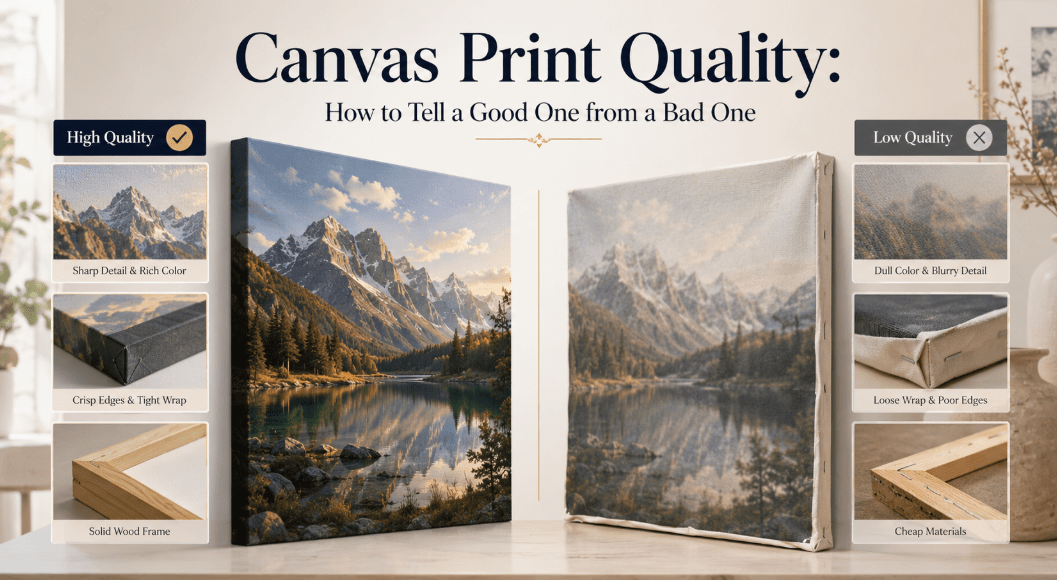
Canvas print quality varies enormously. Two prints at the same price point, from two different sellers, can look completely different on a wall — one holding its colour and depth for decades, the other fading within a few years, canvas sagging, frame warping. The difference is almost entirely in the materials and process.
This guide breaks down exactly what to look for — and what to avoid — before you order any canvas print.
Quick Answer
The five markers of a high-quality canvas print are: archival pigment inks (designed to resist fading), poly-cotton or cotton canvas (not pure polyester), kiln-dried pine stretcher bars, hand-stretching with even tension, and a UV-resistant protective coating. Anything missing from this list is a quality compromise.

The 5 Canvas Print Quality Factors
Every canvas print is made up of the same basic components: the image, the ink, the canvas fabric, the stretcher bars, and the frame. Quality can vary significantly at each stage. Understanding all five gives you the information to make an informed decision — and to ask the right questions before you buy.
1. Ink Quality: The Most Important Variable
Ink quality is the single biggest determinant of how a canvas print looks now — and how it will look in 10 or 20 years. There are two main types of ink used in canvas printing: dye-based inks and pigment-based inks.
Dye-based inks produce vivid, saturated colours at the time of printing. They are also the type most likely to fade — particularly when exposed to sunlight, humidity, or UV light. Dye-based prints can begin to show colour degradation within 5–10 years in a typical home environment. Budget canvas print services often use dye-based inks because they are cheaper to produce.
Pigment-based inks use tiny solid particles of colour suspended in liquid. They are significantly more stable than dye-based inks and are the standard used in professional fine art printing. UV- and fade-resistant HP latex inks — the highest grade — are designed to resist fading under normal display conditions. At Rossetti Art, all canvas prints are produced with UV- and fade-resistant HP latex inks designed to resist fading. This is not a marketing claim — it is a testable specification based on accelerated light-fastness testing by the ink manufacturers.
UV-resistant coating is the second ink-related quality marker. A UV-protective varnish or laminate applied over the printed surface significantly reduces colour degradation from ambient UV light. High-quality canvas prints include this as standard; budget prints often omit it. Look for explicit mention of UV-resistance in the product specifications.

"Soft Grid" — Archival print on poly-cotton canvas, hand-stretched and ready to hang. View the piece →
2. Canvas Material and Stretching
Canvas fabric for fine art printing is typically either pure cotton, poly-cotton blend, or pure polyester. Each has different properties:
Pure cotton canvas has a natural texture that closely resembles the surface of an oil painting. It accepts ink well, has a warm visual tone, and is considered the premium option for fine art reproduction. It is also the most expensive and the least dimensionally stable — it can sag or loosen slightly in humid conditions.
Poly-cotton blend canvas (typically 70–75% polyester, 25–30% cotton) is the most widely used material in professional canvas printing. It combines the visual warmth of cotton with the dimensional stability of polyester. It holds its shape better than pure cotton, accepts ink uniformly, and is the standard used by professional print-on-demand services offering gallery-quality output.
Pure polyester canvas is the budget option. It is dimensionally stable but produces a slightly plastic-looking surface with less texture depth. Under close inspection, the difference from a cotton or poly-cotton print is visible. For large-format prints where the viewer will be close to the surface, pure polyester canvas is a noticeable step down.
Hand-stretching vs machine-stretching matters on larger formats. Machine-stretched canvas can have uneven tension across the surface, which shows as slight ripples or depressions, particularly on pieces wider than 24 inches. Hand-stretching by a trained person produces even tension across the surface. At Rossetti Art, all canvases are hand-stretched over kiln-dried hardwood frames — the kiln-drying process removes residual moisture from the wood, significantly reducing the risk of warping over time.
3. Frame Quality: Stretcher Bars and Floater Frame
Stretcher bars are the internal wooden frame over which the canvas is stretched. They need to be strong enough to maintain tension without warping. The quality markers: kiln-dried pine (more stable than air-dried or green wood), cross-brace construction on larger pieces (prevents the frame from bowing across its length), and corner wedges that allow slight tension adjustment if the canvas loosens over time.
Budget stretcher bars made from unseasoned or undried wood are the most common cause of canvas prints bowing or warping within a few years of purchase — especially in environments with humidity fluctuation (kitchens, bathrooms, rooms with seasonal heating changes).
Floater frames add a second layer of quality assessment. The floater frame — a separate outer frame where the canvas floats inside with a visible gap — should be made from solid wood, not MDF or synthetic moulding. Solid wood floater frames hold their shape, accept stain finishes authentically, and feel substantial in person. MDF frames look similar in product photography but are lighter, less rigid, and more susceptible to damage at corners. At Rossetti Art, the optional floater frame is handcrafted from poplar hardwood — a dense, fine-grained hardwood that takes a consistent finish and holds its form over time.

"Soft Rain Lines" — Gallery-quality canvas print on poly-cotton, hand-stretched, ready to hang. View the piece →

🎨 FREE CANVAS SIZE CHEAT SHEET
Once you know you’re ordering from a quality producer, the next question is always size. Download our free Canvas Size Cheat Sheet — it gives exact canvas dimensions for every room and wall position, so you never order the wrong size.
Download Free →5 Warning Signs of a Low-Quality Canvas Print
These are the red flags to look for before purchasing, based on the most common quality complaints across canvas print buyer reviews.
1. No ink specification. If a brand doesn’t specify whether it uses dye-based or pigment-based inks, assume dye-based. Any quality-focused canvas print brand will state the ink type and ideally the fade-resistance rating explicitly in the product description.
2. Very low price for large formats. A 24×36‐30×40 inch canvas print from a quality producer costs a certain minimum to make. Prices significantly below $60–80 for these sizes usually indicate a materials compromise — thinner canvas, cheaper inks, or machine-only stretching.
3. No mention of stretcher bar material. Pine, poplar, or hardwood stretcher bars are a quality signal. If the product listing doesn’t mention the frame material, it’s either not a quality material or the seller doesn’t know what it is. Both are warning signs.
4. No UV-resistant coating or laminate. UV protection is a standard addition in quality canvas printing that adds minimal cost. Its absence either indicates a budget production process or a supplier indifferent to longevity.
5. No ready-to-hang hardware. A quality canvas print arrives with pre-installed hanging hardware on the back — a wall hook, D-rings, or a sawtooth hanger. If the listing doesn’t mention this, you may be ordering a canvas that requires additional hardware and assembly.

Frequently Asked Questions
Are canvas prints fade-resistant?
It depends on the ink type. Canvas prints produced with UV- and fade-resistant HP latex inks — the standard used by quality-focused brands — are designed to resist fading under normal display conditions (indirect light, standard room humidity). Canvas prints produced with dye-based inks can begin fading within 5–10 years. Always check the ink specification before ordering. At Rossetti Art, all canvas prints use UV- and fade-resistant HP latex inks and include a satin-matte, low-glare finish as standard.
What wood is the frame made of in a quality canvas print?
The stretcher bars (the inner frame the canvas is stretched over) should be kiln-dried pine — pine is light, strong, and dimensionally stable when properly dried. The floater frame (the outer decorative frame, if included) should be solid hardwood — poplar is the most common choice for quality floater frames. At Rossetti Art, the stretcher bars are hardwood and the optional floater frame is handcrafted from poplar hardwood.
How do I know if a canvas print is good quality before buying?
Ask or look for five things: the ink type (archival pigment, not dye-based), the canvas material (poly-cotton or cotton, not pure polyester), the stretcher bar material (kiln-dried pine), UV-resistant coating, and ready-to-hang hardware. Any brand confident in its production quality will state these specifications explicitly. If they don’t, it’s a warning sign. Our guide to canvas prints with floating frames covers frame quality in more detail.
How long do canvas prints last?
A high-quality canvas print — archival pigment inks, kiln-dried pine frame, UV-resistant coating, poly-cotton canvas — is made for long-term display in a normal home environment without noticeable colour degradation. The main enemies of canvas print longevity are direct sunlight, high humidity, and temperature fluctuation. Keep canvas prints away from direct windows and external walls in humid climates. Full detail in our canvas print longevity guide.
Is a stretched canvas or rolled canvas better quality?
Neither is inherently better quality — the materials determine quality, not the format. A stretched canvas arrives ready to hang; a rolled canvas requires the buyer to provide a frame or have it stretched locally. For most buyers, a pre-stretched canvas with hardwood bars is the more convenient and reliable option, since you can verify the stretching quality before hanging rather than after.
Every Rossetti Art canvas print is produced to the specifications described in this guide: UV- and fade-resistant HP latex inks, poly-cotton canvas, hand-stretched over hardwood, satin-matte, low-glare finish, and ready to hang from the box. Browse our Canvas Prints collection and use the Live Preview tool on any product page to see the piece at scale on your wall before ordering.
Keep Reading
About the Author — Chiara Rossetti is the founder of Rossetti Art, a canvas print and original art brand. She writes about interior design, wall art styling, and the art of making a home feel alive.


Leave a comment
This site is protected by hCaptcha and the hCaptcha Privacy Policy and Terms of Service apply.