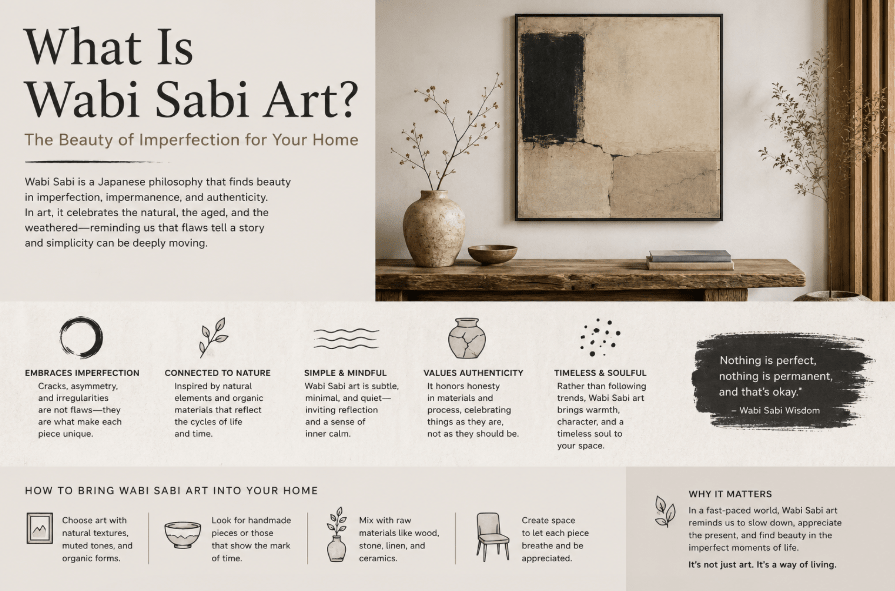
What Is Wabi Sabi Art? The Beauty of Imperfection for Your Home
There's a reason certain rooms feel instantly calm the moment you walk in — not perfectly styled, not fussy, but quietly alive. That feeling often comes from wabi sabi art: a Japanese aesthetic tradition that celebrates imperfection, natural texture, and the beauty of things that don't try too hard. If you've been drawn to earthy tones, raw surfaces, or art that feels honest rather than polished, you've already felt its pull.
This guide explains exactly what wabi sabi art is, what to look for when choosing it, and how to bring that sense of grounded calm into your home.
Quick Answer
Wabi sabi art is rooted in a Japanese aesthetic that finds beauty in imperfection, impermanence, and simplicity. In practice, it means art with muted earthy tones, organic textures, irregular forms, and a quiet, unforced presence — the opposite of slick or symmetrical. It's art that feels real.

What Is Wabi Sabi Art? The Philosophy Explained
Wabi sabi (侘寂) is a Japanese worldview built around two ideas: wabi — the beauty found in simplicity and solitude — and sabi — the beauty that comes with age and wear. Together, they describe an aesthetic that embraces what is incomplete, transient, and irregular. Think of a worn ceramic bowl, a mossy stone, a piece of driftwood with its edges smoothed by the sea. These objects don't need to be perfect to be beautiful. That's the point.
In art, this translates to work that resists symmetry and polish. Wabi sabi art typically features muted, natural tones — beiges, warm whites, soft greys, dusty greens, clay browns. Forms are organic rather than geometric. Surfaces carry visible texture: brushstroke marks, layered paint, the rough grain of natural materials. There's a quietness to it — nothing screaming for attention, everything inviting a slower look.
It's worth noting that wabi sabi art isn't simply "neutral" or "minimalist." Minimalism strips everything away. Wabi sabi keeps what is real and human — the mark of the hand, the trace of time. The difference is that wabi sabi art still has warmth, depth, and presence.
The Key Visual Elements of Wabi Sabi Art
If you're trying to identify whether a piece qualifies as wabi sabi art — or whether it will work in a wabi sabi interior — look for these characteristics:
- Earthy, muted palette — warm whites, sand, taupe, sage green, clay, charcoal. No high-gloss colours, no neon.
- Visible texture — brushstroke marks, layered paint, impasto, torn or irregular edges. The surface should feel like it has memory.
- Organic or irregular forms — shapes that don't look like they were designed with a ruler. Asymmetry is welcome.
- Quietness — nothing demands attention. The work rewards the viewer who slows down and looks.
- Natural references — not necessarily literal landscapes, but work that evokes stone, water, moss, bark, breath.
- Restraint — empty space is as important as filled space. Wabi sabi art doesn't over-explain itself.
Printed with HP latex inks designed to resist fading, canvas prints in this style retain their subtle tonal depth over time — which is exactly right for an aesthetic built around the beauty of age. Hand-stretched over a kiln-dried hardwood stretcher frame, they arrive with a quiet presence that's immediately at home in wabi sabi interiors.

"Soft Grid" — meditative minimalist grid in warm neutral tones. View the piece →
How to Choose Wabi Sabi Art for Your Home
Choosing wabi sabi art is less about following rules and more about trusting a feeling. The right piece will have a quality of stillness — you should be able to look at it for a long time without getting bored, and it should never feel imposing. Here's how to approach the choice:
Start with your palette. Wabi sabi interiors are built on a narrow, warm range of natural tones. A piece that introduces a strong contrast — a vivid blue, a bright red — will work against the aesthetic. Look for art that could have been made from materials found in nature: sand, ash, stone, water.
Consider texture over colour. A piece with visible brushwork or layered paint adds depth to a wall without visual noise. This is especially important in rooms that already have texture — plaster walls, linen upholstery, natural wood furniture. Art with smooth, flat colour can feel out of place in these interiors.
Think about size and breathing room. Wabi sabi art often works best with generous space around it. One larger piece on an empty wall — rather than a crowded gallery arrangement — suits the aesthetic better. Not sure how it will look? Our Live Preview tool lets you visualise the artwork at actual size in your space before you order, taking the guesswork out of size and placement.
Look for the hand. The best wabi sabi art carries evidence of the artist's presence — a mark, a gesture, a slight irregularity. Original paintings and high-quality canvas prints that preserve the textural quality of the original are the right fit.


"Soft Rain Lines" — beige minimalist abstract, vertical flow, warm tone. View the piece →
🎨 FREE ART STYLE FINDER QUIZ
Not sure which art style suits your space? Answer 7 quick questions and discover your aesthetic — whether it's wabi sabi, minimalist, contemporary, or something else entirely. Free PDF, instant download.
Download Free →Wabi Sabi Art for Every Room
The wabi sabi aesthetic suits almost any room, but it shines in spaces where you want calm over stimulation. Here's how to apply it room by room:
Living room. A single large piece above the sofa or console table is the classic wabi sabi move. Choose something with restrained colour and visible texture — a soft abstract in warm whites and earthy browns. The piece should anchor the room without dominating it. Pair with linen throws, natural wood furniture, and unglazed ceramics for the full effect.
Bedroom. Above the bed is where wabi sabi art works best. Choose a horizontal format that spans roughly two-thirds of the headboard width, in tones that won't interrupt sleep — muted sage, dusty rose, warm grey. The goal is art that makes the room feel like a retreat.
Home office. Wabi sabi wall art in a workspace brings the kind of calm that improves focus without distraction. A vertical piece to one side of the desk — quiet, textured, present — works better than a large piece directly in your line of sight. The satin-matte, low-glare finish on our canvas prints means no glare on video calls either.
Entryway. The entrance to a home sets the emotional tone for everything inside. A wabi sabi piece here — imperfect, organic, grounded — signals something important about how this home feels to live in. Consider a handcrafted floater frame made from poplar hardwood to add a further layer of natural material and depth.

"Cycladic Summer" — earthy Mediterranean palette, organic forms, quiet warmth. View the piece →

Frequently Asked Questions
What makes art wabi sabi?
Wabi sabi art has five defining qualities: a muted, earthy palette drawn from natural tones; visible texture or the trace of a human hand; organic rather than geometric forms; negative space used deliberately; and a quality of quietness that rewards slow looking. It doesn't have to be Japanese in origin — any art that embodies these qualities can be considered wabi sabi in character.
Is wabi sabi art the same as minimalist art?
They overlap but they're not the same. Minimalist art reduces composition to its absolute essentials — sometimes to the point of feeling cold or clinical. Wabi sabi art keeps what is human and organic: texture, warmth, imperfection, the mark of the maker. You could describe wabi sabi as "warm minimalism with soul."
What colours go with wabi sabi wall art?
Wabi sabi wall art works best with a palette of warm naturals: off-white, linen, sand, taupe, sage green, warm charcoal, clay, and soft terracotta. Avoid cool whites, high-contrast black, or saturated colours — they create visual tension that works against the wabi sabi aesthetic. If your walls are a warm white or natural plaster tone, almost any piece in our abstract canvas prints collection in neutral tones will work.
Can I use wabi sabi art in a modern home?
Yes — and this is one of the most appealing qualities of the wabi sabi aesthetic. It doesn't require a specific architectural style. Wabi sabi art brings warmth and groundedness to clean, contemporary interiors that might otherwise feel cold. It works equally well in a mid-century modern space, a Japandi-influenced interior, or a simply furnished apartment. The key is restraint: one or two well-chosen pieces rather than a crowded arrangement.
Are canvas prints fade-resistant enough for wabi sabi interiors?
Canvas prints made with UV- and fade-resistant HP latex inks are designed to resist fading and include a satin-matte, low-glare finish. For a wabi sabi interior, where the subtlety of the tonal palette is everything, this matters — the muted beiges and warm greys you chose on day one will still look exactly right decades later. All Rossetti Art canvas prints are produced to this standard.
If you're looking for wabi sabi art that feels genuinely considered — quiet, textured, and made to last — explore our abstract canvas prints or browse the full canvas print collection.
Keep Reading
About the Author — Chiara Rossetti is the founder of Rossetti Art, a canvas print and original art brand. She writes about interior design, wall art styling, and the art of making a home feel alive.

About the Author
Chiara Rossetti
Chiara Rossetti is the founder of Rossetti Art, a canvas print and original art brand. She writes about interior design, wall art styling, and the art of making a home feel alive.

Leave a comment
This site is protected by hCaptcha and the hCaptcha Privacy Policy and Terms of Service apply.