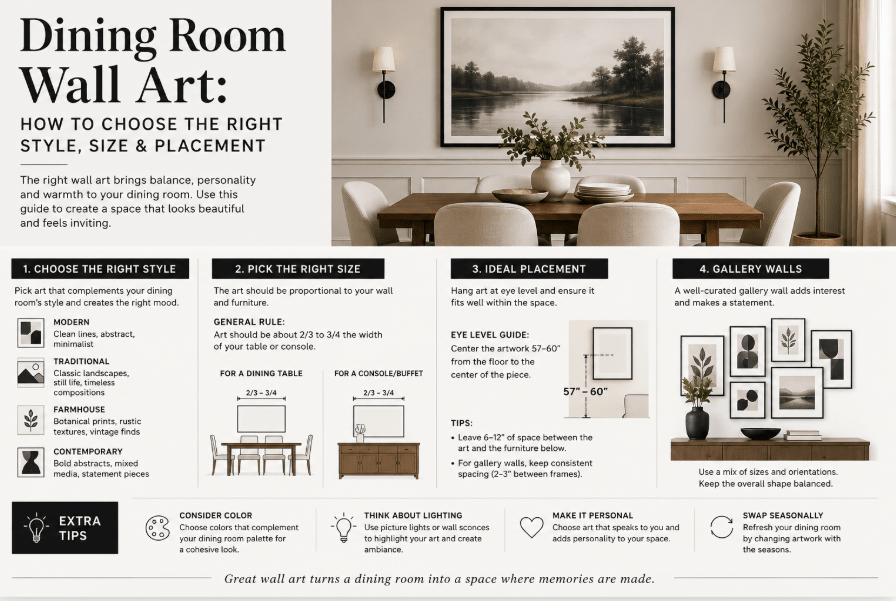
Dining Room Wall Art: How to Choose the Right Style, Size & Placement
The dining room is one of the most underrated spaces for art. It's where people gather, linger, and actually look at the walls — which makes dining room wall art more visible than almost anything else you hang in your home. Yet most dining rooms either have nothing on the walls, or a single piece that feels too small, too safe, or slightly out of place.
This guide covers everything you need to know: the right size, the best styles, where to hang, and how to build a gallery wall that makes your dining room feel intentional and alive.
Quick Answer
The best dining room wall art is large enough to anchor the wall — at least 24×36" for a standard room — in a style that matches the mood: abstract, contemporary or figurative all work well. Hang it at eye level, centred at 57–60 inches from the floor, and choose a horizontal canvas for above a sideboard.

Why Wall Art Transforms a Dining Room
Dining rooms work differently from living rooms. The furniture is fixed — table, chairs, maybe a sideboard — which means the walls do the heavy lifting when it comes to atmosphere. A well-chosen piece of dining room wall art can define the mood of an entire meal: calm and intimate, lively and expressive, or quietly sophisticated.
Research into residential interiors consistently shows that dining rooms with art feel more welcoming and encourage people to linger longer at the table. There's something about a considered piece on the wall that signals the room was designed with intention — that someone thought about the experience of being here, not just the furniture that fills it.
The good news is that dining rooms are forgiving. Unlike living rooms, where art has to compete with sofas, television units and rugs, a dining room wall is often relatively clear — which means a single strong canvas, or a well-arranged gallery wall, can define the entire space.

"Cycladic Summer" — Mediterranean abstract canvas in warm sand and terracotta tones. A bestselling dining room wall art choice at Rossetti Art. View the piece →
What Size Wall Art Works Best in a Dining Room?
Size is the single most common mistake people make with dining room wall art. A piece that's too small on a large wall looks accidental — as though it was hung there because nothing better was available. A piece that fills the wall, by contrast, looks deliberate and confident.
As a general rule, your wall art should cover roughly two-thirds of the wall width it occupies. For a standard dining room wall of 8–10 feet, that means a minimum of 24×36 inches — and ideally 30×40" or larger if the room can hold it. Above a sideboard or buffet, a horizontal canvas at 40×20" or 48×24" creates a strong, balanced composition.
At Rossetti Art, every canvas print is hand-stretched over a kiln-dried hardwood frame and printed with UV- and fade-resistant HP latex inks designed to resist fading — so whatever size you choose, it arrives ready to hang and built to last for decades. Not sure which size works in your space? Use our Live Preview tool to visualise the exact piece at scale on your actual wall before you buy.
Which Art Styles Work Best in a Dining Room?
There's no single correct style for dining room wall art — but some styles perform particularly well in the space. The key is matching the art's energy to the room's mood.
Abstract art is consistently the most popular choice for dining rooms. It adds visual interest without competing with the table setting, and works across a wide range of interior styles — from minimalist to eclectic. Abstract pieces with warm tones (terracotta, ochre, sand, gold) create an intimate, inviting feel; cooler palettes (slate, teal, navy) feel more sophisticated and contemporary.
Figurative and portrait art adds a human presence that makes a dining room feel cultural and considered. A portrait canvas above a sideboard is one of the most classic dining room combinations — seen in both traditional and modern interiors.
Mediterranean and coastal art works especially well in dining rooms because it evokes warmth, light, and the pleasure of gathering around a table. Sun-bleached tones, abstract landscapes, and natural textures all translate beautifully into the dining room environment.
All Rossetti Art canvas prints are available with a handcrafted floater frame made from poplar hardwood — a gallery-quality presentation with a floating shadow gap around the canvas that elevates any dining room wall without the need for additional framing.

"Celestial Mosaic" — geometric abstract canvas in rich jewel tones. A bold dining room wall art statement piece. View the piece →

Where to Hang Wall Art in a Dining Room
The standard rule for hanging art is to centre it at 57–60 inches from the floor — roughly eye level for a standing adult. In a dining room, this works well for any wall that isn't directly above a piece of furniture. When hanging above a sideboard or buffet, aim to leave 6–8 inches of space between the top of the furniture and the bottom of the canvas — enough to feel connected, without looking crowded.
Above the dining table itself is generally not the best position for a single large canvas — the overhead light fitting tends to create a visual conflict. Instead, use the wall opposite or adjacent to the table: that's the wall your guests face, which makes it the most impactful position in the room.
For horizontal canvases, the dining room sideboard wall is the natural home. A wide landscape canvas above a buffet or sideboard is one of the most classical and satisfying dining room arrangements — it anchors the furniture, fills the wall beautifully, and draws the eye along the length of the room. Browse our canvas prints collection and filter by horizontal orientation to find the right fit.
🎨 FREE ROOM-BY-ROOM ART GUIDE
Download our free Room-by-Room Art Guide — covers living room, bedroom, dining room, office and entryway with recommended sizes, placement heights and styling notes for each space.
Download Free →
"Coastal Silence Horizon" — neutral horizontal canvas in soft sand and coastal tones. Ideal dining room wall art above a sideboard or buffet. View the piece →
How to Create a Dining Room Gallery Wall
A gallery wall in the dining room is one of the most satisfying interior decisions you can make. Done well, it fills the wall with personality and makes the room feel like it belongs to someone specific — not a showroom, but a home.
The simplest approach is the grid: three canvases of identical size arranged in a row, spaced 2–3 inches apart. This works best above a long sideboard, where the symmetry mirrors the furniture below. For a more expressive, layered look, use canvases of varying sizes — anchor the arrangement with a larger central piece and build outward with smaller complementary pieces.
Stick to a consistent colour palette across the pieces rather than a consistent style — this creates visual coherence without making the wall feel like a matching set. Warm neutrals, earthy tones and muted abstracts all layer beautifully on a dining room gallery wall. Browse our canvas print collection and original paintings for combinations that work together, and use our Live Preview feature to visualise any piece in your dining room before buying.

Frequently Asked Questions
What is the best size for dining room wall art?
For a standard 8–10 foot dining room wall, the minimum recommended size is 24×36 inches. Ideally aim for 30×40" or larger for a proper statement piece. Above a sideboard, a horizontal canvas at 40×20" or 48×24" creates a balanced, proportional look. Every Rossetti Art canvas is hand-stretched over a kiln-dried hardwood frame and arrives with pre-installed hanging hardware — no additional framing required.
What art style works best in a dining room?
Abstract art, Mediterranean and coastal-inspired pieces, and figurative art all work particularly well in dining rooms. Abstract canvases in warm tones (terracotta, ochre, sand) create an intimate atmosphere ideal for evening dining; cooler palettes (slate, navy, teal) feel more sophisticated. The most important factor is scale — a piece large enough to anchor the wall will look intentional regardless of style.
Where should you hang art in a dining room?
Hang art so the centre of the piece sits at 57–60 inches from the floor — standard eye level for a standing adult. Above a sideboard, leave 6–8 inches between the top of the furniture and the bottom of the canvas. For a gallery wall, anchor the central piece at eye level and build the arrangement outward. Avoid hanging directly above the dining table, where overhead lighting tends to create visual conflict.
Are canvas prints suitable for dining rooms?
Absolutely. Canvas prints are one of the most practical and durable options for dining rooms. Rossetti Art canvases are printed with UV- and fade-resistant HP latex inks designed to resist fading, with a satin-matte, low-glare finish. Dining rooms typically don't receive intense direct sunlight, but even in brighter rooms these prints are built to hold their vibrancy for decades.
Do I need to frame canvas prints for a dining room?
No — Rossetti Art canvas prints are gallery-wrapped and arrive ready to hang straight out of the box. For a more elevated, gallery-quality look, you can opt for a handcrafted floater frame made from poplar hardwood, available in Black, Oak, Brown and White finishes. The canvas floats inside the frame with a small shadow gap — a particularly refined finish for a dining room. Made to order and carefully packaged for safe delivery.
Whether you're looking for a single statement canvas or building a gallery wall across your entire dining room, explore Rossetti Art's canvas print collection and original paintings for sale — all made to order, free shipping, ready to hang.
Keep Reading
About the Author — Chiara Rossetti is the founder of Rossetti Art, a canvas print and original art brand. She writes about interior design, wall art styling, and the art of making a home feel alive.

About the Author
Chiara Rossetti
Chiara Rossetti is the founder of Rossetti Art, a canvas print and original art brand. She writes about interior design, wall art styling, and the art of making a home feel alive.

Leave a comment
This site is protected by hCaptcha and the hCaptcha Privacy Policy and Terms of Service apply.