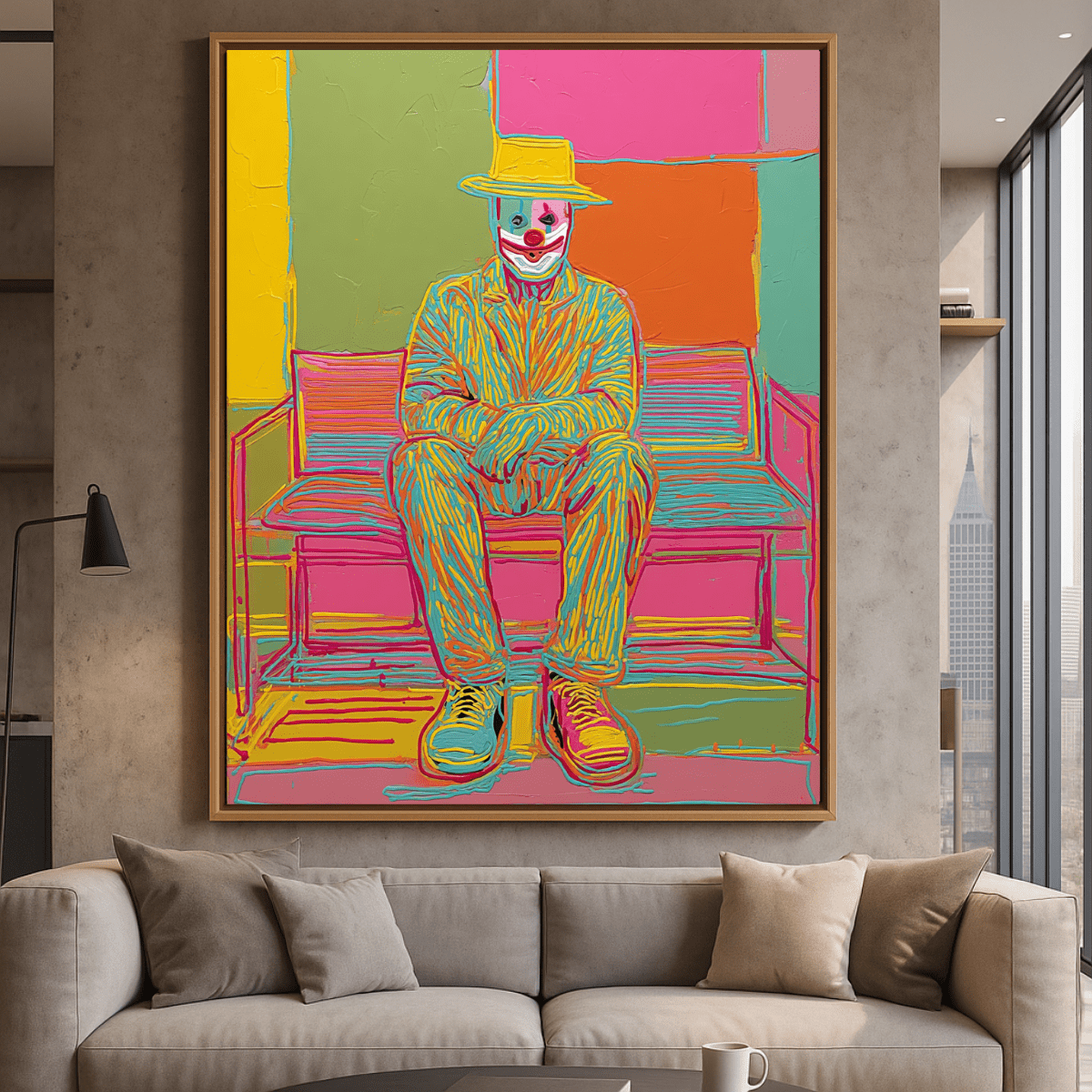
What makes a painted mask feel more honest than a face?
From Watteau’s Pierrot to Rouault’s heavy-lined figures, the stage of painting holds a strange truth.
Think of a performer who is also an image-maker: makeup, pose, and gesture turn a moment into meaning. That blend of show and making defines the modern clown artist and its reach across media.
In Paris and then in New York, works such as Picasso at The Met and Rouault at MoMA shape how we read identity. These paintings are not simple gags; they are rehearsal rooms for feeling where composition and color carry the emotional weight.
Collectors track iconography and provenance, not sentimentality. The practical value of a work depends on catalogues raisonnés and museum citations as much as on the image itself.
In this guide we trace the throughline from Pierrot’s stillness to Harlequin’s agility, showing how the painterly choices create the effect that still grips audiences today.
Key Takeaways
- The term "clown artist" names a performer who turns gestures into visual meaning.
- Historic paintings (Watteau, Picasso, Seurat) map a line from European pantomime to American galleries.
- Museum collections in New York make the lineage visible to U.S. audiences.
- Fame of a piece rests on structure and provenance, not just emotional appeal.
- Painters’ choices—line, color, light—produce the emotional work we respond to.
- The figure moves across film, music, and literature, proving its cross-media power.
Behind the Red Nose: What a clown artist really does in art and performance
Stagecraft and studio practice share a common grammar of pose and pause.
From commedia dell’arte come two ready-made characters. Pierrot, pale and unmasked, reads as linen-white innocence. Harlequin, in a diamond suit and half-mask, offers quick mischief. Painters use those opposites as a visual language of contrast.
On stage, gesture, timing, and blocking shape a scene. In the studio, the same logic appears as posture, light source, and edge. A framed figure placed center stage on canvas can make silence feel loaded with meaning.
- Gesture → mark: a pause becomes an edge or a catch in rhythm.
- Costume → code: dress signals role and social place.
- Backstage labor: pre-show nerves and rehearsal show up in honest details.
Good work strips the mask down to a study of self—risk, role, and the small drama of being seen. That is why this subject stays modern: identity is something tried on, tested, and shown to the viewer.
From Watteau to Picasso: how painters transformed the clown into art’s everyman
Painters turned stage stock into human types, freezing moments that ask to be read. This shift made the mime a stand-in for modern feeling and the small drama before any performance.
Watteau’s Pierrot (Gilles) arrives monumental and front-facing. The figure’s stillness reads like snowfall: weight, breath, and the quiet before a line are all visible. Watteau turns a stock role into an everyman.
Picasso and Seurat offer two different preludes. Picasso’s Harlequin in At the Lapin Agile wears the Rose Period’s weary pose as an alter ego. Seurat’s Circus Sideshow freezes gaslight and a clarinet’s hush, making time itself part of composition.
Later voices extend the range. Toulouse-Lautrec shows backstage labor. Rouault’s heavy contours make compassion into iconography. Klee and Miró turn the figure into rhythm and sign. Ensor’s masks and Buffet’s angular gloom push the theme from tenderness to dread.
Across centuries, the painted figure becomes a proving ground for questions of identity, structure, and spectatorship.
Pierrot vs. Harlequin: archetypes, costume, and the artist’s many masks
Two stock figures wear opposite logics: one asks you to pause, the other to track quick motion. Each serves as a compositional tool painters use to shape mood and meaning.
Pierrot—linen white, unmasked, wistful stillness
Pierrot’s cues are plain: moon-pale linen, long sleeves, and an uncluttered posture. The presence comes from small pauses and controlled edges.
Harlequin—diamonds, half-mask, quick mischief in motion
Harlequin’s telltales include a diamond suit, a half-mask, and a tilted stance that suggests movement. Eyes often glance past the viewer, implying a story off-frame.
- Costume as form: pattern versus plane; mask versus skin changes how light builds volume.
- Painter’s toolkit: Cézanne’s planes, Rouault’s contours, and pattern coding test these archetypes for structure.
| Feature | Pierrot | Harlequin |
|---|---|---|
| Color/Pattern | Plain white plane | Diamond pattern |
| Mask | Unmasked | Half-mask |
| Manner | Stillness, pauses | Tilted pose, quick gesture |
| Spotting tip | Study seams where costume meets shadow | Look for diamonds, half-mask, eyes glancing past |
- 10-second Harlequin checklist: diamonds, half-mask, tilted pose, side-glance.
Ten famous clown paintings that changed how we see performance
A short list of landmark works shows how performers on canvas reshaped the way we read gesture and costume.
Each painting turns a single pose into a compositional rule. Costume, light, and edge become tools for meaning rather than mere props.
Antoine Watteau — Pierrot (Gilles), c.1718–19, Louvre
Monumental and front-facing, Watteau’s Pierrot quiets the room. The vast scale and stillness read like snowfall, setting the template for the modern sad figure.
Pablo Picasso — At the Lapin Agile, 1905, The Met (New York)
Picasso’s Harlequin at the bar fuses theater with fatigue. In the Rose Period palette, the scene becomes an essay on identity and public pose.
Georges Seurat — Circus Sideshow, 1887–88, The Met
Seurat’s pointillist hush stages the prelude. Gaslight, the clarinet player, and an economy of gesture create a held breath before spectacle.
Georges Rouault — Clown, 1912, MoMA (New York)
Thick, black contours give this work an almost icon-like gravity. Comedy is recast as compassion and endurance rather than a simple gag.
- Later moves push the idea: Klee’s rhythmic line, Miró’s symbolic carnival, Ensor’s macabre pairings, Buffet’s postwar angles.
- These paintings endure because they treat performance as structure—edges, planes, and light carry the meaning.
- Check museum object pages to confirm display status, especially for works in New York where rotation is common.
Seeing several works together sharpens the viewer’s eye. Compare how one painter solves light while another codes costume; that contrast is where understanding grows. For a deeper historical route, visit this history of performers in visual.
Where to see iconic clown art in the United States
If you want to trace how paint and performance meet, a short U.S. museum route brings the work to life.
The Met, New York: Begin in New York with Picasso’s At the Lapin Agile (1905) and Seurat’s Circus Sideshow (1887–88). The Met pairs Rose Period intimacy with Seurat’s gaslit hush. These works reward slow looking and let you study how pose and palette set a scene.
MoMA, New York: Cross to Midtown to see Rouault’s Clown (1912). Thick, black contours make the figure feel like stained glass—solemn, architectural, and quietly intense.
Buffalo AKG, Buffalo: Head to Buffalo for Miró’s Harlequin’s Carnival (1924–25). Here the spirit of Harlequin becomes a cosmic dance of signs and color.
National Gallery of Art, Washington, DC: Add Klee’s Feuer Clown I (1921) to hear a musical line on canvas. This stops the tour with a lyrical, intimate counterpoint to the larger galleries.
Practical tips: Check museum object pages for display status; works travel often. Pair gallery visits with local performances to feel how quiet galleries and live shows exchange energy.
| Museum | Key Work | What to look for |
|---|---|---|
| The Met (New York) | Picasso — At the Lapin Agile; Seurat — Circus Sideshow | Rose glow, gaslight hush, pose as identity |
| MoMA (New York) | Rouault — Clown (1912) | Thick contours, solemnity, icon-like presence |
| Buffalo AKG (Buffalo) | Miró — Harlequin’s Carnival (1924–25) | Playful signs, cosmic movement, spirited color |
| National Gallery (Washington, DC) | Klee — Feuer Clown I (1921) | Musical line, lyrical abstraction, small-scale intensity |
Stages and streets: pantomime, Pierrot troupes, and the Golden Age in Paris
Paris’s silent stages taught audiences to read feeling in a single turn of the head.
From about 1825 to 1860, pantomime flourished. Mute theatres filled as gesture replaced speech. Pierrot held the center, and whole plays depended on posture and pause.
Jean‑Gaspard Deburau and the Paris pantomime tradition
Jean‑Gaspard Deburau made Pierrot unforgettable. His mix of shyness, wit, and quiet sorrow gave the role a human edge that painters later studied and echoed.
Cercle Funambulesque to Children of Paradise: the craft behind the mask
The Cercle Funambulesque kept commedia techniques alive, training performers and shaping posters and prints that spread stage grammar into visual culture.
- Marcel Carné’s 1945 film Children of Paradise revived Deburau’s persona for modern audiences.
- British seaside Pierrot troupes mounted daily shows (three performances except Sundays), pairing mime with banjo music.
- Live conventions—sleeve length, stance, mask angle—became visual cues painters adopted.
While words failed Pierrot, his gestures did not. That silent language let painters and photographers translate movement into line, light, and staged silence. In this way, theatre and visual art kept each other in view.
Soundtracks of a clown: music, film, and the echo in American culture
Music and film have long echoed the painted mime, turning silence into a score.
Schoenberg’s Pierrot lunaire sits at the center of this crossover. Its Sprechstimme voice blurs speech and song and mirrors Pierrot’s half-in, half-out presence on canvas. Listen and you hear a visual tension made audible.
Stravinsky’s Petrushka and Pulcinella borrow commedia archetypes too, proving musical modernism and stage clowns share a common DNA. Peter Maxwell Davies’s Eight Songs for a Mad King and Debussy’s settings extend that link across tone and timbre.
Charlie Chaplin shaped his Little Tramp as a kind of Pierrot. The tune “Smile” carries that same bittersweet balm. Films like Laugh, Clown, Laugh and the Pagliacci scene—“Vesti la giubba”—show how performance forces a public smile while private sorrow shows through.
The archetype later darkens. Stephen King’s Pennywise and Batman’s Pierrot Lunaire twist the mask into menace, reminding us a familiar figure can become threatening as easily as tender.
- Hear Schoenberg, then view Rouault to feel how sound and contour create a single emotional effect.
- New York’s concert halls and cinemas offer ideal pairings for cross-medium study and live experience.
Collector’s lens: separating structure from kitsch in clown paintings
Collectors learn to read a picture like a score: lines, costume, and light tell the plot. Start by checking iconography. Pieces that clearly engage Pierrot, Harlequin, or saltimbanques usually hold scholarly interest better than generic sorrow.
Iconography, line, and form: why painterly intent matters
Read the form: ask if you see planes, contour, or pattern supporting expression, or mere sentiment without structure. Compare languages—Cézanne’s planes, Rouault’s heavy contours, Klee’s coded line—to calibrate your eye.
Market reality: provenance, museum citations, and what surfaces at auction
Documentation matters more than drama. Catalogues raisonnés, museum citations, and exhibition histories predict value more reliably than pathos. Masterworks tend to stay in museums; expect studies, prints, and school pieces at auction.
- Start with iconography; named archetypes age better than cliché.
- Slow looking at edges and light—Seurat’s gas-glow or Rouault’s leaded line should feel necessary.
- Study several artists to see how different hands solve the same archetype.
- For deeper archival context, consult a focused resource like period-specific catalogues.
clown artist today: echoes in New York and beyond
Many painters now treat the canvas like a set, arranging light and pose as directors do.
Studios borrow performance logic: gesture, timing, and stagecraft become pictorial problems. Line, value, and surface answer those problems. The result keeps presence active on the page.
American educators and the spirit of the studio
In the United States, teacher-practitioners link workshop to gallery. Donald J. Davenport’s Gemini School foregrounds craft and media fluency, helping students stage theatrical subjects with technical skill.
Inge Van Der Meulen’s statement stresses that art can exceed words, a modern echo of Pierrot’s silent eloquence. Dana Zivanovits brings travel and direct observation into the studio, tuning palette and light as a performer tunes a lamp.
Mark Struzynski uses layered, photo-emulsion canvases like acts in a play; Francesc Sillué works small, attentive scenes that hold expressive detail and quiet motion.
The effect of form: where performance and pictorial craft meet
Form keeps the performance honest: composition and surface decide how persona reads as presence. New York’s museums and classrooms act as a testing ground where old masters inform new moves.
For a focused historical echo, see Toulouse‑Lautrec’s circus work collected in critical texts like Toulouse‑Lautrec’s circus studies.
The spirit of the performance survives because the studio keeps asking the same question: how to balance persona and presence so a painted gesture still feels like a staged moment.
| Educator | Approach | Key effect |
|---|---|---|
| Donald J. Davenport | Craft-led media fluency; studio production | Technical staging of theatrical subjects |
| Inge Van Der Meulen | Statement-driven practice; translation beyond words | Silent eloquence in small gestures |
| Dana Zivanovits | Travel-informed palette; direct observation | Light and atmosphere as stage lighting |
| Mark Struzynski & Francesc Sillué | Layered processes; detailed everyday scenes | Backstage reveal; expressive intimacy |
Conclusion
The painted mime keeps asking a simple question: what happens when a mask meets a face?
In galleries we see that tension at work. Pierrot and Harlequin, from Watteau to Miró, remain fertile. The forms—edges, light, pattern, and planes—give emotion room to breathe without slipping into cliché.
Visit museum collections in the United States to watch how different hands solve the same stage problem. Music and film keep the archetype moving, so these figures belong to more than one medium.
Behind every painted guise is a face asking to be seen. That human scale is why these paintings keep reaching new viewers. For a striking modern example, see Bernard Buffet’s Clown for a study of solitude and line: Bernard Buffet’s Clown.
Enhance Your Space with Unique Modern Masterpieces by Chiara Rossetti

Are you inspired by the innovative mediums and conceptual depth highlighted in our exploration of contemporary art? You’re not alone! Today’s art enthusiasts are seeking cultural relevance and emotional connections in their artwork. However, finding pieces that resonate with modern themes and fit your unique style can be a challenge. That’s where we come in!

At Rossetti Art, we specialize in canvas prints, original paintings, and modern sculptures that celebrate the spirit of now. Each piece created by Chiara Rossetti brings a personal touch that connects deeply with current social narratives—just like the modern masterpieces discussed in the article. Don’t miss out on the chance to elevate your home decor with breathtaking artwork that speaks to your values and aesthetic. Explore our collection today and find your perfect piece! Act now, and transform your space into a gallery of inspiration!
FAQ
What does a clown artist do in performance and visual art?
A clown artist blends physical theater, mime, and visual storytelling. They use costume, gesture, and painted expression to create characters that communicate without relying solely on words. In galleries and on stage, their work explores identity, comedy, and melancholy while engaging audiences through immediacy and play.
How did painters like Watteau and Picasso shape the image of the performer?
Painters translated theatrical types into lasting icons. Watteau’s Pierrot introduced a tender, solitary figure; Picasso’s Harlequin recast the performer as modern, fractured identity. These works moved the performer from ephemeral spectacle into a language of pose, color, and psychological depth.
Where can I see famous performer-themed paintings in the United States?
Major collections include The Metropolitan Museum of Art and MoMA in New York, which house key works by Picasso, Seurat, and Rouault. Regional museums such as the Buffalo AKG also feature related pieces. Check museum websites for current displays and loans.
What’s the difference between Pierrot and Harlequin as visual types?
Pierrot appears in white linen, unmasked, expressing wistful stillness and silent longing. Harlequin is lively, wearing a diamond-patterned costume and a half-mask, embodying mischief and agile movement. Each offers distinct emotional and formal tools for painters and performers.
How has the performer figure influenced music and film?
The performer archetype crosses media: Schoenberg’s Pierrot lunaire reframed the figure in modern music; Chaplin’s Little Tramp translated pantomime into cinema; and scores and songs often underscore the bittersweet or uncanny facets of the performer. These adaptations expand the figure’s cultural resonance.
Are performer portraits collectible or kitsch for collectors?
Value depends on provenance, artistic intent, and execution. Works with museum citations, solid provenance, or clear innovation in iconography and form attract collectors. Pieces that rely on novelty without artistic depth tend to fall into kitsch and lose long-term market value.
How do contemporary New York practitioners keep the tradition alive?
Contemporary practitioners mix studio practice, teaching, and community performance. They study form and showmanship, experiment with mixed media, and bring theatrical training into gallery contexts. Institutions, workshops, and artist-run spaces in New York foster that exchange.
What should I look for when viewing performer-themed paintings in a museum?
Look at composition, brushwork, and costume as signs of intent. Note how the face and posture convey mood, and whether the work references historical types or reinterprets them. Provenance and exhibition history can also reveal a work’s cultural significance.
How do performance and painted form influence each other today?
The two practices inform one another constantly. Painters borrow gesture and timing from stagecraft, while performers adopt visual strategies—color palettes, staging, and framing—from painting. That cross-pollination shapes contemporary shows and studio work alike.


Leave a comment
This site is protected by hCaptcha and the hCaptcha Privacy Policy and Terms of Service apply.