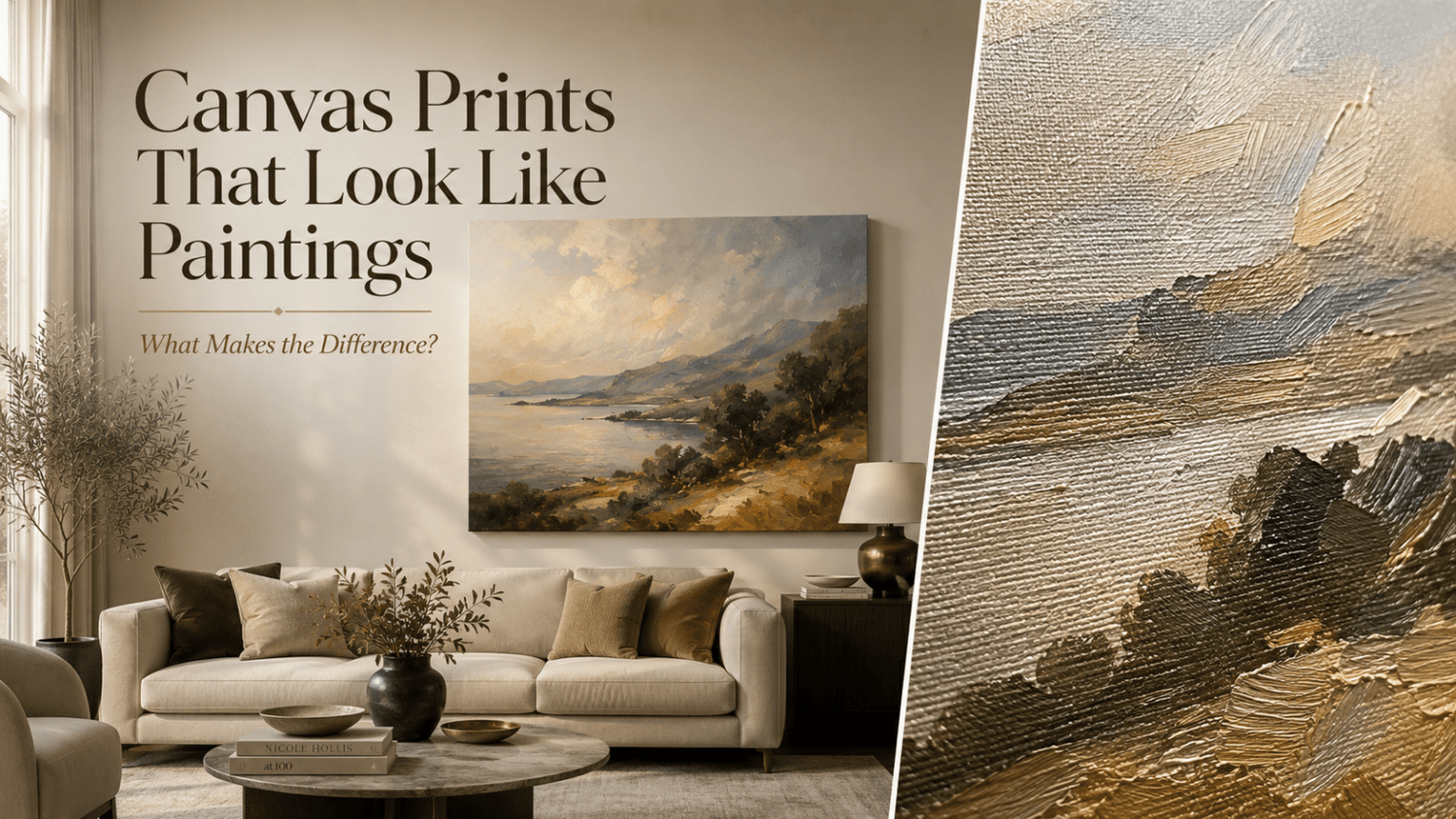
You have seen it in a beautifully decorated room — a canvas print hanging on the wall that stops you mid-sentence because you genuinely cannot tell whether it is a real painting or a print. That is not an accident. It is the result of specific production choices, and understanding them means you can consistently find canvas prints that look like paintings rather than the flat, mass-produced alternatives that fill most online shops.
This guide explains exactly what creates the difference — and what to look for when you are shopping for canvas prints that genuinely have the presence and depth of original art.
Quick Answer
Canvas prints that look like paintings share three characteristics: they are printed on real canvas (not paper or synthetic material), they use HP latex inks with a matte or satin finish rather than glossy, and they are hand-stretched over deep wood frames rather than rolled flat. The depth of the frame, the texture of the canvas surface, and the reproduction quality of the original artwork are the deciding factors.

Why Some Canvas Prints Look Like Paintings and Others Don't
The difference comes down to production quality — specifically, the quality of the canvas, the ink system used, and the way the print is mounted and finished. Most cheap canvas prints fail on all three counts: they use polyester or low-grade cotton blends rather than fine art canvas, they print with dye-based inks that produce flat, slightly glossy results, and they are stretched poorly or not at all (sold rolled in a tube).
A canvas print that looks like a painting uses genuine fine art canvas — a tightly woven, acid-free surface with enough texture to create the visual depth that makes you feel like you are looking at brushwork rather than a digital file. When the ink — HP latex inks, designed to resist fading — is deposited into this surface rather than sitting on top of it, the result has the quality of depth and dimensionality that a painting has.
The frame matters too. A canvas stretched over a 1.5-inch or 2-inch hardwood stretcher frame looks like a painting because it sits away from the wall, casts a subtle shadow, and has physical depth. A canvas print on a shallow frame or pinned flat to a backing board looks like a photograph.

"Carbon Tide" — Textured original painting with palette knife — the kind of surface depth a print alone cannot replicate. View the piece →
The Role of Ink Quality and Canvas Surface
Ink quality is the technical factor that most buyers overlook. Dye-based inks — used in most low-cost canvas prints — produce vivid initial colours but are prone to fading, and they sit on the canvas surface in a way that catches the light uniformly, creating the slight sheen that makes a print look like a print.
HP latex inks penetrate the canvas fibres rather than sitting on the surface. The result is a matte, textured finish where colours appear to come from within the canvas rather than being applied to it. This is exactly how paint behaves on canvas — which is why archival pigment prints create the illusion of painting that dye prints cannot achieve.
Rossetti Art canvas prints use UV- and fade-resistant HP latex inks designed to resist fading, with a satin-matte, low-glare finish. The canvas itself is a fine art cotton blend — woven tightly enough to hold fine detail while retaining enough grain to read as a painted surface when viewed from a normal distance. For a complete breakdown of lifespan, fading and care, see our guide to how long canvas prints last.

"Ignition" — Vivid abstract canvas print with depth and presence — HP latex inks on fine art cotton canvas. View the piece →
How Framing Makes a Canvas Print Look Like a Real Painting
A painting does not sit flat against a wall. It sits in a frame, or on a stretched canvas, that creates physical depth — a gap between the painted surface and the wall behind it. That gap, and the shadow it casts, is part of what makes a painting feel like an object rather than an image.
This is why framing is so important for canvas prints that are meant to look like paintings. A canvas stretched over a 1.5-inch deep hardwood frame already achieves some of this effect — the canvas has dimension, and when hung it sits away from the wall enough to cast a shadow along its lower edge. Our canvas prints are hand-stretched over kiln-dried hardwood frames exactly for this reason — the structural integrity of the frame holds the canvas taught and flat, and the depth gives the piece physical presence.
The hardwood floater frame option takes this further. A floater frame surrounds the canvas with a visible gap between the canvas edge and the frame border — so the canvas appears to literally float inside the frame. It is the single most effective way to make a canvas print look like a gallery-displayed original painting — we explain exactly why in our guide to the canvas print with floating frame. The natural grain of the handcrafted poplar hardwood frame reinforces the premium, handcrafted quality of the piece.

Original Paintings vs High-Quality Canvas Prints
An honest comparison: a high-quality canvas print made from an original artwork does not perfectly replicate the experience of standing in front of the original painting. The brushwork that you can see and feel on a textured original — the ridges of palette knife marks, the layered impasto — is present on the original and absent from the print.
But for most rooms, and for most viewing distances, a gallery-quality canvas print reproduces the visual experience of a painting with extraordinary fidelity. The colours, the composition, the sense of depth created by pigment on canvas — all of these translate. What you gain from the print over the original is accessibility: the ability to own and live with art that would otherwise be out of reach.
For buyers who specifically want the physical presence of an original — the textured surface, the unique object quality — Rossetti Art also offers original paintings in a range of formats. These are made-to-order works, hand-painted by Chiara Rossetti, and signed on the back. They are the real thing, not a reproduction of it.
🎨 FREE ART STYLE FINDER QUIZ
Not sure whether an original painting or a high-quality canvas print is right for your space? Our free Art Style Finder Quiz helps you identify the styles and formats that suit your interior — and your budget.
Download Free →What to Look For When Buying a Canvas Print That Looks Like a Painting
When you are evaluating canvas prints, four criteria separate the ones that will look like paintings from the ones that will look like digital files printed on fabric.
Canvas material. Look for fine art cotton canvas, not polyester blends. The description should specify the canvas composition. If it does not, assume it is a low-grade synthetic.
Ink system. HP latex inks are the standard for fine art reproduction. Avoid anything described as "vibrant dye inks" or that emphasises gloss finish — these are the hallmarks of photographic rather than painterly results.
Frame depth. A 1.5-inch or 2-inch deep frame is minimum for a canvas print that reads as a painting. Anything shallower looks like a flat poster.
Hand-stretching vs machine stretching. Hand-stretched canvas has more consistent tension across the surface — the corners are neat, the surface is flat, and there are no stress wrinkles. Machine-stretched canvas is often uneven, particularly at the corners.
Rossetti Art canvas prints are hand-stretched over kiln-dried hardwood frames, printed with UV- and fade-resistant HP latex inks on fine art cotton canvas, with low-emission satin-matte, low-glare finish applied by hand. They are made to look like paintings — and the people who buy them consistently say that visitors to their homes ask if the art is original.

"Confluence" — Large original black and white abstract painting — depth, scale, and surface quality that only an original can offer. View the piece →

Frequently Asked Questions
What makes a canvas print look like a real painting?
Three things: HP latex inks printed on fine art cotton canvas (not dye inks on synthetic material), hand-stretching over a deep hardwood stretcher frame (1.5 inches or more), and a matte or satin finish rather than gloss. A floater frame further enhances the painting-like quality by giving the canvas physical depth within its display context.
Can you tell the difference between a canvas print and an oil painting?
At normal viewing distance — 3–6 feet — a high-quality canvas print made from an original painting is very difficult to distinguish from the original. The colour, depth, and surface texture all read as painted. Up close, the absence of physical brushwork is apparent. The difference matters less in a room than in a gallery.
Are archival canvas prints really fade-resistant?
Yes — UV- and fade-resistant HP latex inks used in fine art printing are independently tested for light-fastness. Rossetti Art prints are designed to resist fading under normal indoor lighting conditions. This is a genuine material specification, not a marketing claim — it is why museums and galleries use HP latex inksjet printing for reproduction work. For the full lifespan and care breakdown, read how long do canvas prints last.
What is a floater frame and why does it make canvas look more like a painting?
A floater frame is a style of frame where the canvas sits inside the frame with a visible gap between the canvas edge and the inner edge of the frame — so the canvas appears to float. This replicates the way paintings are displayed in galleries and creates physical depth that makes the canvas look like an artwork rather than a print. Rossetti Art's floater frame is handcrafted from poplar hardwood with a natural grain finish, available in oak, black, brown and white. See our full floating frame guide.
Is it worth buying an original painting instead of a canvas print?
It depends on what you value. An original painting is a unique object with physical presence, brushwork, and a made-to-order quality that no print can fully replicate. A high-quality canvas print of an original artwork gives you most of the visual experience at a much lower price point. Rossetti Art offers both — see our original paintings and our canvas prints to compare.
Browse our full range of canvas prints and original paintings — and use Live Preview to see how any piece looks on your wall before you buy.
Keep Reading
About the Author — Chiara Rossetti is the founder of Rossetti Art, a canvas print and original art brand. She writes about interior design, wall art styling, and the art of making a home feel alive.

About the Author
Chiara Rossetti
Chiara Rossetti is the founder of Rossetti Art, a canvas print and original art brand. She writes about interior design, wall art styling, and the art of making a home feel alive.



Leave a comment
This site is protected by hCaptcha and the hCaptcha Privacy Policy and Terms of Service apply.