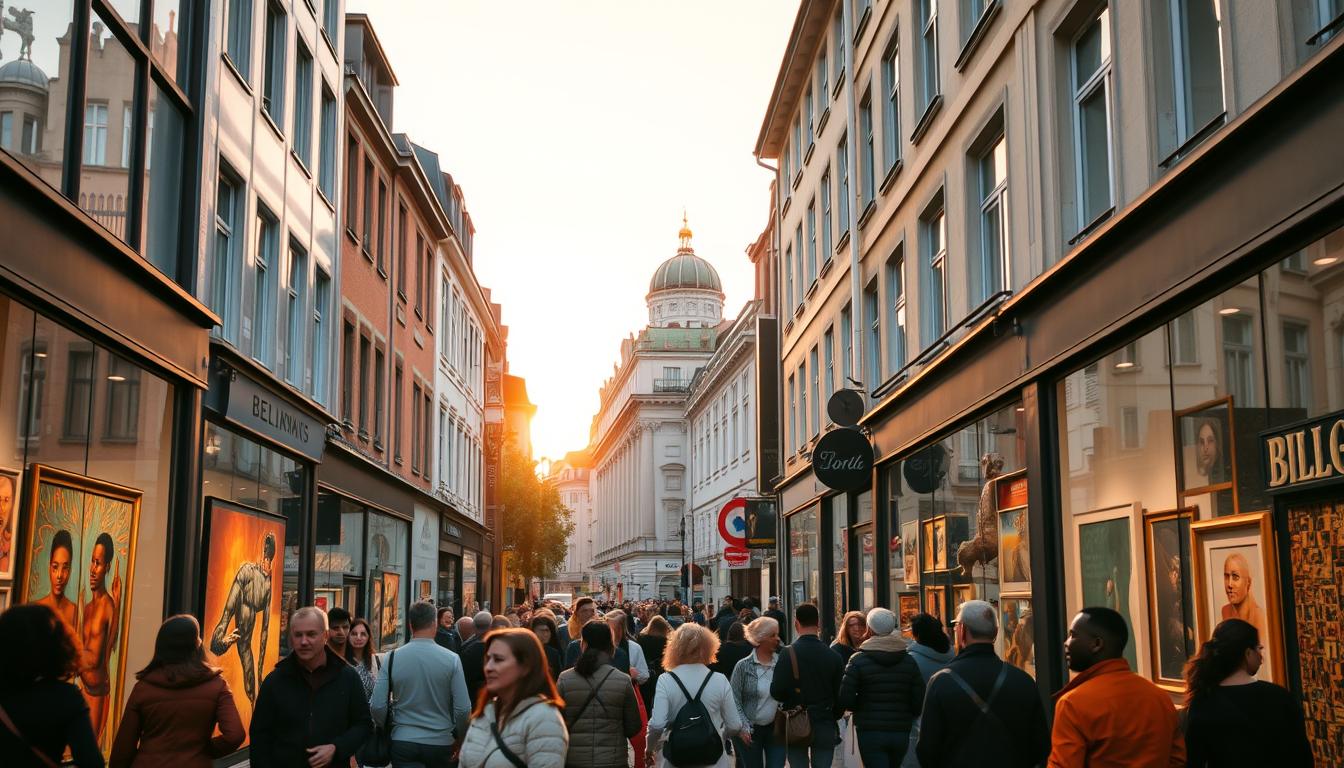
Can a city rewire the global conversation around creativity? Berlin’s post-reunification energy pushed bold, politically charged practices that reshaped the art world and opened doors for new voices.

Visitors and collectors find a focused scene where intimate galleries like ARTCO Galerie bridge cities and amplify artists working in painting and photography. Institutions from Tate Modern to Rele Gallery and Ernie Wolfe Gallery deepen ties with London, New York, and Los Angeles, while fairs such as 1-54 drive auction records and sustained attention.
In this guide you’ll get names, neighborhoods, and programs that make the experience rich and navigable. Expect shows that mix lived histories, political urgency, and striking beauty. Read on to plan a visit with a collector’s eye and an enthusiast’s curiosity.
Key Takeaways
- Berlin’s post-reunification spirit nurtures boundary-pushing practices and meaningful shows.
- ARTCO Galerie and partner hubs link local galleries to global platforms.
- Contemporary african art now commands institutional space and auction attention.
- The scene is accessible: small galleries make it easy to meet artists and learn themes.
- This guide highlights where to go, who to know, and what to expect on a focused visit.
Why Berlin Matters in Contemporary African Art
Berlin’s gallery culture turned daring experiments and political urgency into a global platform for diasporic voices. The city’s post-reunification energy made room for mission-driven spaces that work closely with artists. These venues favor sustained projects over fast publicity.
The city’s experimental energy and politically charged art scene
Curators and makers use painting and photography as clear entry points for tough conversations. Grassroots networks normalize collaboration and welcome south african perspectives alongside other diaspora voices.
From post-reunification edge to global conversations
Smaller galleries maintain long-term focus, which helps themes grow into research-led shows. Institutional attention and market interest—from exhibitions to occasional auction results—follow ideas rather than hype.
- Risk-friendly programming encourages political candor.
- Close curator-artist ties deepen project development.
- Global linkages connect the city to London and Los Angeles networks.
| Feature | How it helps artists | Outcome |
|---|---|---|
| Small, focused galleries | Long-term exhibitions and research | Deeper public engagement |
| Political programming | Direct, urgent themes | Broader critical attention |
| Global curatorial links | Cross-city shows and partnerships | Increased visibility and market traction |
Top Berlin Galleries Championing African and Diaspora Voices
Several small galleries in Schöneberg act as focused platforms for work that crosses continents and conversations.
ARTCO Galerie, Schöneberg: Cross-continental focus on painting and photography
ARTCO Galerie anchors a clear program: a curated selection of painting and photography by african artists. The gallery keeps a compact roster so each work receives deep research and attention.
Signature shows and themes: Social commentary, portraits, and politically engaged works
Observer & Commentator paired Richard Mudariki and Kufa Makwavarara in a show where painting addressed political conditions with sharp insight and dark humor. Portrait-led presentations often act as accessible entry points for visitors new to the scene.
Berlin–Cape Town bridge: How sister locations amplify artists’ reach
ARTCO’s sister space in cape town extends visibility across south africa and Europe. That link helps both established emerging practitioners reach collectors and critics in multiple markets.
- Compact program: deep engagement with each artist.
- Research-driven themes: wall texts and talks that add context.
- Cross-continental reach: pairings and exchanges that boost long-term careers.
| Feature | Benefit | Result |
|---|---|---|
| Small roster | Focused curation and follow-up | Consistent quality and deeper public dialogue |
| Portrait-led shows | Personal narratives meet political themes | Strong audience entry points |
| Berlin–Cape Town program | Access to collectors and critics in two regions | Greater visibility for south african artists |
For a broader look at networks and profiles of diaspora creators, see this spotlight on diaspora artists.
african contemporary art berlin: Where to See Standout Exhibitions
Find the most striking exhibitions by following gallery programs that favor depth over scale. Small venues often curate a tight run of works that spotlight both established emerging talents and new voices. That focused approach creates memorable visits.
Focused gallery programs spotlighting established and emerging artists
Look for galleries that run series instead of sprawling group shows. These programs let curators develop context and let artists show work in sequence.
From intimate spaces to larger shows: Creating dialogue across media
Intimate spaces let you study painting and photography closely, ask questions, and learn about process. Larger shows can expand those conversations into mixed-media displays and public programs.
- Pace your day to compare neighborhoods and see how curators build conversations.
- Return over months to watch how a gallery supports careers and critical dialogue.
- Keep a short list of what resonates—medium, tone, and themes—to guide follow-ups.
| Gallery Type | Advantage | Typical Outcome |
|---|---|---|
| Small focused space | Close curator-artist ties and research-led shows | Deep visitor engagement and lasting critical attention |
| Program with Cape Town links | Cross-city exposure and paired exhibitions | Wider audience and market reach for artists |
| Larger institutional show | Broader public programs and cross-media scope | Expanded dialogue and institutional recognition |
Artists to Know: From Wangechi Mutu to William Kentridge
This shortlist highlights artists whose works often become focal points in major exhibitions. Look for recurrent themes—gender, memory, power, and environment—woven through striking formal choices and public programs.

Wangechi Mutu
Wangechi Mutu combines collage, painting, sculpture, and film to make hybrid female-animal figures that probe identity and desire. Her bronze Seated I–IV, commissioned by The Metropolitan Museum of Art in New York, shows how museum recognition can amplify an artist’s reach.
William Kentridge
William Kentridge uses animation and charcoal drawing to meditate on south african history and social injustice. His layered narratives often resonate in museum shows and academic programs where audiences unpack memory and politics.
Yinka Shonibare
Yinka Shonibare works with Dutch wax textiles and satirical installations to question colonial legacies and global exchange. His sculptures and displays use costume and wit to reframe public memory.
Abdoulaye Konaté
Abdoulaye Konaté treats textiles as monumental panels—almost like painted fields—assembled from locally sourced fabric. His immersive works translate political and environmental concerns into large-scale installations.
Tracey Rose
Tracey Rose centers performance and video to confront gender and racial politics. Her practice is direct and historically informed, often placing the artist’s body at the core of the work.
Amoako Boafo
Amoako Boafo is known for finger-painted portraits and rapid museum visibility. Collaborations with fashion houses and shows at major collections highlight how portraits and painting can cross markets and museums.
- Collector’s tip: Track museum citations, biennial participations, and publication histories rather than relying on short-term auction chatter.
- Curatorial note: Paintings and sculptures by these artists often anchor exhibitions, helping curators build dialogues around portraits, textiles, and performance.
For more profiles and networks, see this guide to key artists.
Institutions, Collections, and the Global Context
International institutions and focused collections offer frames that shape local exhibitions. These anchors create language, standards, and expectations that smaller programs adapt.
How London’s Tate Modern and The Africa Centre influence curation
The Africa Centre (Southbank) holds a permanent collection featuring William Kentridge and Cinthia Sifa Mulanga. Its holdings foreground identities, migration, and post-colonial themes.
Tate Modern has brought Nigerian Modernism and artists like El Anatsui into the global canon. That kind of museum validation helps normalize diaspora narratives within the art world.
Los Angeles platforms and cross-city dialogues
Rele Gallery moves artists between Lagos and Los Angeles, shaping selection strategies that independent spaces borrow. Ernie Wolfe Gallery works by appointment and models long-term connoisseurship for sculptures and other media.
Look at wall texts, catalogs, and lender credits to see how shows are assembled and how artists circulate. Fairs like 1-54 (London, New York, Marrakech) further calibrate market and research priorities.
| Institution | Role | Influence |
|---|---|---|
| The Africa Centre | Permanent collection and programming | Context for identity and migration themes |
| Tate Modern | Major exhibitions and scholarship | Canon-building and museum validation |
| Rele / Ernie Wolfe | Gallery networks and connoisseurship | Cross-city circulation and selection models |
| 1-54 Fair | Market and critical visibility | Platform linking collectors, curators, and venues |
Collecting and the Market: From Auctions to Gallery Selections
A confident collector treats exhibitions, auctions, and scholarship as a single ecosystem.

Start with gallery visits led by curators. Compare pricing, condition, and medium. That helps you balance paintings with works on paper and editions.
Navigating media and value
Understand category differences: paintings usually command higher prices and require different care than prints or textiles. Editions and mixed media have distinct logistics and resale paths.
Reading auction signals
Auctions show demand, but spikes can mislead. Always check exhibition history, catalogs, and museum citations that support long-term value.
- Build relationships with dealers who share provenance and condition reports.
- Use fairs like 1-54 to see patterns across the world and spot emerging momentum.
- Be patient: follow artists through shows and publications before bidding.
| Step | What to check | Why it matters |
|---|---|---|
| Curator-led gallery visit | Selection, documentation, pricing | Context and trusted provenance |
| Auction catalog review | Sale history, estimates, comparables | Market signal with short-term volatility |
| Due diligence | Export rules, shipping, insurance | Protects budget and legal ownership |
Practical tip: favor galleries that support african artists early and provide scholarship rather than chasing sensational auction headlines. For perspective on market context and museum influence, see Strauss & Co perspectives as one useful essay Strauss & Co perspectives.
Plan Your Visit: Neighborhoods, Media, and Thematic Trails
Plan a route that links Schöneberg’s compact galleries to nearby project spaces for a layered viewing experience. Start with a base and let short walks reveal differences in scale and display. Small venues make it easy to compare shows and ask questions.
Schöneberg and beyond: Mapping galleries and project spaces
Begin at ARTCO Galerie and branch out on foot. Many project spaces sit close by, so you can move between exhibitions without long transit times.
Note: cross-continental programming with cape town often appears on seasonal rosters and shapes what you see.
Focus by medium: Painting, photography, and mixed-media installations
Build a medium-led itinerary. Compare painting, painting photography pairings, and mixed media to see how similar themes shift across formats.
What to look for: Portraits, textiles, and politically charged themes
Watch for portraits and textiles that foreground identity. These works often open deeper themes and invite conversation with curators and artists.
- Ask for checklists and press releases to track exhibitions and artist histories.
- Time visits for gallery weekends or nearby auction previews to add market context.
- Photograph wall labels when allowed and jot notes about works that spark interest.
| Tip | Why it helps | Action |
|---|---|---|
| Start in Schöneberg | Compact route and curator access | Walk local galleries, ask questions |
| Medium-led plan | See themes across formats | Compare painting and photography shows |
| Collect materials | Track artists and exhibitions | Save press releases and labels |
Conclusion
Local galleries, museums, and fairs now form a dense network that reveals how practices and markets evolve. , This network makes it possible to see how artists build careers across neighborhoods and cities like New York and Los Angeles.
Return visits reward attention: compare exhibitions, read catalogs, and track museum citations rather than chasing auction noise. Concentrated programs and curator-led shows offer the most durable signals about where meaning and value grow.
Use this guide as a practical map. Keep exploring, ask questions, and follow artists over time. What has unfolded is not a fad but a lasting recentering of voices that enriches the art world and reveals real beauty across media.
Enhance Your Space with Unique Modern Masterpieces by Chiara Rossetti

Are you inspired by the innovative mediums and conceptual depth highlighted in our exploration of contemporary art? You’re not alone! Today’s art enthusiasts are seeking cultural relevance and emotional connections in their artwork. However, finding pieces that resonate with modern themes and fit your unique style can be a challenge. That’s where we come in!

At Rossetti Art, we specialize in canvas prints, original paintings, and modern sculptures that celebrate the spirit of now. Each piece created by Chiara Rossetti brings a personal touch that connects deeply with current social narratives—just like the modern masterpieces discussed in the article. Don’t miss out on the chance to elevate your home decor with breathtaking artwork that speaks to your values and aesthetic. Explore our collection today and find your perfect piece! Act now, and transform your space into a gallery of inspiration!

FAQ
What makes Berlin an important hub for contemporary African artists and diaspora voices?
Berlin’s experimental energy and politically charged scene attract curators, collectors, and artists. The city fosters cross-continental dialogue through gallery programs, project spaces, and festivals that foreground painting, photography, performance, and textile works from across the continent and its diasporas.
Which neighborhoods should I visit to see the best gallery shows?
Start in Schöneberg for galleries with strong cross-continental programs, then explore Mitte and Kreuzberg for project spaces and pop-up exhibitions. These areas host a mix of intimate venues and larger institutions that stage thematic trails focused on portraiture, textiles, and politically engaged works.
Who are some key artists shown in Berlin’s galleries right now?
Look for names such as Wangechi Mutu, William Kentridge, Yinka Shonibare, Abdoulaye Konaté, Tracey Rose, and Amoako Boafo. Their work spans collage, animation, textiles, performance, and portraiture, and often appears in museum collections and major international exhibitions.
How do Berlin galleries collaborate with spaces in Cape Town, London, and Los Angeles?
Galleries form sister-location partnerships and loan networks with institutions in Cape Town, London’s Tate Modern and The Africa Centre, and U.S. galleries like Rele Gallery. These ties amplify artists’ visibility, create touring exhibitions, and shape curatorial perspectives across continents.
What should collectors focus on when building a collection from these shows?
Prioritize works with strong provenance, condition reports, and clear editioning for photography and multiples. Pay attention to painting and textile panels that engage political and historical themes, and consider emerging names alongside established artists to balance long-term value and cultural impact.
Are there specific themes I should look for in exhibitions around the city?
Expect recurring themes such as identity, postcolonial histories, gender and feminism, migration, and urban life. Portraiture, fashion references, and textile-based installations often surface alongside socially engaged photography and sculptural projects.
How can I find upcoming exhibitions and signature shows in Berlin?
Follow gallery newsletters, visit museum calendars, and check arts platforms that list openings and fairs. Social media and curator talks are also good sources for signature shows and thematic programs focused on painting, photography, and mixed media.
What role do museums and major collections play in shaping the local scene?
Museums and major collections provide research resources, touring exhibitions, and institutional validation that influence gallery programming. Collaborations with international centres help frame local discourse and attract global audiences and collectors.
Can I see performance and video works, or is the focus mainly on painting and photography?
You can see a wide range of media. Many spaces program performance, video, and installation alongside painting and photography to create dialogues across forms. Check gallery schedules for live programs and screenings tied to exhibitions.
How accessible are gallery shows for first-time visitors and international travelers?
Most galleries offer free entry and host regular opening nights and guided tours. Museums may charge admission but often provide multi-lingual materials. Plan visits around openings and public programs to get context and meet curators or artists.


Leave a comment
This site is protected by hCaptcha and the hCaptcha Privacy Policy and Terms of Service apply.