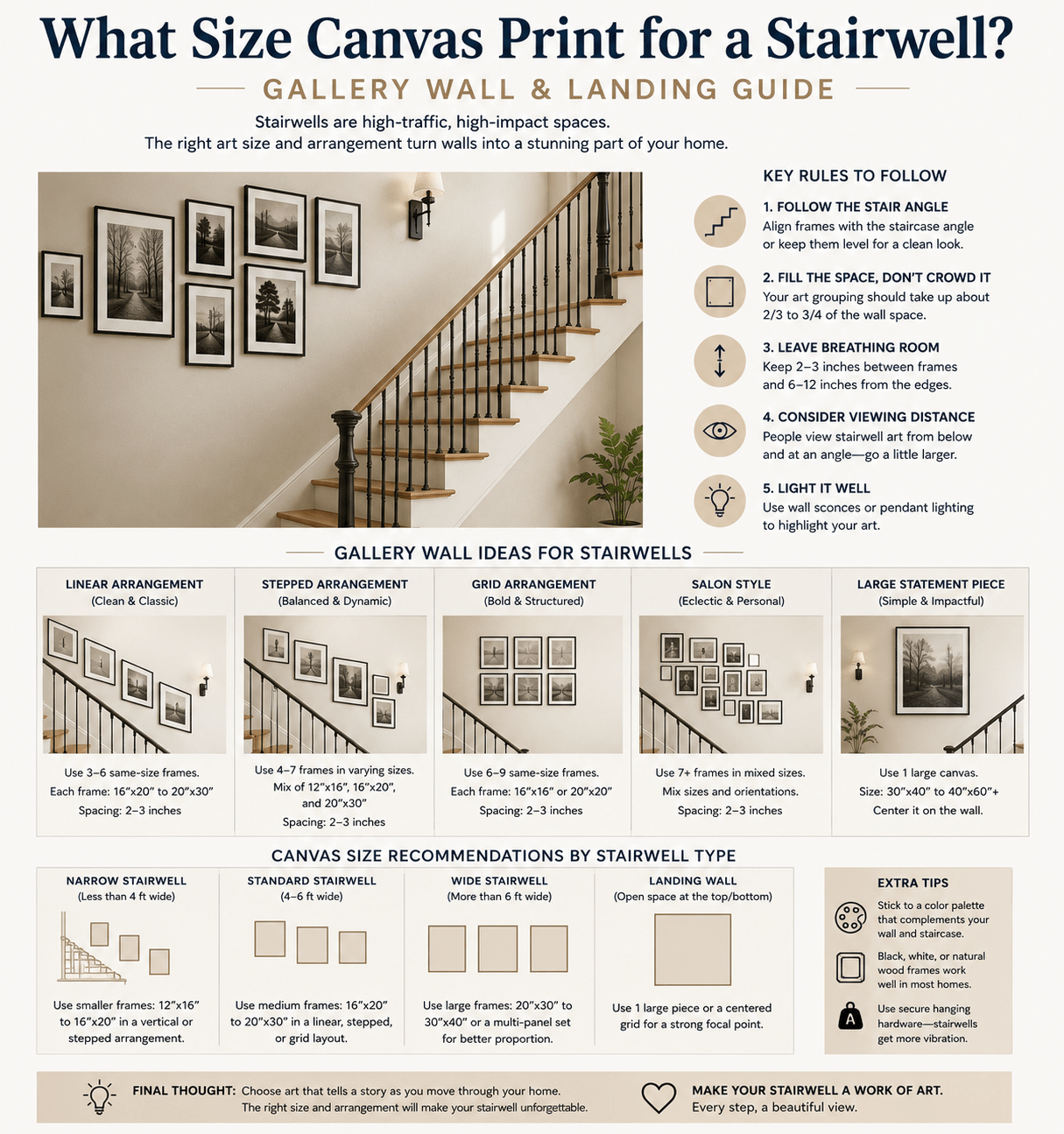
What Size Canvas Print for a Stairwell? Gallery Wall and Landing Guide
Stairwells are one of the most dramatic decorating opportunities in the home — and one of the most commonly wasted. A blank staircase wall is a missed opportunity every single time you go up or down the stairs. Done well, a staircase gallery wall or a single landing statement piece becomes the most talked-about feature in the house.
Getting the canvas sizes right — and understanding the difference between a staircase side wall and a landing focal wall — is the key to making this work beautifully.
Quick Answer
For a staircase gallery wall, use canvas prints 16×20" to 24×30" — a mix of sizes creates rhythm without chaos. Hang them along a diagonal line that follows the stair pitch, with 6–8 inches between pieces. For a landing focal wall, a single large canvas 30×40" or bigger works beautifully — size it to two-thirds of the landing wall width.

Two Types of Stairwell Wall
Before sizing anything, identify which type of stairwell wall you are working with — because the approach is completely different.
Type 1: The staircase side wall. This is the long, diagonal wall that runs alongside the stairs as you climb. It is the wall that most people think of when they say "staircase gallery wall." It is typically 8–15 feet long and rises diagonally with the staircase pitch. This wall calls for a gallery wall arrangement — a series of canvases hung at staggered heights that follow the diagonal of the stairs.
Type 2: The landing focal wall. This is the flat, vertical wall you see head-on at the top of the stairs, or on a half-landing. It does not rise diagonally — it faces you directly. This wall can carry a single large statement canvas, hung exactly as you would hang one in a living room or hallway.
Many stairwells have both — a long side wall on the way up, and a landing focal wall at the top. The approach for each is different.

"Signal" — a graphic pop art portrait that stops you mid-stair. View the piece →

"The Editor" — a characterful canvas that brings warmth to a stairwell gallery wall. View the piece →
Canvas Sizes for Staircase Walls
| Wall Type | Approach | Recommended Canvas Sizes |
|---|---|---|
| Staircase side wall — narrow (under 40") | Gallery wall, portrait-dominant | 12×16", 16×20", 20×24" |
| Staircase side wall — standard (40–60") | Mixed-size gallery wall | 16×20", 20×24", 24×30" |
| Staircase side wall — wide (60"+) | Large-format gallery wall | 20×24", 24×36", 30×40" |
| Landing focal wall — small (under 72") | Single statement canvas | 24×36" or 30×40" |
| Landing focal wall — large (72"+) | Large single canvas or grouped pair | 36×48" or 40×54" |
Use our Live Preview tool on any product page to see how a canvas looks in your space at real scale before committing — especially useful when planning a staircase arrangement.
How to Create a Staircase Gallery Wall
A staircase gallery wall looks effortlessly styled when done right — and chaotic when done wrong. These are the rules that separate the two.
Follow the stair pitch with a diagonal hanging line. Imagine a line running parallel to the staircase angle, approximately 57–60 inches above each stair tread. The canvas centres should follow this rising diagonal. This creates the visual flow that makes a staircase gallery wall feel intentional rather than random.
Use 6–8 inches of spacing between pieces. Consistent spacing is what makes a gallery wall read as curated rather than cluttered. In a stairwell, maintain 6–8 inches between all canvas edges. Tighter than 6 inches feels crowded; wider than 10 inches breaks the visual flow.
Mix sizes but repeat proportions. A mix of portrait canvases in two sizes — say, 16×20" and 24×30" — creates rhythm without chaos. Avoid using too many different sizes (more than three) in one arrangement — it starts to look random.
Anchor the arrangement with your largest piece at the widest part of the wall. The bottom of a staircase wall often has more horizontal space than the top (where the ceiling closes in). Lead with your largest canvas down low, and reduce the size of pieces as the staircase rises.
All Rossetti Art canvas prints are hand-stretched over kiln-dried pine frames with archival pigment inks rated fade-resistant for 75+ years — consistent quality across a multi-piece arrangement, even purchased over time, because the print standards do not change.

The Landing Wall: One Large Statement Canvas
The landing focal wall is a different proposition entirely. Instead of a gallery arrangement, this wall benefits from a single, strong piece — something that hits you as you reach the top of the stairs and makes you stop for a moment.
Size it to two-thirds of the wall width. The same rule that applies to a sofa or sideboard applies here. For a 96-inch landing wall, a 48–60 inch canvas is the target range. Going wider starts to compete with the architectural frame of the wall; going narrower and the piece fails to command the space.
Height: canvas centre at eye level. On a landing, eye level when standing is the correct reference — 57–60 inches from the landing floor to the canvas centre.
Bold composition, visible from below. The landing wall is often glimpsed from the bottom of the stairs before you reach it. Choose a piece with strong, clear composition that reads from a distance — high-contrast abstracts, strong figurative works, and large-form botanical prints all work well. Subtle, detailed work tends to get lost at distance.
Style Tips for Stairwells
Tell a story as you climb. A staircase gallery wall is one of the few places where art can create a genuine visual narrative — because you experience it in motion, not standing still in front of it. Use this to your advantage. Start with calmer, smaller pieces at the bottom and build to something bolder at the top. Or maintain a consistent style throughout for a clean, collected look.
Consistent framing throughout. If you choose the oak floater frame for one piece in a staircase gallery, use it for all of them. The floater frame — crafted from solid wood with a natural grain finish — gives the arrangement a cohesive quality that looks like a considered, permanent collection rather than assembled over time. This is true even when the canvases differ in size and composition.
Darker walls, bolder art. Stairwells with dark-painted walls (navy, forest green, charcoal) can carry bolder, more saturated canvas prints than any other room in the house. The contrast between a deep wall and a vivid abstract or figurative print is dramatic in the best possible way. Our abstract canvas prints are particularly well-suited to this.
🎨 FREE CANVAS SIZE CHEAT SHEET
Room-by-room canvas size recommendations, the 2/3 rule explained visually, and the most common sizing mistakes to avoid — all in one free download.
Download Free →
Frequently Asked Questions
How do I hang canvas prints on a staircase wall?
Identify the diagonal line of the staircase pitch. Hang the canvas centres along a line parallel to this angle, approximately 57–60 inches above each stair tread. Start with your largest piece at the widest point of the wall (usually the bottom), and work upward with progressively smaller or similarly sized pieces. Maintain 6–8 inches between canvas edges throughout. All Rossetti Art canvases ship with hanging hardware included.
How many canvas prints do I need for a staircase gallery wall?
For a standard staircase (10–12 steps), 5–8 pieces is typical. You can start with 3–4 anchoring pieces and add to the arrangement over time — this approach often produces the most authentic, collected feeling. Use consistent sizing pairs (two sizes only) to maintain coherence as the collection grows.
What is the best size canvas for a stairwell landing?
For a standard landing wall (7–8 feet wide), a 30×40" or 36×48" canvas makes a strong statement. Apply the two-thirds rule: two-thirds of the wall width is your target canvas width. Hang the canvas centre at 57–60 inches from the landing floor, and choose a piece with strong, clear composition that reads well from the bottom of the stairs.
Should I use the same size canvas throughout a staircase gallery wall?
Not necessarily. A mix of two canvas sizes creates more visual interest than identical pieces repeated along the wall — the variation gives the arrangement rhythm and energy. Use a consistent style and colour family across all the pieces to maintain cohesion. Mixing three or more very different sizes starts to look random rather than curated.
Can I hang large canvas prints in a narrow stairwell?
In a narrow stairwell (40 inches or less wall width), keep individual canvas widths below 24 inches — but go taller with portrait-format pieces. A 20×30" portrait canvas has real presence without being too wide for a tight corridor. On the landing focal wall (which faces you head-on), you can use a wider piece because it is not competing with the narrow corridor width.
Browse the full canvas print collection or explore figurative portrait canvas prints for stairwell inspiration — all available in multiple sizes, ready to hang, with free shipping.
Keep Reading
About the Author — Chiara Rossetti is the founder of Rossetti Art, a canvas print and original art brand. She writes about interior design, wall art styling, and the art of making a home feel alive.

Leave a comment
This site is protected by hCaptcha and the hCaptcha Privacy Policy and Terms of Service apply.