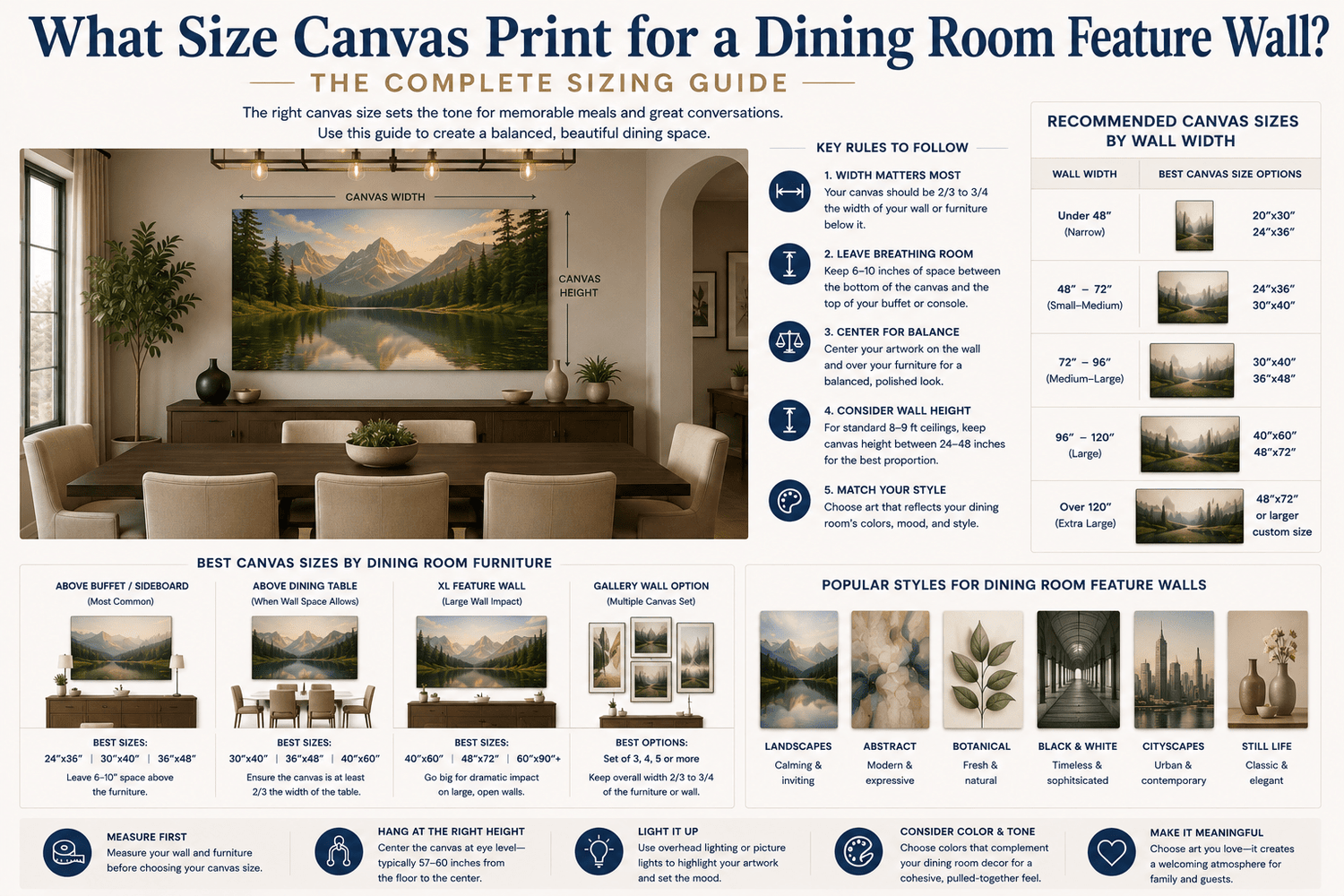
What Size Canvas Print for a Dining Room Feature Wall?
The dining room feature wall is one of the most underused opportunities in the home. Most people choose something small, hang it too high, and wonder why the room never quite comes together. The truth is, the dining room rewards boldness — large scale, rich colour, and confident composition — more than almost any other space in the house.
Here is exactly how to size a canvas print for a dining room feature wall, and how to hang it so every dinner feels like a proper occasion.
Quick Answer
For a standard dining room wall (10–12 feet wide), a canvas 48–60 inches wide creates a confident feature. If there is a sideboard or buffet against the wall, the canvas should be two-thirds its width. Hang it so the canvas centre sits at 57–60 inches from the floor — eye level when standing, comfortable when seated.

How to Size a Canvas for a Dining Room Feature Wall
There are two ways to approach dining room canvas sizing, depending on whether you have furniture against the wall.
If there is a sideboard, buffet, or console table against the wall: apply the two-thirds rule to the furniture width, not the wall. A canvas two-thirds the width of the sideboard creates a contained, intentional composition. A 72-inch sideboard calls for a canvas around 48 inches wide.
If the wall is open (no furniture): work with the wall width itself. For a standard 10-foot dining room wall, aim for a canvas 60–72 inches wide for a genuine statement piece. For smaller walls (8 feet), 48–60 inches works well. For very large open walls (12+ feet), consider a gallery wall or a panoramic landscape-format canvas of 72 inches or wider.
All Rossetti Art canvas prints are hand-stretched over kiln-dried hardwood frames, making them significantly lighter than framed prints at the same size — important for dining room walls where you may be anchoring into plasterboard.

"Gilded Perch" — a rich gold canvas that elevates a dining room feature wall. View the piece →

"Arabesque" — an elegant line art canvas for a refined dining room. View the piece →
Canvas Size Chart for Dining Room Walls
| Situation | Reference Measurement | Ideal Canvas Width |
|---|---|---|
| Small dining room (8' wall) | 96" wall width | 48–60" |
| Standard dining room (10' wall) | 120" wall width | 60–72" |
| 48" sideboard / buffet | 48" furniture width | 30–36" |
| 60" sideboard / buffet | 60" furniture width | 40–45" |
| 72" sideboard / buffet | 72" furniture width | 48–54" |
Not sure how a specific size will look on your dining room wall? Use our Live Preview tool on any product page to visualise it at true scale in your space before you order.
How High to Hang a Canvas in the Dining Room
The dining room has a unique consideration: people view the wall both standing (entering the room, serving food) and seated (during the meal). The hanging height that works best for both:
- Canvas centre at 57–60 inches from the floor — the museum standard. This sits at comfortable standing eye level and remains clearly visible when seated around the table.
- Above a sideboard: 6–8 inches of clear space between the top of the furniture and the bottom edge of the canvas. This mirrors the sofa rule and looks intentional.
- On an open wall: centre the canvas at 57–60 inches. Do not hang it higher — dining rooms often have higher ceilings and the temptation is to push art upward. Resist it.
- For a gallery wall grouping: treat the grouping's vertical midpoint as the 57–60 inch mark. Individual pieces will range above and below this line.

Single Canvas vs Gallery Wall in the Dining Room
Single oversized canvas — ideal for contemporary, minimal, and transitional dining rooms. One large canvas (40×60" or bigger) creates a dramatic focal point with no fuss. The cleaner the wall, the more powerful the piece.
Gallery wall — works beautifully in eclectic, bohemian, and collected dining rooms. Mix canvas prints with other works on paper, vintage mirrors, and small framed pieces. Use a consistent mounting line (the 57-inch midpoint rule) and vary piece heights around that axis.
For a dining room gallery wall, our abstract canvas prints work especially well as the anchor pieces, with smaller figurative or botanical prints filling in around them.
Style Tips: Choosing the Right Canvas for Your Dining Room
Go bold. The dining room is the one space in the home where you eat, drink, and entertain. It tolerates — and rewards — art that makes a statement. Rich, saturated palettes, large format, and dynamic composition all thrive here.
Consider the mood at night. Dining rooms are often experienced by candlelight or under warm artificial light. Art that feels calm by day can feel dramatic and sensual at night. Deep-toned pieces with warm undertones (burnt orange, terracotta, burgundy, deep teal) come alive in evening light in a way that brighter-palette pieces do not.
The oak floater frame for formal dining rooms. If your dining room leans traditional or transitional, the oak floater frame — crafted from solid wood with a natural grain finish — adds a finishing touch that makes the canvas read as proper, considered art rather than a reproduction. Pairs beautifully with dark wood dining furniture.
🎨 FREE CANVAS SIZE CHEAT SHEET
Room-by-room canvas size recommendations, the 2/3 rule explained visually, and the most common sizing mistakes to avoid — all in one free download.
Download Free →
Frequently Asked Questions
What size canvas print works for a dining room with a sideboard?
Apply the two-thirds rule to the sideboard width. For a 60-inch sideboard, choose a canvas 40–45 inches wide. Leave 6–8 inches of clear space between the top of the sideboard and the bottom edge of the canvas. This creates a composed, intentional look that anchors the wall beautifully.
Is a large canvas print too overwhelming for a small dining room?
Not necessarily — in fact, a single large canvas often reads better in a small dining room than a cluster of small pieces. One 30×40" canvas with a bold composition gives the room a clear focal point and actually makes the space feel more deliberate. Avoid going wider than two-thirds of the wall width.
What art style works best in a dining room?
Abstract and figurative art both work beautifully in dining rooms. Abstracts with rich palettes (deep teal, burnt orange, dark burgundy) are the most versatile. Figurative pieces with warmth and presence can add a collected, gallery-like quality. Botanical prints work well in lighter, more casual dining rooms.
Should I use a portrait or landscape canvas in a dining room?
Landscape (horizontal) orientation works best for dining rooms with wide, lower walls. Portrait (vertical) works better in narrow dining rooms or alcoves where you want to fill vertical space. For a very large wall, consider a wide panoramic canvas at 40×72" or larger.
Are canvas prints fade-resistant in dining rooms with natural light?
Rossetti Art canvas prints are printed with UV- and fade-resistant HP latex inks designed to resist fading, with a satin-matte, low-glare finish. They handle the ambient light conditions in most dining rooms without issue. For south-facing rooms with strong direct sunlight through large windows, a UV-filtering window film adds an additional layer of protection.
Browse the full canvas print collection or explore abstract canvas prints for dining room feature wall inspiration — all available in multiple sizes, ready to hang, with free shipping.
Keep Reading
About the Author — Chiara Rossetti is the founder of Rossetti Art, a canvas print and original art brand. She writes about interior design, wall art styling, and the art of making a home feel alive.

About the Author
Chiara Rossetti
Chiara Rossetti is the founder of Rossetti Art, a canvas print and original art brand. She writes about interior design, wall art styling, and the art of making a home feel alive.

Leave a comment
This site is protected by hCaptcha and the hCaptcha Privacy Policy and Terms of Service apply.