Quick Answer
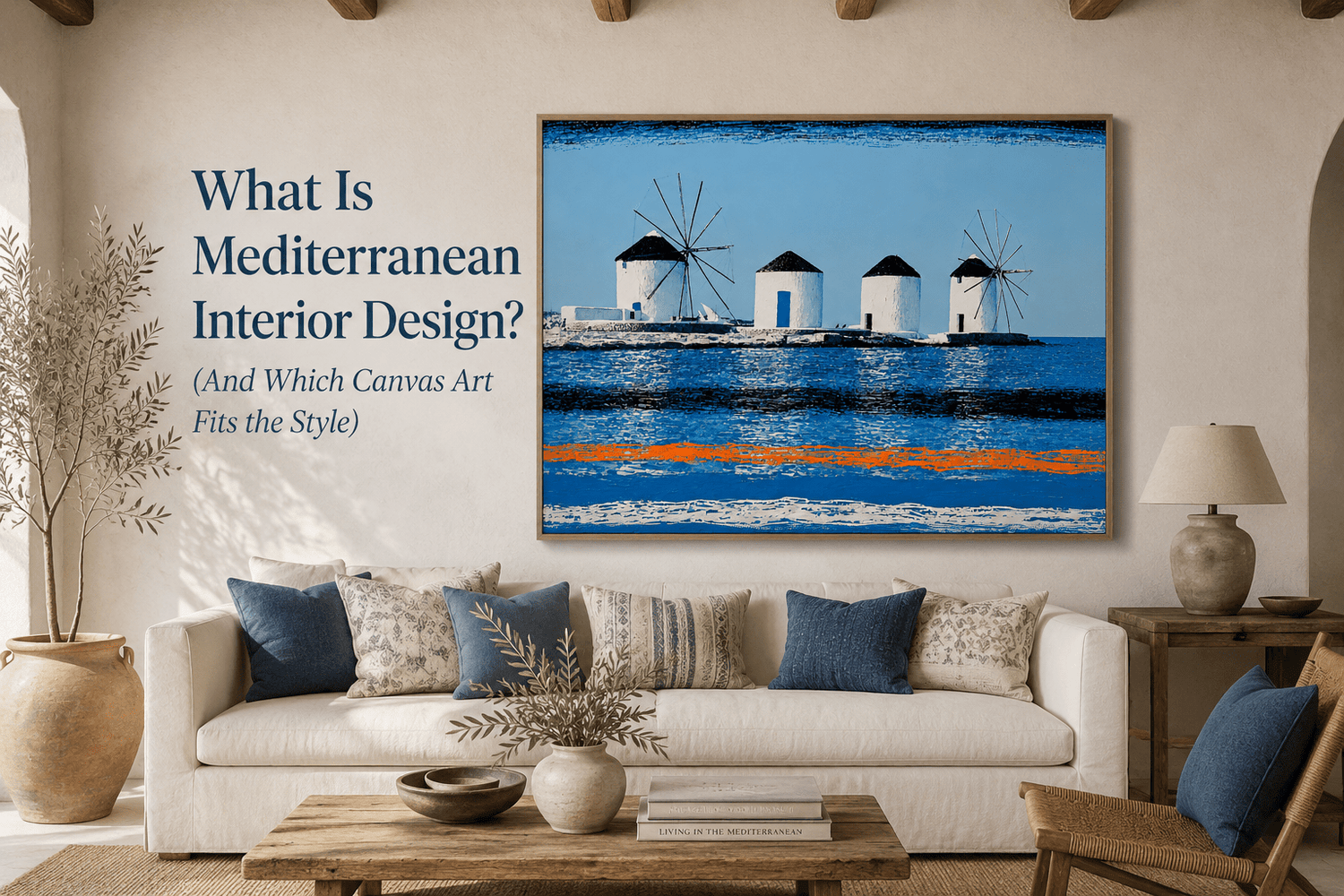
Mediterranean interior design draws on the warm, sun-bleached aesthetic of southern Europe — terracotta tones, whitewashed walls, natural textures, and botanical or landscape art. It creates rooms that feel effortlessly relaxed, earthy, and full of light.

What Is Mediterranean Interior Design?
Mediterranean interior design is an aesthetic rooted in the landscapes, materials, and way of life found along the coastlines of southern Europe — Greece, Italy, Spain, and southern France. It is not a single rigid style but a family of related looks unified by a common spirit: warmth, texture, natural light, and a sense of calm abundance.
At its core, Mediterranean design asks a simple question: what does a life well-lived by the sea actually look like? The answer involves terracotta floor tiles, linen curtains catching the afternoon breeze, rough-plastered walls in cream and white, wrought-iron fixtures, and — above all — natural materials that tell you someone actually lives here. There is nothing sterile about it. It is a style built for comfort.
In interior design terms, Mediterranean style overlaps with several adjacent aesthetics: coastal and botanical art, Tuscan farmhouse, Greek island minimalism, and Iberian warmth. All of these share the same DNA — sunlight, nature, texture, and earthy colour.
Key Characteristics of the Style

Understanding Mediterranean interior design means understanding what it is built from. Five characteristics define almost every room done well in this style.
Natural materials throughout. Stone, terracotta, linen, jute, unfinished wood — Mediterranean spaces use materials that look better with age. The frame on the wall should feel as though it has been there for decades, not just ordered online.
Whitewashed or warm plaster walls. The walls of a Mediterranean home are almost always pale: bright white, warm cream, or a soft dusty beige. This is not minimalism — it is contrast, a background that lets texture and colour sing.
Arched doorways and organic forms. Hard 90-degree angles are the exception, not the rule. Mediterranean architecture favours curves: arched windows, rounded doorways, domed niches. This softness carries through to furniture and art choices.
Abundant natural light. Mediterranean rooms are designed around sunlight. Large windows, open floor plans, light-filtering curtains — everything is calibrated to keep the space bright and airy from morning to evening.
Art that references nature, landscape, and the botanical. This is where canvas art becomes essential. A Mediterranean interior without wall art feels unfinished — but the art must earn its place. Olive trees, coastal landscapes, botanical specimens, and sun-washed open fields are the vocabulary of this style.
The Mediterranean Colour Palette
The Mediterranean colour palette is deceptively simple. It is based on the landscape itself: the white of a Cycladic house, the terracotta of a Tuscan roof tile, the deep blue of the Aegean, the dusty green of an olive grove, the warm ochre of a sunlit hillside.
For walls and large surfaces, the palette stays neutral: warm whites, creams, soft sandy beiges, and light grey-greens. For accents — textiles, ceramics, art — deeper tones come in: terracotta orange, Aegean blue, olive and sage green, warm gold, and faded coral.
Canvas art for a Mediterranean room should live somewhere in this palette. Cool greys and stark blacks feel out of place. Warm earth tones, botanical greens, and deep ocean blues are at home. Artworks in landscape format work particularly well — they echo the wide, sun-filled horizon that defines Mediterranean light.

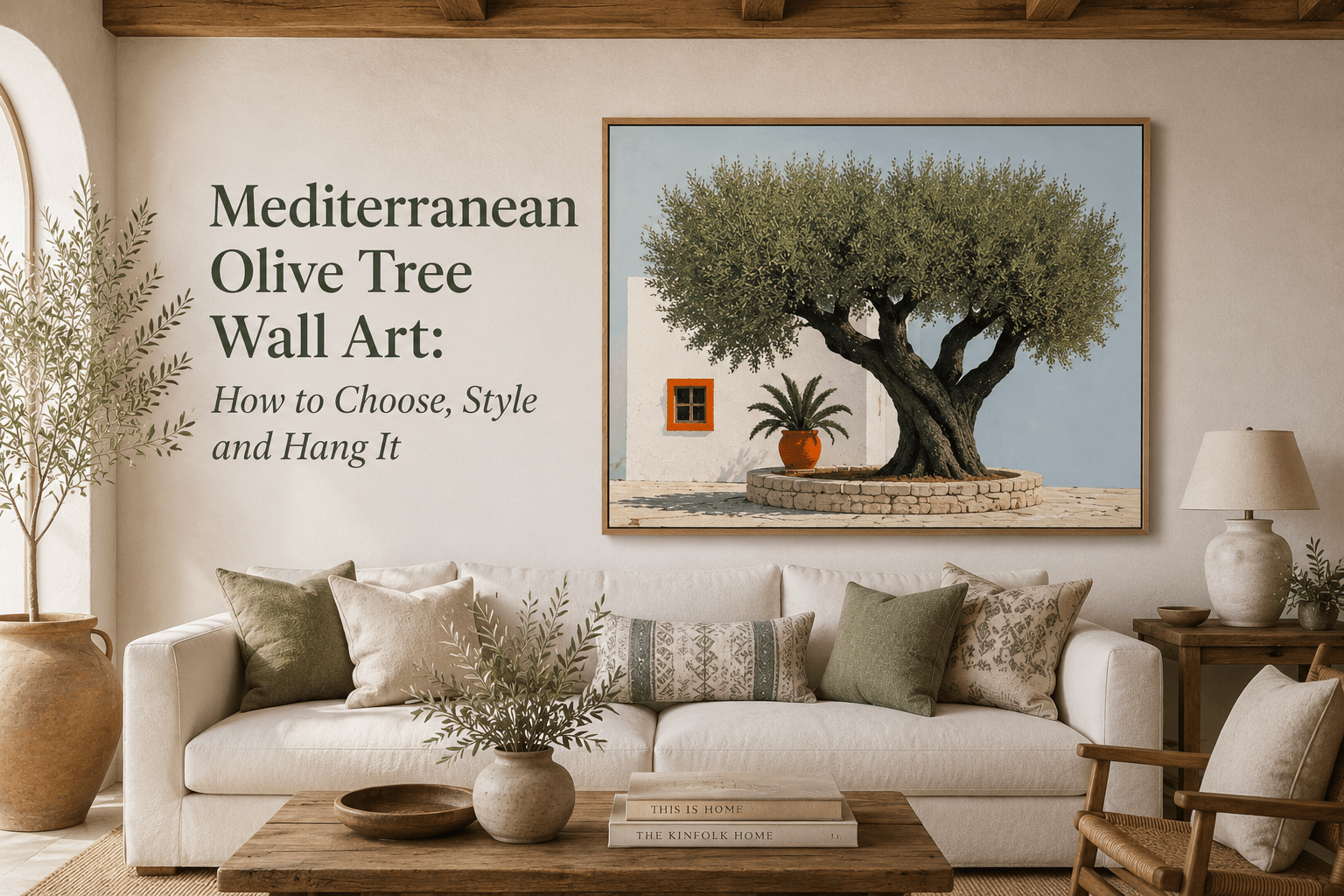
"Aegean" — Mediterranean olive tree canvas print in warm earth tones. View the piece →
Which Canvas Art Fits Mediterranean Style?
Not every canvas print belongs in a Mediterranean room. The style has a clear set of preferences — and understanding them makes choosing art much easier.
Mediterranean canvas art works best when it:
- References nature directly — trees, landscapes, botanical elements, coastal scenes
- Uses a warm or earthy colour palette — terracotta, olive, sand, sage, deep blue
- Has a quiet, unhurried quality — Mediterranean interiors are calm, never loud
- Is printed on a material with texture — canvas printed on archival-quality material with a slight grain suits the style far better than a flat photographic print
- Is displayed in a natural wood frame — a hardwood floater frame, for example, adds the warmth and materiality the style demands
Abstract art can work in Mediterranean spaces, but it must feel warm and organic rather than geometric and clinical. Figurative art — particularly botanical illustration or portrait-style landscape painting — is almost always a safe choice.
At Rossetti Art, our canvas prints are hand-stretched over a kiln-dried hardwood frame and printed with UV- and fade-resistant HP latex inks designed to resist fading. The optional hardwood floater frame — crafted from solid wood with a natural grain finish — is the natural companion to a Mediterranean-style room. Not sure whether a piece will work on your wall? Our Live Preview tool lets you visualise any artwork in your own space before you buy.
Olive Tree and Botanical Art
The olive tree is the defining botanical symbol of the Mediterranean. It appears in Greek mythology, Italian landscape painting, Provençal still life — wherever the Mediterranean culture has put down roots, the olive tree follows. In interior design terms, olive tree art is therefore not a trend. It is an archetype.
A well-executed Mediterranean olive tree canvas print does two things at once: it grounds the room in a specific cultural and geographical identity, and it introduces organic, curved form into a space dominated by straight-edged furniture and architecture. The result is softness — the feeling that the room is alive.
Botanical art more broadly — including garden botanicals, leafy canopies, and soft-focus landscape pieces — serves a similar function. It brings the outside in, which is the foundational gesture of Mediterranean living.

"Emerald Quiet Canopy" — a lush botanical tree canvas print, perfect for Mediterranean-styled rooms. View the piece →

Landscape and Coastal Art
Beyond botanical work, landscape canvas prints are perhaps the most versatile category for Mediterranean interiors. A wide, horizontal landscape — whether it depicts a hillside, an open field, a coastal cliff, or a sun-drenched plain — creates an immediate sense of space and light in a room.
The key is restraint. Mediterranean landscape art should feel contemplative, not dramatic. Quiet colours, soft light, a sense of distance. A piece that makes you feel as though you could step into it and sit there for an hour — that is the benchmark.
Minimalist landscape prints work particularly well in bedrooms and reading corners: they provide a point of visual focus without competing with the rest of the room's texture and warmth. Larger, more detailed landscape canvases work beautifully above a sofa or as a statement piece on a dining room feature wall.

"Silent Grove Horizon" — a minimalist landscape canvas with a quiet, Mediterranean mood. View the piece →
🎨 FREE ROOM-BY-ROOM ART GUIDE
Not sure which art works in which room? Our free guide shows you exactly how to choose and place canvas art in every room of your home — living room, bedroom, dining room, entryway, and more.
Download Free →How to Style Mediterranean Canvas Art in Your Home
Choosing the right piece is only half the work. How you display it matters just as much.
Scale it up. Mediterranean interiors are generous with space. A small canvas on a large wall looks tentative, not curated. For a feature wall — above a sofa, above a bed, along a hallway — choose a canvas of at least 24×36 inches. A piece this size commands the room without overwhelming it. Multiple sizes are available across all Rossetti Art pieces, so it is worth taking the time to measure the wall before choosing.
Frame it in natural wood. The hardwood floater frame is the ideal companion to Mediterranean canvas art. The warm grain of solid wood echoes the natural material palette of the style — it is the visual equivalent of placing a terracotta vase on a linen tablecloth. The canvas appears to float within the frame, giving the piece a gallery quality that suits a considered interior.
Let it breathe. Mediterranean rooms are not gallery walls. They do not pack the walls with dozens of small pieces. They give each artwork space — air on all four sides, room to be seen. A single large canvas, well chosen and well placed, does more for a Mediterranean interior than a dozen smaller prints fighting for attention.
Use our Live Preview feature. Before you buy, use the Live Preview tool on every Rossetti Art product page to see exactly how the canvas looks on your wall — at the right size, in the right light. It removes the guesswork entirely, which matters when you are investing in a piece intended to last.

Frequently Asked Questions
What colours work best for Mediterranean interior design?
The Mediterranean palette is built on warm neutrals — cream, sand, terracotta — with accents of deep Aegean blue, olive and sage green, and warm ochre. On walls, keep it pale and warm. Introduce deeper tones through textiles, ceramics, and botanical and landscape canvas art. Avoid cool greys and stark whites, which feel too clinical for the style.
What type of canvas art is best for a Mediterranean interior?
Botanical art (olive trees, leafy canopies, garden scenes), landscape prints (coastal, hillside, open fields), and nature-inspired abstract work in warm palettes all suit Mediterranean interiors well. Art printed on quality canvas with HP latex inks — designed to resist fading — is ideal, as the style favours materials that age gracefully.
What size canvas print works best in a Mediterranean-style room?
For a feature wall, aim for at least 24×36 inches. Mediterranean rooms are generous with scale — a piece that fills the wall confidently looks intentional and considered. For a bedroom or reading nook, a 16×24-inch piece can work well as a quieter accent. Use our Live Preview tool to see your chosen size on your actual wall before buying.
What frame style suits Mediterranean interior design?
A natural wood floater frame — particularly the hardwood floater frame — is the ideal choice. The warm grain of solid wood echoes the natural materials of Mediterranean design. The floater style, where the canvas sits slightly inside the frame with a small shadow gap, gives the piece a clean, gallery-quality finish that works beautifully against whitewashed or warm plaster walls.
Is Mediterranean interior design still popular in 2026?
Yes — and growing. The broader shift toward natural materials, earthy palettes, and organic forms in home interiors has made Mediterranean-influenced design one of the strongest trends of the mid-2020s. It is a style that wears well over time precisely because it is rooted in something enduring: the visual culture of the places where people have lived beautifully for thousands of years.
Explore our Botanical & Nature collection and our Landscape collection for canvas art that belongs in a Mediterranean interior. Every piece arrives ready to hang, hand-stretched over a kiln-dried hardwood stretcher frame, with UV-resistant coating to protect the colours for decades.
Keep Reading
About the Author — Chiara Rossetti is the founder of Rossetti Art, a canvas print and original art brand. She writes about interior design, wall art styling, and the art of making a home feel alive.

About the Author
Chiara Rossetti
Chiara Rossetti is the founder of Rossetti Art, a canvas print and original art brand. She writes about interior design, wall art styling, and the art of making a home feel alive.

Leave a comment
This site is protected by hCaptcha and the hCaptcha Privacy Policy and Terms of Service apply.