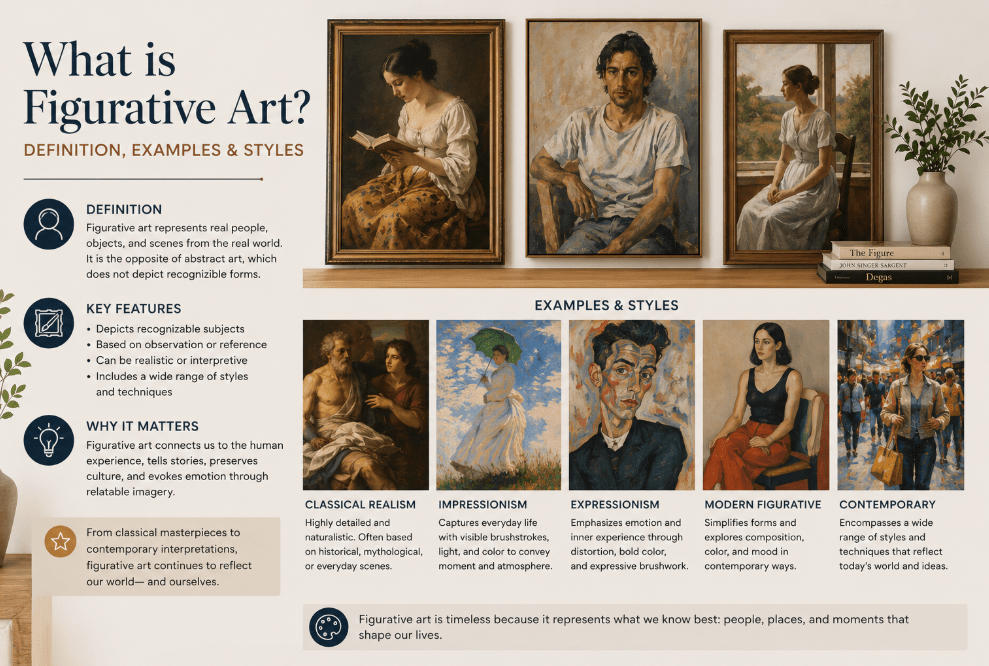
There is something about looking at a painting of a person and feeling, for a moment, genuinely seen. Figurative art does this better than almost any other form — it connects across centuries, cultures, and living rooms with remarkable directness.
Whether you are new to buying wall art or trying to understand the difference between figurative and abstract, this guide gives you a clear figurative art definition, covers the main styles, and shows you how to bring figurative work into your home.
Quick Answer
Figurative art is any artwork that depicts recognisable subjects from the real world — human figures, animals, landscapes, or objects. Unlike abstract art, it maintains a clear visual connection to reality. It encompasses portraiture, expressionist figure painting, abstract figuration, and narrative art, and remains one of the most emotionally resonant forms of visual art.

What Does "Figurative Art" Actually Mean?
The simplest figurative art definition is this: figurative art represents recognisable things. A person. An animal. A tree. A street. If a viewer can look at the work and identify what is being depicted, the artwork is figurative.
The term comes from the Latin figura, meaning shape or form. It is used to distinguish artwork that depicts the visible world from work that does not — which is abstract art. Importantly, figurative art does not mean realistic art. A painting can be expressively distorted, loosely gestural, or dramatically stylised and still be considered figurative — as long as the underlying subject remains identifiable. This is why artists like Francis Bacon, Lucian Freud, and Egon Schiele are considered figurative painters, even though their work is far from conventional realism.
A Brief History of Figurative Art
Figurative art is as old as art itself. The earliest known cave paintings — at Lascaux in France (c. 17,000 BC) and Altamira in Spain — depict animals in motion. Ancient Egyptian tomb art, Greek sculpture, and Roman mosaic work were all figurative: all communicating something about the people and cultures that made them.
The Renaissance elevated figurative painting to its highest classical expression. Botticelli's Birth of Venus, Michelangelo's Sistine Chapel ceiling, Leonardo's portrait studies — all defined by the human form rendered with extraordinary technical ambition. For centuries, figuration was considered the pinnacle of artistic achievement.
The 20th century challenged this. With the rise of abstraction — Kandinsky, Mondrian, Pollock — many critics declared figurative art outdated. But it never disappeared. Picasso maintained figurative subjects while fragmenting them through Cubism. Expressionists pushed the figure to psychological extremes. And in the 21st century, figurative painting has experienced a major global revival: artists like Kehinde Wiley, Jenny Saville, and Cecily Brown command record auction prices, and contemporary figurative work fills the world's leading art fairs.

"Dream in Red" — original figurative painting by Chiara Rossetti. View the piece →
Types of Figurative Art
Portraiture focuses on the human face and upper body, exploring identity, expression, and psychological depth. It spans every era and style — from formal oil portraits to intimate charcoal studies to hyperrealist painted photographs.
Figurative expressionism distorts the human form to communicate emotion rather than accuracy. Colours become symbolic, anatomy is exaggerated or compressed, and feeling takes priority over fidelity. The tradition runs from Munch's The Scream through to the gestural figure painters of today.
Abstract figuration sits at the intersection of the two major categories. The human figure or other subject is present but simplified, fragmented, or partially dissolved. You can see a shape that reads as a person, but the painter has stripped away detail in favour of form and energy. Many of the most collectible contemporary artists work in this space.
Narrative painting uses figurative subjects to tell stories — mythological scenes, historical events, psychological dramas. It was the dominant mode of Western painting for centuries and continues to influence artists who engage with symbolism and representation.

FREE ART STYLE FINDER QUIZ
Not sure what art style is right for you? Answer 6 questions and discover your Rossetti Art collection in 2 minutes.
Download FreeFigurative Art vs Abstract Art: What's the Difference?
The clearest distinction: in figurative art, you can name what you are looking at. In abstract art, you cannot.
| Figurative Art | Abstract Art | |
|---|---|---|
| Subject | Recognisable — person, animal, landscape | Non-representational — colour, shape, form |
| Viewer response | Emotional connection to the subject | Response to mood, energy, atmosphere |
| Room function | Strong focal point, conversation piece | Atmospheric backdrop, mood-setter |
| Examples | Portraiture, expressionist figures, narrative painting | Colour field, geometric abstraction, action painting |
The two are not strict opposites — they exist on a spectrum. Abstract figuration deliberately occupies the middle ground, where the subject is present but dissolving. Many of the most interesting contemporary artists work in this ambiguous zone.
When choosing between figurative and abstract for your home, consider what you want the art to do. Figurative art creates a strong focal point and emotional presence — the human figure draws the eye and holds it. Abstract art works as atmosphere, setting a mood without demanding narrative attention. Not sure which suits you? Our free Art Style Finder Quiz maps your taste to the right Rossetti Art collection.

"Whirlwind of Colors" — figurative expressionist original painting by Chiara Rossetti. View the piece →
How to Use Figurative Art in Your Home
Figurative art behaves differently from abstract in a domestic space, and understanding this helps you place it well. The human figure in particular carries psychological weight — it becomes an active presence in the room rather than pure background atmosphere.
In a living room, a single large figurative canvas print creates an immediate focal point. It works best on a feature wall with enough breathing room around it. The wall above the sofa is the natural position — centre the canvas at eye level, with the bottom of the frame approximately 20–30 cm above the sofa back.
In a bedroom, figurative art benefits from thoughtful placement. Portraits facing directly toward the bed can feel watchful. Consider positioning figurative work on the side wall instead, or choose abstract figuration where the form is present but not confrontational. The result is warmth and presence without intensity.
In an office, figurative art brings life to a space that could otherwise feel sterile. A strong expressionist figure or a work with movement and energy signals a curated, considered environment — and performs better than generic prints in professional settings where making an impression matters.
At Rossetti Art, every figurative canvas print is hand-stretched over a kiln-dried hardwood frame and printed with UV- and fade-resistant HP latex inks designed to resist fading. A satin-matte, low-glare finish protects against colour degradation over time. The hardwood floater frame — crafted from solid wood with a natural grain finish — elevates figurative work to genuine gallery-quality presentation. Use our Live Preview tool on every product page to see exactly how a piece will look at scale on your wall before you buy.

Frequently Asked Questions
What is the difference between figurative and abstract art?
Figurative art depicts recognisable subjects — people, animals, objects, landscapes. Abstract art does not represent anything from the visible world; colour, shape, and form carry the meaning instead. The two can overlap in abstract figuration, where a recognisable subject is present but fragmented or simplified beyond easy identification.
Is figurative art the same as realism?
No. Realism is one style of figurative art — it aims to represent the world accurately and objectively. But figurative art also includes expressionism, cubism, surrealism, and loose gestural painting. A work can be highly distorted or emotionally exaggerated and still be figurative, as long as the underlying subject is identifiable.
What makes a painting figurative?
A painting is figurative if a viewer can identify a real-world subject within it — most commonly a human figure, but also animals, still life objects, or landscapes. The level of stylisation or distortion does not matter; what defines a work as figurative is the presence of a recognisable subject from the visible world.
Can figurative art be modern or contemporary?
Absolutely. Figurative art never stopped being made, and in the 2020s it is experiencing a major critical and commercial revival. Artists like Cecily Brown, Kehinde Wiley, and Jenny Saville command enormous auction prices. Contemporary figurative canvas prints and original paintings bring this living tradition into modern interiors with tremendous impact.
What size figurative canvas print works best for a living room?
For a standard 200–220 cm sofa, a canvas width of 100–140 cm works well as a single statement piece. For larger walls or open-plan spaces, 140 cm and above creates genuine presence. Rossetti Art canvas prints are hand-stretched over a kiln-dried hardwood frame and available in multiple sizes — use our Live Preview tool on every product page to visualise the exact scale on your wall before buying.
Explore the full range in our Figurative & Portrait Canvas Prints collection, or browse Original Figurative Paintings for a made-to-order piece by Chiara Rossetti — made to order and gallery-quality from the first brushstroke.
Keep Reading
About the Author — Chiara Rossetti is the founder of Rossetti Art, a canvas print and original art brand. She writes about interior design, wall art styling, and the art of making a home feel alive.

About the Author
Chiara Rossetti
Chiara Rossetti is the founder of Rossetti Art, a canvas print and original art brand. She writes about interior design, wall art styling, and the art of making a home feel alive.
![Best Desenio Alternatives for Canvas Wall Art [2026]](http://rossettiart.com/cdn/shop/articles/best-desenio-alternatives-for-canvas-wall-art-2026-5100047.png?v=1781256019&width=883)

Leave a comment
This site is protected by hCaptcha and the hCaptcha Privacy Policy and Terms of Service apply.