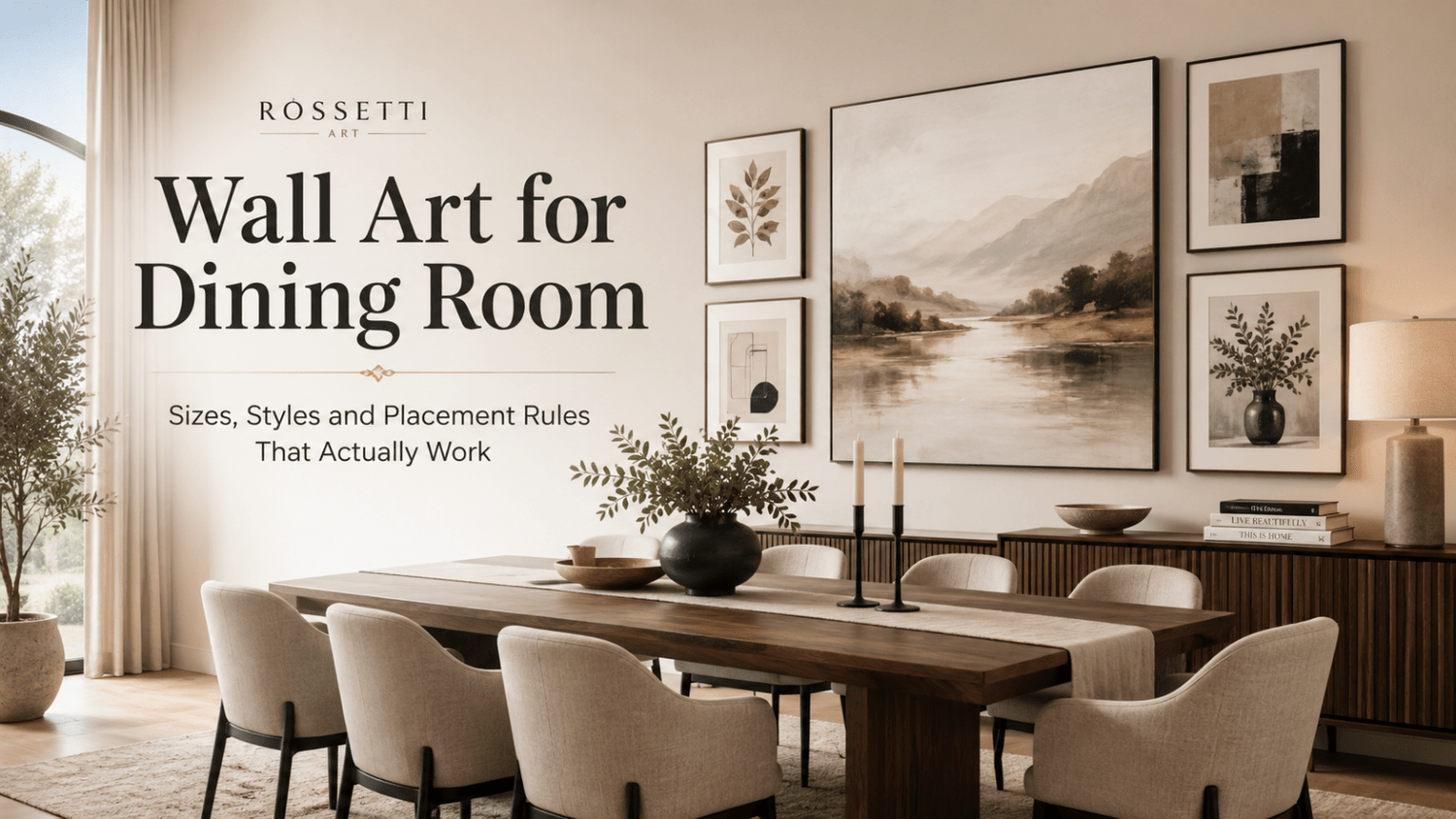
Wall Art for Dining Room: Sizes, Styles and Placement Rules That Actually Work
The dining room is the one space in your home where people actually stop, sit, and look around. Unlike a hallway they walk through or a living room where the TV competes for attention, the dining room gives art a real audience. That makes choosing the right piece both more important — and more rewarding.
But most guides on wall art for dining rooms tell you to hang a nice floral print above the sideboard and call it done. This one goes further: the exact sizing rules, the styles that actually work (and a few that don't), and how to make your dining room art feel considered rather than just filled.
Quick Answer
For wall art in a dining room, choose a piece that is two-thirds the width of your dining table, hang it so the centre sits at eye level (57–60 inches from the floor), and go with abstract, botanical, or figurative art rather than food or wine themes — which tend to feel predictable.

How Big Should Wall Art Be in a Dining Room?
Size is the single most common mistake people make with dining room art — and it almost always goes in the same direction. Too small. A piece that looks generous on a website arrives and vanishes against the wall, overwhelmed by the furniture below it.
The rule that works: your artwork should be roughly two-thirds the width of whatever it hangs above. Above a six-foot dining table, that means looking at pieces in the 40–48 inch range. Above a 60-inch sideboard, aim for 38–42 inches wide.
| Furniture width | Recommended art width | Format to consider |
|---|---|---|
| 48" (122 cm) table | 30–32" wide | Single portrait or square piece |
| 60" (152 cm) table | 38–42" wide | Wide landscape or diptych |
| 72" (183 cm) table | 46–50" wide | Large statement piece or set of 2 |
| 60" sideboard or buffet | 38–42" wide | Landscape or gallery wall |
Hanging height matters too. The centre of the artwork should sit at eye level — around 57 to 60 inches from the floor when people are standing. If the piece hangs above a sideboard or console, leave about 6–8 inches of gap between the top of the furniture and the bottom of the frame.
Not sure how a size will actually look on your wall? Use our Live Preview tool — it lets you visualise the exact canvas on your wall, at scale, before you order. No guessing, no measuring stress.

"Fragments of Color" — bold abstract canvas, ideal as a statement piece above a dining table or sideboard. View the piece →
What Style of Art Works Best in a Dining Room?
The dining room has a job: it should feel warm, inviting, and slightly special — a room that lifts an ordinary Tuesday dinner into something a little more considered. The art you hang here does quiet emotional work. Which means the style needs to serve the mood, not just fill the wall.
These are the styles that consistently work well:
- Abstract canvas prints — Rich colour fields, textured surfaces, and bold compositions give the dining room energy without demanding too much attention. They work across interior styles and do not compete with food or conversation.
- Botanical and nature prints — Oversized leaf illustrations, botanical studies, and soft floral compositions feel fresh and timeless in a dining setting. They bring the outdoors in without being on-the-nose.
- Figurative and portrait art — A striking figurative piece gives the room a gallery quality and becomes a genuine conversation starter at the table.
- Wabi-sabi and neutral textured art — Earthy, textured, imperfect. This aesthetic suits dining rooms that lean calm and contemplative, and is one of the strongest interior trends of 2026.
Above the Table vs Above the Sideboard — Placement Rules
These are the two most common positions for dining room wall art, and they call for slightly different approaches.
Above the dining table: This is the hero position — whatever hangs here becomes the focal point of the whole room. Go bold. One large-format canvas (or a diptych of two matching pieces) works better than a cluster of small frames. The art needs visual weight to hold the space above a full table.
Above the sideboard or buffet: This position is more flexible. A single landscape-format piece works well, but so does a gallery wall — three or four complementary pieces at the same hanging height, unified by colour or tone. The sideboard below provides a natural anchor.
Feature wall behind the table: If your dining room has a wall visible from the main seating, this is prime real estate. A single oversized canvas (36×48 inches or larger) creates an immediate focal point and frames the whole dining experience.


"Floral Fusion" — original painting with bold botanical energy. Works beautifully above a dining sideboard. View the piece →
Should the Art Match Your Dining Room Colour Scheme?
This is one of the most asked questions about dining room wall art — and the honest answer is: it does not need to match, but it needs to converse.
Matching your art exactly to your dining room colours produces a safe, flat result. What works better is pulling one colour from the art that echoes something already in the room — a chair cushion, the curtains, even the grain of a wooden table — while letting the rest of the piece introduce something new.
For neutral or white dining rooms, almost any colour palette will work. For rooms with stronger colour — deep greens, navy, terracotta — look for art that complements the dominant tone or deliberately contrasts it with a punch of warmth or light.
One practical rule: if your dining room furniture and textiles are all in the same tonal family, your art is the place to add the counterpoint. A warm abstract against cool grey walls. A deep-toned canvas in a room of pale linens. That contrast is what makes a room feel intentional.
FREE ROOM-BY-ROOM ART GUIDE
Download our free Room-by-Room Art Guide — the exact sizes, styles, and placement rules for every room in your home, including dining rooms, living rooms, bedrooms, and more.
Download Free →Is Food and Wine Wall Art Actually a Good Idea?
Short answer: usually not. Longer answer: here is why.
Food and wine prints in dining rooms feel obvious — the room is for eating, so hang art about food — but in practice they tend to make a space feel like a restaurant rather than a home. They are literal where the best art is evocative. They tell guests exactly what the room is for, rather than letting the room speak for itself.
There are exceptions. A beautifully executed still life — a Dutch master-style composition of fruit and ceramics — can work in a traditional dining room. A bold illustration in a mid-century modern space can feel considered and playful. The test is always: does this feel chosen, or does it feel defaulted to?
The stronger play for dining rooms in 2026 is art that creates atmosphere rather than theme: a large abstract in warm reds and terracottas, a botanical canvas with depth and texture, a figurative portrait that makes people want to look twice. These pieces make the dining room feel like a real room rather than a stage set.

"Radiant Bloom" — a statement abstract that brings energy and warmth to any dining room wall. View the piece →

Frequently Asked Questions
What size canvas should I get for above my dining table?
A canvas that is two-thirds the width of your dining table is the right target. For a standard 60-inch table, that means a piece roughly 38–42 inches wide. If you are going with a diptych, each panel should be around 20 inches wide. When in doubt, go slightly larger — undersized art above a dining table is one of the most common decorating mistakes.
Should dining room wall art have frames?
An oak floater frame adds a layer of refinement that suits the dining room particularly well. The floating effect — where the canvas sits within the frame with a small gap — gives the piece a gallery quality that elevates the whole room. It works across styles, from modern to traditional. Browse our dining room wall art collection to see how the oak floater frame looks across different styles.
How high should I hang art in a dining room?
Centre your artwork at 57–60 inches from the floor — this is standard gallery height and roughly eye level when standing. If the art hangs above a sideboard or console, leave a gap of 6–8 inches between the top of the furniture and the bottom of the frame. This gap is what makes the piece feel anchored rather than floating randomly on the wall.
Can I have a gallery wall in a dining room?
Yes — a gallery wall works beautifully in a dining room, particularly above a sideboard or on a feature wall behind the table. Keep the collection cohesive: same frame style, same colour palette, or both. A grid of three or four same-size pieces in matching frames is the easiest way to achieve a gallery wall that feels intentional. Build one using our canvas prints collection.
What art is best for a small dining room?
In a small dining room, one considered piece always works better than several competing ones. Choose a portrait-format canvas that draws the eye upward and makes the ceiling feel higher. Keep the palette light or neutral. Abstract or botanical prints in soft tones work well — they add character without making the space feel busy.
Browse our full dining room wall art collection for pieces sized and styled for this room — or explore our canvas prints range for statement pieces for every room in the house.
Keep Reading
About the Author — Chiara Rossetti is the founder of Rossetti Art, a canvas print and original art brand. She writes about interior design, wall art styling, and the art of making a home feel alive.



Leave a comment
This site is protected by hCaptcha and the hCaptcha Privacy Policy and Terms of Service apply.