
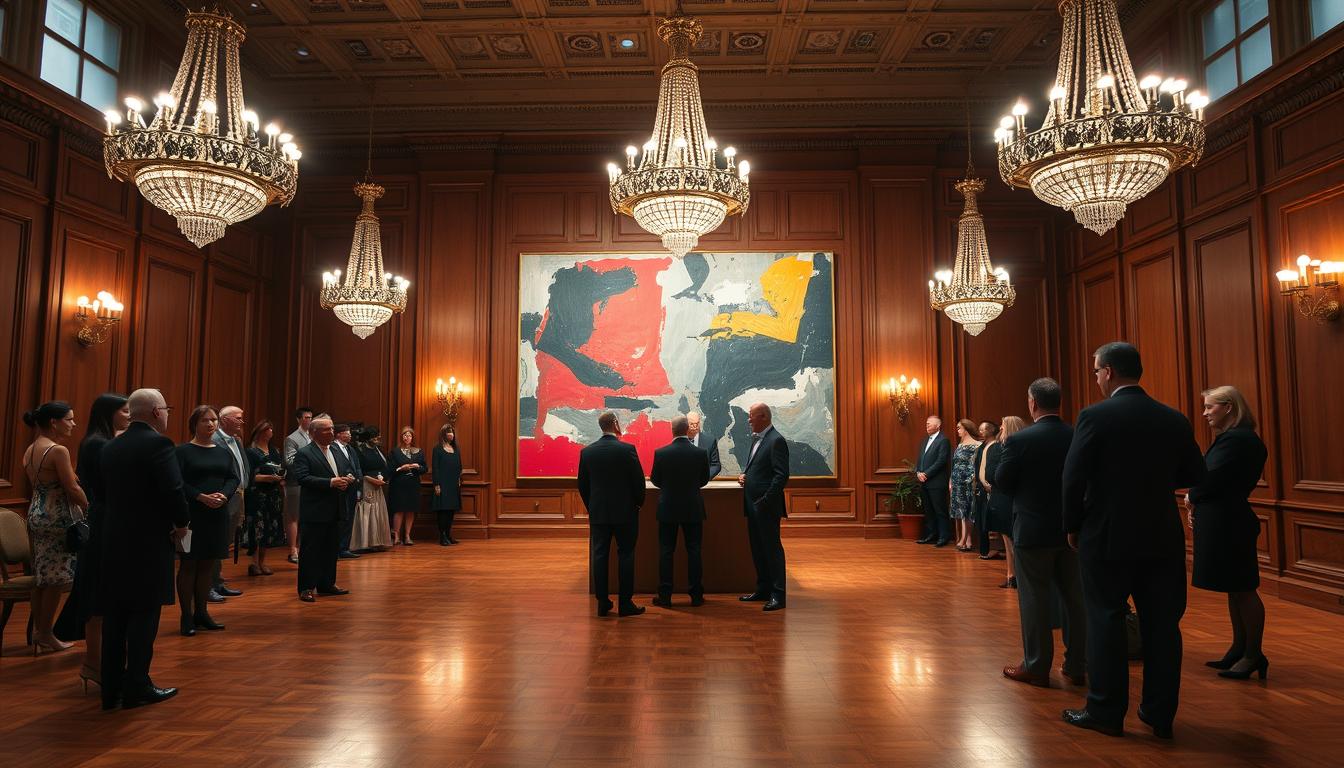
Could a single evening in New York reframe the value of modern art forever? That question captures why collectors, dealers, and curious readers track headline numbers from auctions.
We start by explaining how a near‑$70M figure reads in the New York auction ecosystem. Houses typically report the inclusive total, not just the hammer, so a round number in a headline can mask fees and buyer’s premium.
This brief intro points you to the real benchmarks. From Salvator Mundi’s $450.3M high‑water mark to major Rothko results and Koons’s living‑artist record, the New York evening rooms anchor the art market conversation.
Read on for a clear, friendly walkthrough of which works match the $70M class, why exact figures rarely repeat at sale time, and how provenance, estimates, and lot placement shape what collectors pay.

Key Takeaways
- Headline totals often include fees; know the hammer vs. final price distinction.
- New York sales set visible benchmarks that shape global market sentiment.
- Rothko and other key artists repeatedly influence evening‑room results.
- Exact round numbers are rare; estimates, provenance, and lot order matter.
- Understanding past records helps predict future shifts in collecting strategy.
Quick answer: the closest public match to the $70M mark
In short: the nearest widely cited public match is Mark Rothko’s White Center (Yellow, Pink and Lavender on Rose), which sold for $72.8 million at Sotheby’s in New York on May 15, 2007.
This lot was consigned by David Rockefeller, Sr., and bought by Sheikh Hamad bin Khalifa Al‑Thani. The headline figure reflects the hammer plus buyer’s premium, a common practice in New York evening sales.
Why this sale is cited as the benchmark
Rockefeller’s provenance gave collectors confidence and helped draw intense bidding in an evening auction setting. The canvas’ scale and color intensity made it a magnet for competitive buyers.
Practically, a high‑sixties hammer can publish as a $70M‑plus price once fees are added. That clarity makes this result a textbook example when discussing headlines from Sotheby New and other New York rooms.
- Provenance: David Rockefeller’s ownership boosted trust.
- Placement: Evening sale status drove attention from top collectors.
- Market signal: The result now serves as a simple comparator for similar works at auction.
Headline vs. hammer: how “$70 million” gets reported at auction
Auction headlines blend numbers. The hammer is the last bid called by the auctioneer. The public figure usually adds a buyer’s premium and any applicable fees.
Hammer price, buyer’s premium, and the inclusive headline
The hammer reflects pure bidding. The buyer’s premium is a percentage charged on top and varies by house and price band.
That extra percentage can push a hammer into a round headline number you see in the press.
Why identical hammers can publish different totals
- Different houses have different premium schedules; Christie New and Sotheby’s New York may report different inclusive totals for the same hammer.
- Estimate bands and lot placement — especially an evening sale slot — change bidder energy and final inclusive prices.
- Auction record claims use the inclusive total to standardize reporting across the art market.
"The headline price tells a story about fees and momentum, not just the bidder's willingness to pay."
Practical tip: when you see a headline near a key threshold, translate it back to the likely hammer to gauge real bidder appetite at the time of the sale.
what-painting-sold-for-70-million
Collectors and advisors often point to two Rothko evening sales as the closest public matches to that price tier. These results show how a high‑sixties hammer plus buyer’s premium can publish as a rounded headline in New York.
Rothko’s White Center and No. 1 as benchmark answers
White Center (1950) produced a $72.8M reported total at Sotheby New York on May 15, 2007. Provenance and evening placement pushed bidder confidence.
No. 1 (Royal Red and Blue) (1954) fetched $75.1M at Sotheby New York on November 13, 2012. Both works are cited as clear benchmarks for this price class.
Closest comparables in New York evening rooms
These two Rothkos sit within a tight band of high‑profile results. Collectors study their year, scale, and exhibition history when setting an estimate or planning a lot for an evening sale.
- Provenance: Rockefeller stewardship and strong collection histories lifted trust.
- Sale dynamics: Evening lots and strategic estimates build momentum among bidders.
- Practical takeaway: a high‑sixties hammer often becomes a low‑to‑mid $70M headline after premium.
"Use these Rothko results as a working reference when advising collectors or sizing expectations for similar consignments."
Listicle: iconic results hovering around the $70M class
Below is a compact run‑down of Rothko evening results that hover from the high‑sixties to mid‑$80M. This snapshot helps collectors compare price, provenance, and sale context at a glance.
Mark Rothko — White Center (1950)
Result: $72.8M, Sotheby New York (2007).
Large scale and Rockefeller provenance lifted bidding in an evening sale. The inclusive headline reflects hammer plus premium.
Mark Rothko — No. 1 (Royal Red and Blue) (1954)
Result: $75.1M, Sotheby New York (2012).
Vivid chroma and prime placement drove competitive bids above estimate. This work is a close comparator to the $70M band.
Mark Rothko — Untitled (1952)
Result: $66.2M, Christie New York (2014).
Smaller canvas scale and a conservative estimate left this work just under the high‑sixties threshold.
Contextual ladder: from $70M to mid‑$80M
For perspective, two other marquee outcomes show how strong evenings push prices higher.
| Work | Result | House / Year | Why it mattered |
|---|---|---|---|
| Orange, Red, Yellow | $86.9M | Christie’s New York, 2012 | Powerful palette and evening placement; estimate attracted global bidders. |
| No. 10 | $81.9M | Christie’s New York, 2015 | Large canvas scale and strong provenance lifted the final inclusive price. |
| White Center / No. 1 / Untitled | $66.2M–$75.1M | Sotheby New York & Christie New York | Shows how estimates and evening sale dynamics cluster many Rothko works near the $70M class. |
Takeaway: These results show how provenance, estimate strategy, and lot timing in New York auctions shape whether a painting lands just below or well above the round headline. Use this list as a compact reference when sizing expectations for similar works.
"Evening placement and a modest estimate often tempt bidders into competitive ranges that create headline results."
Christie’s New York moments that redefined the market
Christie’s New York evenings have repeatedly rewritten price expectations for modern art. A few curated lots became market levers, showing how a single sale can lift an entire evening.
Pablo Picasso — Les Femmes d’Alger (Version O): $179.4M
Les Femmes d’Alger (Version O) achieved $179.4 million at Christie’s New York on May 11, 2015. The house timed the lot in a tightly edited evening and used catalogue storytelling to broaden global interest.
Andy Warhol — Shot Sage Blue Marilyn: $195M
Shot Sage Blue Marilyn reached $195 million at Christie’s New York on May 9, 2022. Strategic estimates and active international bidding pushed the work past the 100 million line and set new auction record headlines.
"The right lot, at the right time, can change expectations for years."
Both results sit under the long shadow of Salvator Mundi’s $450.3M ceiling, but they show how Christie’s engineers headline momentum. Lot order, collector profiles, and underbidders often signal deep liquidity and shape future consignments.
Sotheby’s New York highlights near and above the threshold
Sotheby’s New York has shown how a single evening can lift works well past the typical high‑sixties band into nine‑figure territory.
Two standout results make the point. Both demonstrate how lot placement, specialist teams, and deep collector interest combine to drive record numbers.
Claude Monet — Meules: Meules realized $110.7M at Sotheby’s New York on May 14, 2019. This Impressionist masterpiece proved that a classic painting can headline and energize an evening sale.
Claude Monet — Meules: $110.7M
Monet’s haystacks drew broad competitive bidding across time zones. The result shows how an Impressionist work can capture the same evening momentum often seen for modern names.
Amedeo Modigliani — Nu couché (sur le côté gauche): $157.2M
Modigliani’s reclining nude achieved $157.2M at Sotheby’s New York on May 15, 2018. A blue‑chip name, scale, and presentation produced one of the most electric rostrum moments in recent years.
Why these sales matter:
- They show how quickly the price ladder can escalate from the $70M benchmark into nine figures.
- Collector depth and pre‑sale interest often set the tone long before the lot reaches the block.
- Evening pacing and catalogue positioning amplify competition and final price.
"The right lot in the right evening turns specialist interest into global bidding momentum."
| Work | Result | House / Year | Why it mattered |
|---|---|---|---|
| Meules (Claude Monet) | $110.7M | Sotheby’s New York, 2019 | Impressionist classic leading a contemporary-leaning evening; strong international bidding. |
| Nu couché (sur le côté gauche) (Amedeo Modigliani) | $157.2M | Sotheby’s New York, 2018 | Blue‑chip name and scale; attracted deep collector competition and record attention. |
| Connection to $70M bench | $110M–$157M | Sotheby’s New York evenings | Highlights how placement and specialist teams can push works well above the $70M class. |
From $70M to sky-high: how records are set
A landmark sale can shift how specialists and collectors value entire categories.
Salvator Mundi sits at the peak of that path. The painting by leonardo vinci reached a reported $450.3M at Christie’s New York on November 15, 2017. That inclusive total remains the highest price ever paid at auction for a painting.
Rarity, attribution and global storytelling pushed the lot past typical estimate bands. The headline figure combined hammer plus premium, reinforcing the earlier hammer‑plus‑premium lesson.
Private comps and their ripple effect
Private transactions also set expectations. Willem de Kooning’s Interchange reportedly traded for about $300M in September 2015.
These private comps anchor dealer estimates and give consignors confidence. They help explain why some works leap from the $70M class into nine figures during high‑visibility New York seasons like May.
| Work | Reported Total | Sale Type / Date | Why it mattered |
|---|---|---|---|
| Salvator Mundi | $450.3M | Christie’s New York, Nov 15, 2017 | Record auction result; global media narrative; attribution to leonardo vinci. |
| Interchange (de Kooning) | ~$300M | Private sale, Sept 2015 | High private comp that influenced public estimates and market confidence. |
| Les Femmes d’Alger (Picasso) | $179.4M | Christie’s New York, May 2015 | May evening momentum; helped prove seasonal surge past $100 million. |
"Headline records reshape how future estimates are set and how collectors judge fair price."
For context and comparables, see a short primer on auctions and high‑end results here.
Rothko at the red line: the $70M club and beyond
When a major Rothko appears in a prime evening slot, its final total can soar well above typical estimates. Two Christie New York outcomes show how scale, palette, and pre‑sale momentum push canvases into the $80M band.
Orange, Red, Yellow (1961): $86.9M at Christie’s New York
Result: $86.9M, Christie New York, May 8, 2012. Large scale and a vivid palette made this canvas a centerpiece of the evening.
No. 10 (1958): $81.9M at Christie’s New York
Result: $81.9M, Christie New York, May 13, 2015. A prized year and strong pre‑sale exposure helped lift bidding above estimate.
- Why it matters: These works show how a single work can set a record or shift market expectations for related paintings.
- Market mechanics: Collector depth, smart sequencing in an evening sale, and clear provenance amplified demand.
- Context: Sotheby New York outcomes near the benchmark often reflect similar dynamics across major New York auctions.
| Work | Result | House / Year | Why it mattered |
|---|---|---|---|
| Orange, Red, Yellow | $86.9M | Christie New York, 2012 | Large canvas and evening placement; strong collector interest. |
| No. 10 | $81.9M | Christie New York, 2015 | Prized year and pre‑sale exposure pushed bids past estimate. |
| Impact on market | $80M–$90M band | New York evening auctions | Reinforced confidence across Rothko works and related estimates. |
"A charged evening and a standout canvas turn specialist interest into broad bidding momentum."
Picasso power: muse portraits and nine‑figure momentum
A well-timed Picasso lot often becomes the evening’s momentum engine, drawing global bidders. In New York, a single portrait can push past the 100 million mark and reset expectations for related works.

Femme assise près d’une fenêtre (Marie‑Thérèse): $103.4M
Result: The canvas reached $103.4M at Christie New York on May 13, 2021.
Provenance, catalogue scholarship, and pre‑sale display built deep interest. Dealers and advisors helped shape bidding depth and set durable comps.
Garçon à la pipe: $104.2M
Result: Garçon à la pipe realized $104.2M at Sotheby’s New York in 2004, showing this appetite is consistent across houses.
Dora Maar au chat (≈$95.2M) further proves that muse portraits often attract near‑record outcomes at major auctions.
- How it happens: smart estimates, visible exhibitions, and dealer support create competitive lots.
- Market take: a single headline can prompt similar collections to consign in future May evenings.
- Collector lesson: condition, story and timing can move a painting from high eight figures into the $100M class.
For a concise overview of related auction benchmarks, see this Picasso nine‑figure primer.
Abstract Expressionism’s big-ticket works and private pathways
For top Abstract Expressionist works, the market splits between visible auction drama and confidential private negotiations. That split matters when you track headline totals and museum‑grade demand.
Jackson Pollock’s No. 5, 1948 reportedly moved in a private deal for about ~$140M in 2006. The transaction stayed out of public lots, yet it set an invisible benchmark for dealers and collectors.
Public anchor: Francis Bacon’s triptych
Francis Bacon — Three Studies of Lucian Freud sold for $142.4M at Christie’s New York on November 12, 2013. That public sale created a clear record that underpins evening estimates.
- Private sales like Pollock and de Kooning’s reported ~ $300M Interchange can outpace many auction results.
- Dealers and advisors often broker these private routes to offer confidentiality and flexible terms.
- The hands a work passes through — collection history and dealer stewardship — shape buyer confidence and estimate strategy.
| Route | Example | Reported total | Market effect |
|---|---|---|---|
| Public auction | Francis Bacon triptych | $142.4M (Christie’s New York, 2013) | Creates transparent comps and boosts estimates |
| Private sale | Jackson Pollock No. 5 / de Kooning Interchange | ~$140M / ~ $300M (reported) | Offers discretion; influences dealer price guides |
| Hybrid | Dealer-facilitated consignments | Varies by deal | Shapes both auction strategy and private negotiations |
"Private deals and public records together map the true extremes of the market."
Provenance, guarantees, and lot sequencing: why prices leap
Named provenance often turns a private story into public bidding confidence. A clear ownership line reduces doubt. It helps bidders justify stretching beyond an estimate in a charged evening.
Rockefeller effect: White Center’s confidence boost
White Center carried David Rockefeller’s name into the rostrum at sotheby new. That provenance made buyers more willing to compete. The result—$72.8M—showed how a trusted collection lifts both estimate and demand.
Third‑party guarantees and irrevocable bids in evening sales
In many New York evening sales, third‑party guarantees and irrevocable bids lower seller risk. A guarantor or an irrevocable bid provides a safety net that attracts trophy consignments.
Dealers and houses sequence lots to keep energy high. Placing a marquee work near the peak of the sale can push bidders to stretch toward a headline, sometimes nudging totals past the $100 million mark.
| Mechanism | How it helps | Outcome |
|---|---|---|
| Named provenance | Builds trust for bidders | Higher estimates and stronger bids |
| Third‑party guarantee | Reduces seller risk | More trophy consignments accepted |
| Lot sequencing | Maintains auction momentum | Creates competitive pressure on the hammer |
"Clear provenance and market safeguards make it easier for buyers to back bold bids."
Practical tip: read the catalogue for guarantees and lot position. That tells you which work is likeliest to outperform its estimate in a New York evening sale run by christie new or others.
Private sales vs. the rostrum: why some $70M paintings stay quiet
High‑value paintings often trade quietly, far from the rostrum and the headlines. Major works may move in private deals for bespoke terms, confidentiality, or tax and estate reasons. These routes appeal to sellers and buyers who value speed and certainty over public drama.
Dealers and private teams at major houses match a work with a collector faster than a public sale. A dealer will negotiate directly, reduce exposure risk, and often close a sale that would face uncertainty in a New York evening sale.
Private outcomes still shape the market. Reported private prices — from Pollock’s No. 5 to high‑value attributions like a Caravaggio candidate — nudge public estimates even when exact figures stay undisclosed.
Watch for signals that a piece may have traded off‑market: institutional loans, fresh scholarship, or persistent market chatter. These hints help collectors read the true picture behind the public record.

"The public record is powerful, but it often shows only half the story at the very top."
| Route | Why chosen | Effect on public prices |
|---|---|---|
| Private sale | Confidential terms, speed, certainty | Raises estimates without transparent records |
| Dealer‑mediated deal | Targeted buyer matching | Removes auction volatility; sets hidden comps |
| Public auction | Transparent bidding, headline prices | Creates clear, citable records for the market |
Impressionist and Modern milestones that anchor the scale
Key sales from London and New York create anchor points that shape auction expectations.
Two benchmark results help frame the $70M conversation across impressionist modern auctions. They show how season, provenance, and museum visibility set a floor and a ceiling for competing bidders.
Claude Monet — Le Bassin aux Nymphéas: $80.5M, Christie’s London
Result: $80.5M at Christie’s London on June 24, 2008.
Monet’s late water‑lilies carry series authority and museum interest. That visibility draws deep international bidding and pushes the painting above the typical high‑sixties band.
Paul Cézanne — Rideau, Cruchon et Compotier: $60.5M, Sotheby’s New York
Result: $60.5M at Sotheby’s New York on May 10, 1999.
Cézanne’s canvas anchors a durable baseline for modern paintings. Condition, rarity in the market, and a clear exhibition history kept buyer confidence steady at auction.
Why these matter: London and New York auction seasons calibrate global estimates. Christie’s and Sotheby’s set expectations by blending impressionist modern lots with modern art and Picasso comparables, making it easier to read how the ladder climbs toward 100 million outcomes.
| Work | Result | House / Year | Market impact |
|---|---|---|---|
| Le Bassin aux Nymphéas (Monet) | $80.5M | Christie’s London, 2008 | Shows late‑series power; drives strong international fields |
| Rideau, Cruchon et Compotier (Cézanne) | $60.5M | Sotheby’s New York, 1999 | Provides a steady baseline for modern paintings at auction |
| Combined effect | $60M–$80M band | London & New York seasons | Helps collectors set estimates and balance evening lots with Picasso and modern art benchmarks |
"Impressionist and modern milestones give collectors a practical scale for pricing and strategy."
Living artists at the summit: sculpture and the $90M line
Sculpture can apex the market as convincingly as any painting, especially when a single object captures global attention. Jeff Koons’s sale of Rabbit is the clearest recent proof.
Jeff Koons — Rabbit: the stainless steel sculpture reached a reported $91.1M at Christie New York on May 1, 2019. That total set the living artist record as of May 2025.
The result shows how a living artist can command top headlines in a New York evening. Sculpture’s physical presence and cultural resonance drove international bidding and media focus.
Why this sale matters
- Sculpture headlines: a three‑dimensional work can define a season and lift market interest in living creators.
- Estimate and exposure: smart pre‑sale touring and catalogue storytelling concentrate global bidders ahead of the auction.
- Market signaling: a living artist record nudges peers toward higher estimates as consignors and galleries recalibrate value.
Collectors weigh studio output, exhibition momentum, and primary‑market prices when deciding to bid. For Australian buyers watching from afar, New York evenings concentrate attention and often set the comps used worldwide.
"A single object, well presented, can reset expectations for an entire generation of living artists."
| Work | Result | House / Year | Why it mattered |
|---|---|---|---|
| Rabbit (Jeff Koons) | $91.1M | Christie New York, 2019 | Set the living artist record; boosted demand for contemporary sculpture |
| Effect on living artist market | Raised expectations | Post‑2019 New York seasons | Higher estimates and more trophy consignments for living creators |
| Comparison note | N/A | Inclusive totals | Headline totals include buyer’s premium; compare like‑for‑like with painting records |
Conclusion
Major rostrum moments in New York compress decades of market signals into a single bid.
, Use Rothko’s White Center at $72.8M as the clearest public answer near the $70M band. It shows how a hammer plus buyer’s premium becomes a headline and how provenance and lot timing matter.
The broader art market lesson is simple. Big outcomes from Picasso, Andy Warhol and even Salvator Mundi have pushed the ceiling past $100 million. Christie New York and Sotheby New York remain the stages where evening sales create global comps.
Read catalogues with these benchmarks in mind. They help you spot which paintings may test new records next time the market heats up.
Enhance Your Space with Unique Modern Masterpieces by Chiara Rossetti

Are you inspired by the innovative mediums and conceptual depth highlighted in our exploration of contemporary art? You’re not alone! Today’s art enthusiasts are seeking cultural relevance and emotional connections in their artwork. However, finding pieces that resonate with modern themes and fit your unique style can be a challenge. That’s where we come in!

At Rossetti Art, we specialize in canvas prints, original paintings, and modern sculptures that celebrate the spirit of now. Each piece created by Chiara Rossetti brings a personal touch that connects deeply with current social narratives—just like the modern masterpieces discussed in the article. Don’t miss out on the chance to elevate your home decor with breathtaking artwork that speaks to your values and aesthetic. Explore our collection today and find your perfect piece! Act now, and transform your space into a gallery of inspiration!
FAQ
What painting is often cited when someone mentions a work selling for around $70 million?
The most commonly referenced match is Mark Rothko’s White Center (Yellow, Pink and Lavender on Rose), 1950, which sold for $72.8 million at Sotheby’s New York. It serves as a handy public benchmark when media or collectors mention a "$70 million" sale.
Why do people use $70 million as a shorthand in reports about auction results?
Writers and auction houses sometimes round hammer price plus buyer’s premium to a neat figure. The Rothko example sits close to $70M, so it becomes a familiar reference point in headlines and quick comparisons of high‑value evening sales.
How does the hammer price differ from the total reported sale price?
The hammer price is the winning bid announced at the rostrum. The final, inclusive figure typically adds the buyer’s premium and any fees. That total is what newspapers or auction summaries often quote as the sale price.
Can identical hammer prices result in different published totals?
Yes. Buyer’s premiums vary by auction house, sale type, and guarantee arrangements. Two identical hammers can yield different final figures once premiums and fees are applied, which explains occasional discrepancies in reporting.
Besides White Center, which Rothko works sit near the $70M range?
Comparable Rothko results include No. 1 (Royal Red and Blue) at about $75.1M and Untitled (1952) at around $66.2M at major New York evening sales. These results create a cluster that journalists and market watchers point to when discussing the $70M tier.
Which other iconic auction results hover near or above the $70M class?
Notable outcomes include Rothko’s Orange, Red, Yellow at $86.9M and No. 10 at $81.9M, Monet’s Meules at $110.7M, Modigliani’s Nu couché at $157.2M, and Picasso’s Les Femmes d’Alger (Version O) at $179.4M. These sales show how the market spans the $70M range into much higher territory.
How did Christie’s New York shape perceptions of high‑end prices?
Christie’s has staged headline evening sales with landmark results such as Picasso’s Les Femmes d’Alger and Warhol’s Shot Sage Blue Marilyn. Those marquee auctions reset expectations and drew public attention to multi‑million and nine‑figure outcomes.
What are private comparables and how do they affect public auction estimates?
Private sales—sometimes confidential and high‑value, like reports around Willem de Kooning’s Interchange—inform market estimates and appraisals. Auction houses and dealers use these private comps to set pre‑sale expectations and reserves for public lots.
Has any painting ever smashed far past the $70M benchmark?
Yes. Leonardo da Vinci’s Salvator Mundi set a dramatic record at $450.3M at Christie’s New York. Such outsized results highlight the gap between the $70M class and the rare, blockbuster tier of the market.
Do guarantees and provenance influence whether a lot reaches—or exceeds—$70M?
Definitely. Strong provenance, museum ownership, celebrity collectors (for example, works with Rockefeller provenance), and guarantees or irrevocable bids reduce seller risk and can push competition higher, helping a lot clear or surpass the $70M threshold.
Why do some high‑value works sell privately instead of at auction?
Private sales offer confidentiality, speed, and tailored terms that some buyers and sellers prefer. They can keep prices out of the public record, so many transactions around or above $70M never appear in official auction tallies.
Which living artists have reached the top price strata in recent years?
Living‑artist records include Jeff Koons’s Rabbit at $91.1M. Sculpture and contemporary canvases by living artists sometimes approach or surpass the $70M line, signaling strong private and institutional demand.
How should a collector interpret "near $70M" when comparing works by Pollock, Bacon, or Picasso?
Use published auction results and verified private comps as context. Pollock and Bacon have achieved very high outcomes (for example, Francis Bacon’s Three Studies of Lucian Freud at $142.4M), while Picasso routinely occupies the nine‑figure zone. These examples show that "near $70M" sits within a broader ladder of market values.
Where can I find reliable auction records and sale details for verification?
Consult auction house archives (Sotheby’s, Christie’s), industry databases like Artprice and Artnet, and reputable art‑market coverage from the New York Times, Financial Times, and specialized journals. These sources publish hammer prices, buyer’s premiums, and provenance notes.



Leave a comment
This site is protected by hCaptcha and the hCaptcha Privacy Policy and Terms of Service apply.