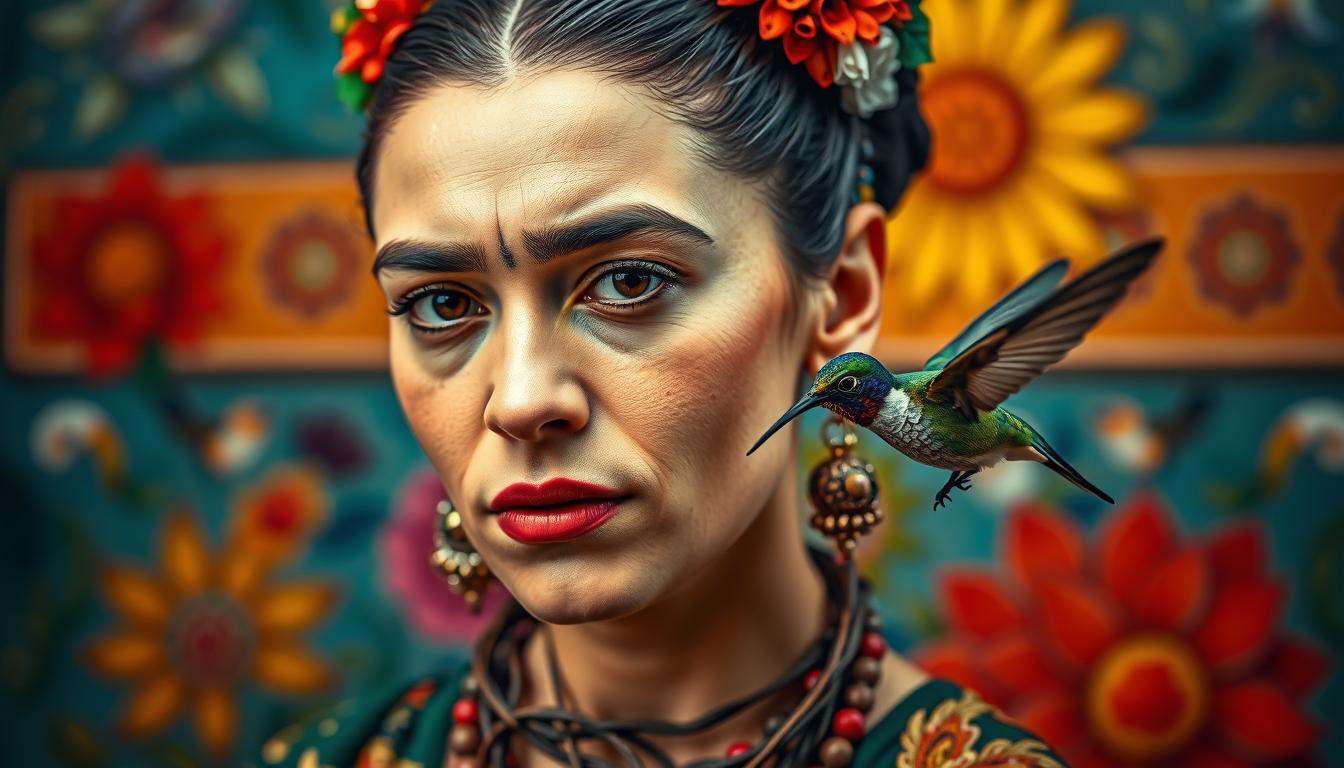
"Passion is the bridge that takes you from pain to change." These words, spoken by Frida Kahlo herself, capture the essence of an artist whose work transcended mere paint on canvas. Frida Kahlo's art stands as a testament to human resilience, a vibrant chronicle of pain transformed into beauty, and a bold declaration of identity that continues to resonate across cultures and generations.
In this journey through Frida's world, we'll explore the vivid symbolism of her paintings, the revolutionary spirit that defined her approach to art and life, and the enduring legacy that makes her work as relevant today as it was in the tumultuous Mexico of the early 20th century. Whether you're encountering her striking self-portraits for the first time or rediscovering her complex visual language, Frida's story invites us to see art not just as decoration, but as a powerful expression of the human experience.
Who Was Frida Kahlo?
Born Magdalena Carmen Frida Kahlo y Calderón on July 6, 1907, in Coyoacán, Mexico, Frida's life was marked by physical suffering and emotional intensity from an early age. At six, she contracted polio, which left her right leg thinner and weaker than her left. This early encounter with physical limitation would foreshadow the bodily struggles that would later define much of her artistic expression.
The defining moment in Frida's life came at age 18, when a horrific bus accident left her with lifelong injuries. A steel handrail impaled her through the pelvis, fracturing her spine in three places and breaking numerous bones throughout her body. During her lengthy recovery, confined to bed and encased in plaster corsets, Frida turned to painting as both therapy and expression. "I paint myself because I am often alone and I am the subject I know best," she would later explain, illuminating the deeply personal nature of her art.
What emerged from this crucible of pain was not merely art as escapism, but art as confrontation—with suffering, with identity, with the political and social realities of her time. Frida's work became a visual diary where personal pain intertwined with broader themes of Mexican identity, gender, class, and postcolonialism. Her paintings, particularly her numerous self-portraits, reveal a woman who refused to look away from difficult truths, whether they were about her own broken body or the complex cultural landscape of post-revolutionary Mexico.
Bring Frida's Bold Spirit Into Your Space
Experience the emotional power of Frida Kahlo's artistic vision with our exclusive collection of museum-quality canvas prints. Each piece captures the vibrant colors and symbolic depth that made her work revolutionary.
Explore Frida-Inspired ArtEarly Life and the Beginning of Her Artistic Journey
Frida's father, Guillermo Kahlo, was a German immigrant photographer whose influence on her artistic sensibilities cannot be overstated. From him, she inherited not only a keen eye for composition but also a sense of cultural duality that would inform her work. Her mother, Matilde Calderón y González, came from a mixed Indigenous and Spanish background, further contributing to Frida's complex cultural identity.
Though initially headed for medical school, Frida's plans were derailed by the bus accident. During her recovery, she began to paint using a special easel designed for use in bed and a mirror positioned above her. These early works, often small in scale due to her physical limitations, already displayed the unflinching honesty and symbolic richness that would become her hallmarks.
In 1929, Frida married the already-famous muralist Diego Rivera, beginning a tumultuous relationship that would profoundly influence both her life and art. Their marriage, which Rivera once described as "the union between an elephant and a dove" due to their physical and temperamental differences, was marked by mutual infidelity, passionate reconciliations, and shared political ideals. Through Rivera, Frida gained entry into artistic and intellectual circles, but she would ultimately forge her own distinct artistic identity—one that in many ways surpassed her husband's in its lasting cultural impact.
The Symbolism in Her Paintings
To view a Frida Kahlo painting is to enter a world where nothing is merely decorative—every element carries meaning, often multiple layers of it. Her work combines influences from pre-Columbian Mexican art, European Surrealism, and ex-voto or retablo paintings (small devotional works on metal). Yet what emerged was entirely her own: a visual language that spoke directly to the viewer's emotions while engaging with complex ideas about identity, nationality, gender, and suffering.
In "The Two Fridas" (1939), painted shortly after her divorce from Diego Rivera, Kahlo presents two versions of herself holding hands. One wears a European-style white Victorian dress, while the other appears in traditional Tehuana costume—the style Rivera admired. Their exposed hearts are connected by a single vein, with the European Frida's heart cut and bleeding. The painting powerfully visualizes her dual heritage and the emotional pain of her marital separation, with the traditional Mexican Frida remaining whole while her European counterpart suffers.
Animals appear frequently in Kahlo's work, each carrying symbolic weight. Monkeys, which in Mexican mythology represent lust, appear as surrogates for the children she could never have due to her injuries. Hummingbirds symbolize hope, while deer represent vulnerability. In "The Wounded Deer" (1946), Frida's face appears on a young stag's body, pierced by arrows—a potent metaphor for her physical suffering and the operations that failed to heal her.
Pain, Love, and Identity in Color
Color in Kahlo's work is never arbitrary. The vibrant palette she employed draws directly from Mexican folk art traditions, but she wielded these colors with psychological precision. Reds pulse with life and pain, greens connect to nature and fertility, yellows speak to madness and illness, while blues often reflect her emotional states.
In "Self-Portrait with Thorn Necklace and Hummingbird" (1940), one of her most iconic works, Kahlo portrays herself wearing a necklace of thorns that draws blood from her neck. A dead hummingbird hangs as a pendant, while a black cat and monkey look on from behind her shoulders. Set against a background of lush leaves, the painting juxtaposes life and death, pain and beauty. The thorns reference Christ's suffering, transforming Frida into a secular martyr of physical pain, while the dead hummingbird suggests that hope itself has been sacrificed.
Perhaps most striking in Kahlo's symbolic vocabulary is her unflinching depiction of the broken female body. In "The Broken Column" (1944), she portrays herself split open, her spine replaced by a crumbling Ionic column, her body held together by medical corsets. Far from seeking pity, these works assert the dignity of suffering and the persistence of identity even when the body fails. Through them, Frida transformed private pain into universal human experience, creating art that continues to resonate with anyone who has experienced physical or emotional wounding.
Experience Frida's Symbolic World
Our collection features faithful reproductions of Frida's most symbolic works, each capturing the emotional depth and cultural richness that made her a revolutionary artist. These museum-quality prints bring the power of her vision into your home.
View Canvas CollectionFrida's Impact on Feminism and Modern Art
While Frida Kahlo did not explicitly identify as a feminist in her lifetime—the movement as we understand it today was still evolving—her work and life embodied feminist principles that were revolutionary for her era. At a time when women artists were marginalized and expected to create "feminine" art focusing on domestic scenes or flowers, Kahlo boldly painted her own reality, including subjects considered taboo: miscarriage, female anatomy, blood, and physical suffering.
Her self-portraits, which make up about one-third of her total work, reclaimed the female image from the male gaze that dominated art history. Rather than presenting herself as an object of beauty for others' appreciation, Kahlo depicted herself as a subject with agency, often staring directly at the viewer with an unflinching gaze. She refused to idealize her appearance, prominently featuring her unibrow and facial hair—characteristics that defied conventional beauty standards.
In works like "Self-Portrait with Cropped Hair" (1940), painted after her temporary separation from Diego Rivera, Kahlo depicts herself in a man's suit, surrounded by locks of her recently cut hair. The painting challenges gender norms while expressing the complex emotions of her marital troubles. The inscription at the top reads: "Look, if I loved you it was because of your hair. Now that you are without hair, I don't love you anymore." Through such works, Kahlo explored female identity as complex, contradictory, and self-determined.
The Timeless Message of Self-Expression
Frida's approach to art was revolutionary in its merging of the personal and political. While the dominant artistic movements of her time—including the Mexican Muralist movement that her husband helped define—focused on grand historical narratives and collective experience, Kahlo insisted that her individual story mattered. This radical centering of personal experience anticipated later feminist art movements by decades.
Her work challenged the artificial separation between "high art" and folk traditions, incorporating elements of Mexican popular culture and Indigenous artistic traditions at a time when European modernism dominated discussions of serious art. This validation of non-Western aesthetic traditions helped expand the canon of art history and inspired later generations of artists from marginalized backgrounds.
Perhaps most significantly, Kahlo's art offered a new visual language for expressing female pain and resilience. In paintings like "Henry Ford Hospital" (1932), which depicts her experience of miscarriage, she made visible experiences that had been largely absent from art history. By refusing to sanitize or sentimentalize female suffering, she created space for authentic expression of women's lived realities.
Today, contemporary artists across disciplines continue to draw inspiration from Kahlo's fearless self-expression and her integration of personal narrative with broader social and political concerns. Her influence extends beyond painting to photography, performance art, literature, and fashion. Artists as diverse as Cindy Sherman, Kara Walker, and Shirin Neshat have acknowledged Kahlo's pioneering role in creating art that centers marginalized perspectives and challenges dominant narratives.
Why Frida Kahlo Remains a Global Icon
More than six decades after her death in 1954, Frida Kahlo has transcended the boundaries of art history to become a global cultural phenomenon. Her image appears on everything from t-shirts to tote bags, while exhibitions of her work draw record-breaking crowds worldwide. This extraordinary posthumous fame raises the question: what makes Frida's appeal so enduring and universal?
At the heart of Kahlo's lasting impact is the authenticity that permeates her work. In an age of carefully curated public personas, her unflinching honesty about pain, disability, and emotional struggle feels refreshingly real. Her paintings offer no easy answers or comfortable resolutions—instead, they invite viewers to confront difficult truths about the human condition. This emotional authenticity resonates across cultural and temporal boundaries.
Frida's visual identity—her distinctive Tehuana dresses, flower-adorned hair, and prominent unibrow—has become instantly recognizable worldwide. Yet this iconic image represents more than mere style; it embodies her deliberate construction of identity as a political act. By embracing traditional Mexican dress at a time when European fashion dominated elite circles, Kahlo made a statement about cultural pride and resistance to colonialism that continues to inspire those navigating multiple cultural identities today.
Her Lasting Influence on Artists and Collectors
For contemporary artists, Kahlo's legacy offers several powerful lessons. Her work demonstrates that the most personal art can also be the most universal—that by diving deeply into one's own experience, an artist can touch something fundamentally human. She showed that art could be simultaneously politically engaged and emotionally intimate, challenging the false dichotomy between personal expression and social commentary.
For collectors and art enthusiasts, Kahlo's work represents a unique intersection of artistic innovation and cultural significance. Her paintings connect viewers to key historical moments—the aftermath of the Mexican Revolution, the rise of international communism, the cultural exchanges between Mexico and the United States—while remaining deeply relevant to contemporary conversations about identity, gender, and the body.
The market for Kahlo's original works reflects this enduring significance. In 2021, her painting "Diego y yo" (Diego and I) sold for $34.9 million at Sotheby's, setting a record for Latin American art and for any work by a female artist at the time. This record was broken in 2023 when her "The Dream (The Bed)" sold for $54.7 million. Beyond the art market, her influence extends to fashion, literature, film, and popular culture, with directors like Julie Taymor and artists like Madonna drawing inspiration from her life and aesthetic.
Perhaps most importantly, Frida Kahlo's legacy offers a model of resilience and self-creation that transcends art history. Her life demonstrates how creativity can transform suffering into meaning, how identity can be consciously crafted rather than passively accepted, and how one person's unique vision can change how we see the world. In an era of increasing global connectivity alongside persistent social divisions, her work reminds us of art's power to bridge differences and speak to our shared humanity.
Own a Piece of Artistic History
Our collection of Frida Kahlo-inspired artwork allows you to bring her revolutionary vision and vibrant aesthetic into your own space. Each piece is crafted with attention to detail that honors her artistic legacy.
Discover OriginalsExplore Frida-Inspired Art at Rossetti Art
At Rossetti Art, we celebrate visionaries like Frida Kahlo whose art transcends time and emotion. Our exclusive Frida-inspired canvas prints and originals honor her fearless creativity and unyielding passion. Bring her spirit into your home — explore the collection today and transform your space into a tribute to art, resilience, and individuality.
Self-Portrait with Thorn Necklace
This iconic self-portrait captures Frida's ability to transform pain into beauty. The thorns draw blood while butterflies and a hummingbird symbolize hope and resilience.
The Two Fridas
This powerful double self-portrait explores Frida's dual heritage and emotional state after her divorce from Diego Rivera. The connected hearts tell a story of divided identity and emotional vulnerability.
Viva La Vida (Watermelons)
Created in the final days of her life, this vibrant still life celebrates the sweetness of existence despite suffering. The carved message "Viva la Vida" (Long Live Life) reflects Frida's enduring spirit.
Self-Portrait on the Border
This politically charged work explores Frida's complex relationship with Mexico and the United States, contrasting industrial modernity with traditional Mexican culture.
The Wounded Deer
This surrealist self-portrait combines Frida's face with the body of a wounded deer, symbolizing her physical suffering and vulnerability while maintaining her distinctive identity.
Self-Portrait with Monkeys
This vibrant self-portrait features Frida surrounded by protective monkeys, symbolizing the children she could never have due to her injuries. The lush background celebrates Mexican natural beauty.
Transform Your Space with Frida's Vision
Our collection brings together the most powerful and iconic works from Frida Kahlo's artistic journey. Each piece is reproduced with meticulous attention to color and detail, allowing you to experience the full emotional impact of her revolutionary vision.
Explore the Complete CollectionThe Enduring Legacy of Frida Kahlo
Frida Kahlo's life was relatively short—she died at 47—but her artistic legacy continues to grow with each passing decade. What began as a deeply personal form of expression has evolved into a global phenomenon that transcends the boundaries of fine art. Her unflinching honesty about pain, her celebration of Mexican cultural identity, and her revolutionary approach to female self-representation continue to speak to contemporary audiences seeking authenticity in an increasingly complex world.
Today, visitors from around the world make pilgrimages to La Casa Azul (The Blue House) in Coyoacán, where Frida was born, lived much of her life, and eventually died. Now the Frida Kahlo Museum, this vibrant blue building houses not only her artwork but also her personal belongings—the corsets she wore to support her damaged spine, her collection of traditional Mexican clothing, and the four-poster bed where she both suffered and created. These intimate artifacts remind us that behind the iconic image was a real woman whose extraordinary art emerged from ordinary human struggles.
For artists today, Frida's legacy offers permission to make art that is deeply personal yet politically engaged, that draws from cultural traditions while creating something entirely new. For viewers and collectors, her work continues to offer a window into a unique vision that transforms pain into beauty without diminishing its reality. In bringing Frida's art into our homes and lives, we connect not only with her distinctive aesthetic but with her revolutionary spirit—her insistence that every life, every identity, and every struggle deserves to be seen, honored, and transformed through creative expression.
"I never painted dreams. I painted my own reality." - Frida Kahlo
Celebrate Frida's Legacy in Your Home
At Rossetti Art, we celebrate visionaries like Frida Kahlo whose art transcends time and emotion. Our exclusive Frida-inspired canvas prints and originals honor her fearless creativity and unyielding passion. Bring her spirit into your home — explore the collection today and transform your space into a tribute to art, resilience, and individuality.
Explore Frida-Inspired Art


Leave a comment
This site is protected by hCaptcha and the hCaptcha Privacy Policy and Terms of Service apply.