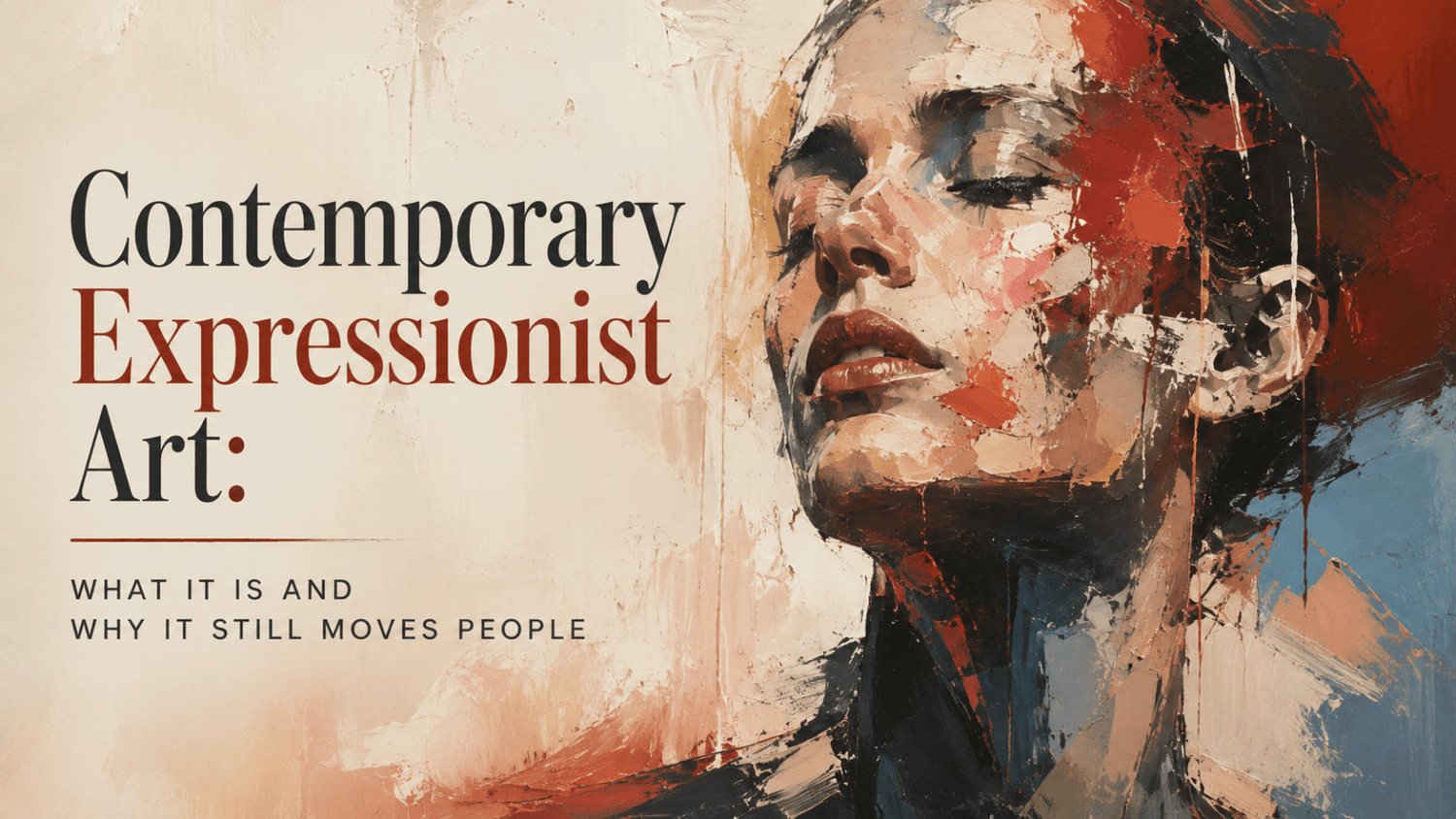
Contemporary Expressionist Art: What It Is and Why It Still Moves People
There is a particular kind of painting that stops you mid-step. The colour is too urgent to ignore, the brushwork too alive to be decoration. That is what a contemporary expressionist artwork does — it refuses to be polite about how it feels. The style is not a trend. It is a persistent human impulse: to put raw inner life directly onto a surface.
This guide explains what the term actually means, how it connects to — and breaks from — earlier movements, and what to consider when you want to bring this energy into a room.
Quick Answer
Contemporary expressionist art is work made today that prioritises emotional truth over visual accuracy — using gestural brushwork, heightened colour, and distortion to show how something feels rather than how it looks. It descends from early 20th-century Expressionism and Abstract Expressionism, but is shaped by the world artists live in now.

What is contemporary expressionist art?
Contemporary expressionist art is painting or mixed-media work made today that prioritises emotional truth over visual accuracy. Rather than depicting the world as it looks, a contemporary expressionist distorts form, heightens colour, and applies paint with physical urgency — gestural brushstrokes, palette knife marks, layered impasto — to show how something feels. The result is art that reads as both immediate and deeply personal.
The roots go back to the early 20th century, when German Expressionists like Ernst Ludwig Kirchner and Egon Schiele broke from academic realism to paint psychological states. That impulse never disappeared. It resurfaced in the Abstract Expressionists of the 1940s and 50s, the Neo-Expressionists of the 1980s, and continues today in painters who work with the same restless conviction — but with a contemporary eye shaped by the world they actually live in.
What makes the contemporary expressionist distinct from historical predecessors is context, not method. Today's expressionist painters absorb influences from street art, digital culture, and global visual language, then strip that back to something physically made — paint, texture, the mark of a hand. In an era of frictionless digital images, that physicality hits harder than ever.

"Fragments of the Mind" — original expressionist painting by Chiara Rossetti. View the piece →
How contemporary expressionism differs from abstract expressionism
The two terms are often used interchangeably, but they are not the same.
Abstract expressionism was a specific mid-20th century American movement — think Jackson Pollock's drip paintings, Mark Rothko's colour field canvases, Willem de Kooning's frenzied figures. It was largely non-representational, driven by the idea that pure form and colour could carry emotion without depicting anything recognisable.
Contemporary expressionism is broader and less doctrinaire. Today's expressionist painters often include recognisable figures, landscapes, or objects — but distorted, fragmented, or emotionally charged. There is no manifesto. The common thread is the insistence that emotion leads and observation follows. Figurative, semi-abstract, and purely abstract approaches all sit under the same roof.

"Whirlwind of Colors" — gestural, emotionally charged original painting. View the piece →

Why contemporary expressionist paintings work in interior spaces
The design world has quietly moved back toward work that has presence. Not the safe, neutral canvas prints that disappeared into a wall — but paintings that create a psychological atmosphere in a room. Contemporary expressionist wall art does this better than almost any other style, for a simple reason: it was made to be felt, not just seen.
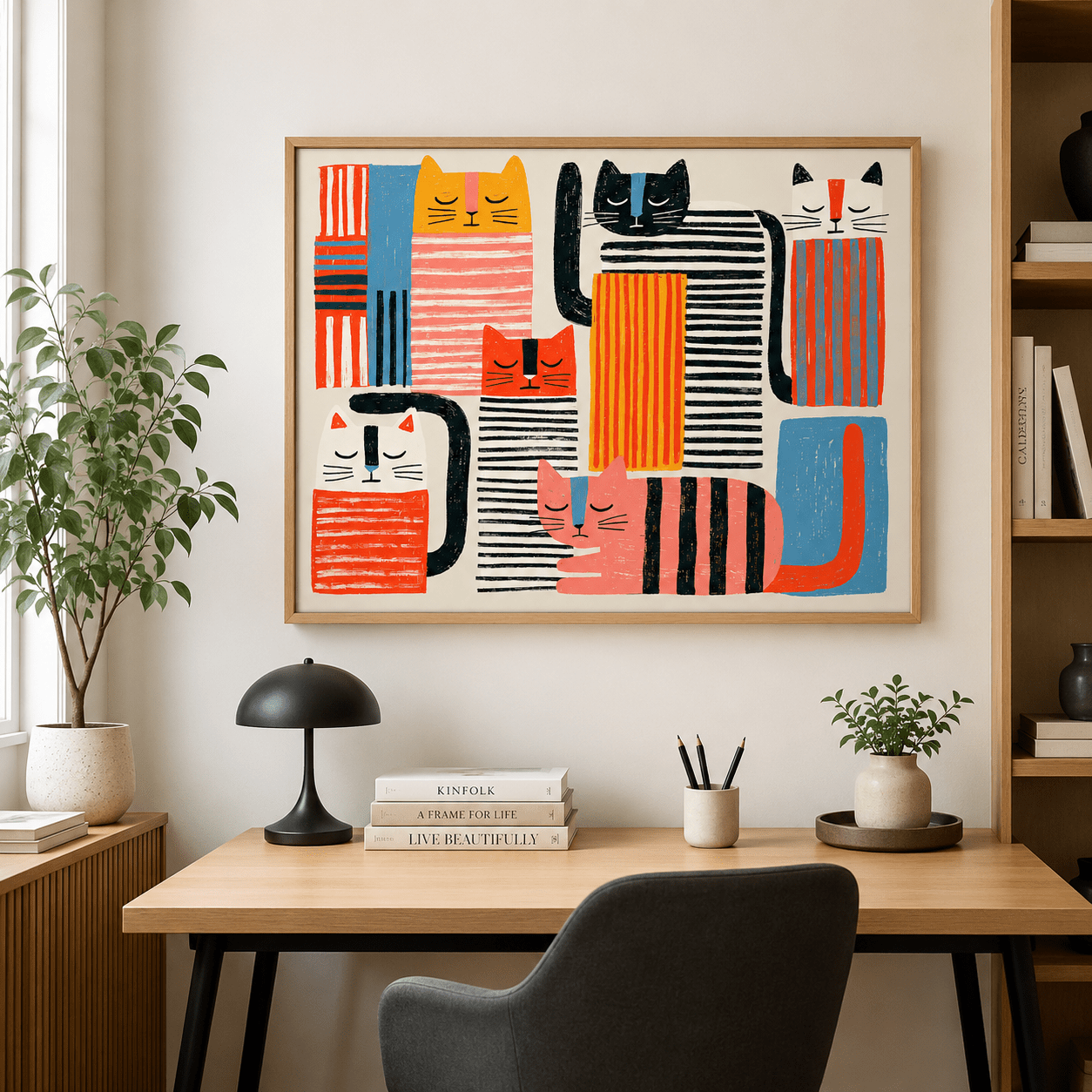
A single large expressionist canvas above a sofa changes the emotional register of the entire room. The impasto texture — thick, directional paint that catches light differently at different times of day — gives the piece a life that a flat reproduction cannot match. At Rossetti Art, every abstract canvas print is produced on hand-stretched canvas over a hardwood frame, with HP latex inks that are UV-resistant and gallery-quality — preserving the intensity of colour that makes expressionist work so alive on the wall.
Practically, this style is also more forgiving than people expect. The boldness of the work tends to anchor a room rather than fight with it. Neutral walls — white, greige, warm stone — amplify the painting. Dark walls create a gallery intensity that suits larger, more dramatic pieces. What doesn't work is trying to match every element: expressionist art looks best when it is allowed to lead. Browse our original paintings for sale to find a piece with the presence to own a room.

"Dream in Red" — original figurative expressionist painting by Chiara Rossetti. View the piece →
🎨 FREE QUIZ
Not sure which art style suits your space? Take the Art Style Finder Quiz — 6 questions, 4 collector profiles, one clear answer.
Download the Quiz →What to look for when buying contemporary expressionist wall art
Buying expressionist work is different from buying decorative prints. Here is what actually matters:
Colour intensity. Expressionist work lives or dies on colour. Ensure the print you are buying uses pigment-based, HP latex inks — not dye-based inks that fade within a few years. At Rossetti Art, all prints are made to order using professional-grade, UV-resistant inks on artist-grade canvas. What you see on screen is what arrives on your wall.
Scale. Contemporary expressionist paintings are almost always better large. A piece that reads as powerful in a gallery can feel timid at 30×40 cm on a home wall. If the artwork has strong gestural energy, give it room: 60×80 cm minimum for a side wall, 80×120 cm or larger for a feature wall or above a sofa. Use our Live Preview tool — available on every product page above the Add to Cart button — to see exactly how a piece looks on your wall before you buy, at true scale.
Frame or no frame. For expressionist work, the oak floater frame is almost always the right choice. It adds just enough structure to separate the canvas from the wall, creating depth that makes the painting feel like an object rather than a print. Rossetti Art offers this as a standard option on every figurative and portrait canvas print and abstract piece.
The emotional test. Before you buy, ask one question: does looking at this piece do something to me? Not — do I understand it. Not — does it match my sofa. Just: does it land. That instinct is what the artist was trying to reach. Trust it.

Frequently Asked Questions
What makes a painting "expressionist"?
A painting is expressionist when emotional truth takes priority over accurate representation. The artist distorts, exaggerates, or heightens visual reality — through colour, mark-making, or form — to communicate a feeling or inner state rather than describe an external scene. Read more in our guide to the Expressionism art movement.
Is contemporary expressionism the same as abstract art?
Not exactly. Contemporary expressionism can be figurative, semi-abstract, or fully abstract. What defines it is the emotional intent and gestural approach, not the level of abstraction. An expressionist portrait distorts the figure to reveal feeling; an expressionist abstract landscape may retain recognisable elements. Abstract art, by contrast, removes all representational reference.
How do I know if a contemporary expressionist piece will work in my home?
Scale and colour temperature matter most. A warm-toned expressionist canvas (reds, ochres, earth colours) works in almost any interior. Cooler, more intense pieces suit rooms with neutral or dark walls where the artwork can lead. Use Rossetti Art's Live Preview tool — above the Add to Cart button on every product page — to visualise any piece at real size on your actual wall before purchasing.
What is the difference between Neo-Expressionism and contemporary expressionism?
Neo-Expressionism was a specific international movement in the 1980s — painters like Georg Baselitz, Anselm Kiefer, and Jean-Michel Basquiat — that returned to figurative, emotionally charged painting after the dominance of conceptual art. Contemporary expressionism is broader: it encompasses artists working today in an expressionist mode, absorbing all that came before without being bound to a single decade or ideology.
Drawn to this kind of work? Explore our Abstract Canvas Prints — hand-stretched, gallery-quality, with optional oak floater framing and free shipping. Or discover made-to-order original paintings by Chiara Rossetti.
Keep Reading
About the Author — Chiara Rossetti is the founder of Rossetti Art, a canvas print and original art brand. She writes about interior design, wall art styling, and the art of making a home feel alive.

About the Author
Chiara Rossetti
Chiara Rossetti is the founder of Rossetti Art, a canvas print and original art brand. She writes about interior design, wall art styling, and the art of making a home feel alive.

Leave a comment
This site is protected by hCaptcha and the hCaptcha Privacy Policy and Terms of Service apply.